
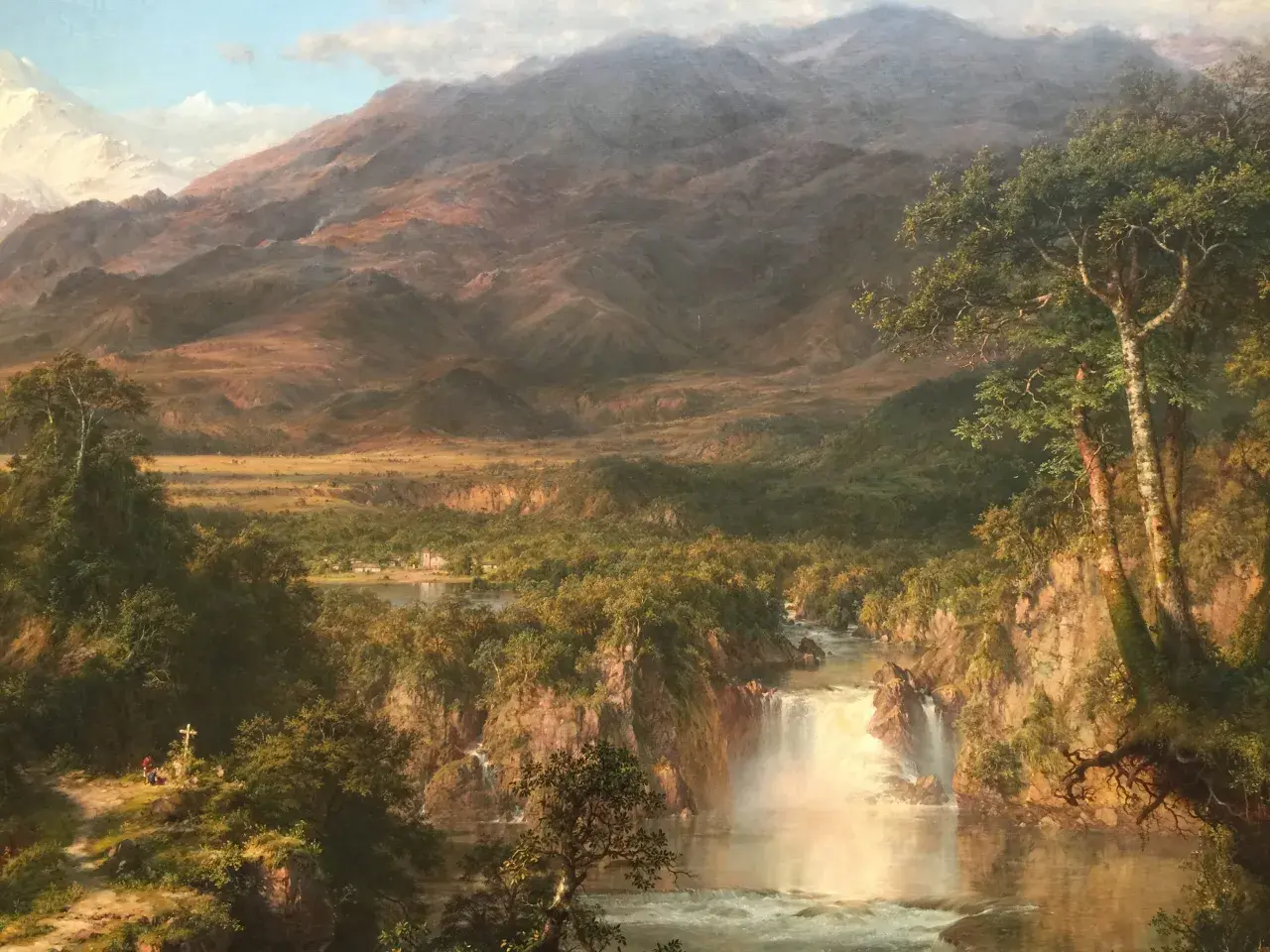
Frederic Edwin Church’s Heart of the Andes is one of the clearest examples of how a landscape painting can be both a visual spectacle and an intellectual statement. It is also often discussed next to Albert Bierstadt’s work, which makes attribution and context worth getting right before anything else. This article explains what the painting is, how Church constructed it, why its 1859 debut became a sensation, and what to notice if you are studying it through art history, preservation, or authentication.
Key facts that explain the painting’s lasting fame
- It was painted in 1859 by Frederic Edwin Church, not Albert Bierstadt.
- It is an oil on canvas measuring 66 1/8 x 120 3/16 inches, so scale is part of the meaning.
- Church built it from South American sketches into a composite landscape shaped by observation, science, and symbolism.
- Its first New York exhibition drew huge crowds because the display was theatrical, controlled, and unusually immersive.
- It remains important for understanding Hudson River School painting, provenance, and conservation practice.
Why the attribution matters
One reason this painting gets searched so often is that Church and Bierstadt are paired constantly in Hudson River School discussions, so the names blur together. They were contemporaries and the two most successful landscape painters of their generation, but they solved different artistic problems: Bierstadt tended toward frontier spectacle, while Church used vast scale to create a carefully ordered vision of nature.
| Feature | Church’s painting | Bierstadt’s comparison point |
|---|---|---|
| Artist | Frederic Edwin Church | Albert Bierstadt |
| Best-known work here | Heart of the Andes, 1859 | The Rocky Mountains, Lander’s Peak, 1863 |
| Subject | Ecuadorian Andes, assembled from sketches | Wind River Range in present-day Wyoming |
| Primary effect | Scientific, botanical, and spiritual depth | Frontier scale and territorial drama |
| Why viewers confuse them | Both are huge Hudson River School landscapes | Both helped define American landscape spectacle |
That distinction is not academic nitpicking. Once you know the painting belongs to Church, you can read its details as evidence of composition, not just grandeur, and that makes the image much richer. With that in place, the next question is how he packed so much geography into a single canvas.

How Church built a landscape that feels observed and composed
Church did not invent this view from a single lookout point. He assembled it from the sketches he made in Ecuador, and that composite method is exactly why the painting feels so complete. The foreground plants, the waterfall, the middle-distance valley, and the far peak guide the eye through a sequence of climate zones, from dense tropical life to cooler high-altitude air.
What I find most compelling is the way the image turns geography into an argument. The landscape is not just beautiful; it is structured around a Humboldtian idea that altitude, vegetation, weather, and geology belong to one system. The small cross and the tiny human figures add a devotional note, but they do not break the scene. They sit inside it, as if culture were one more layer of the natural world.
That compositional logic is why the painting stays legible even when reproduced at a smaller size, and it also explains why the exhibition history matters so much.
Why the 1859 exhibition became a sensation
Church understood that the way people saw the picture would shape the meaning they took from it. He showed it in a huge windowlike frame, in a darkened room, and encouraged viewers to use opera glasses so they could slow down and read the botanical detail. The effect was theatrical, but it was also practical: the picture asks for close looking, even though its scale first registers as spectacle.
The New York debut drew about 12,000 visitors in three weeks, which was extraordinary for a single work. It then traveled to Britain and seven American cities over a two-year tour, extending its reputation well beyond the city where it first caused a stir. That kind of reception tells you something important: the painting was never just an object on a wall. It was an event.
The lost original frame matters here as much as the canvas itself, because the presentation turned viewing into a ritual and made the work feel like a destination rather than a decoration.
What the painting says about Hudson River School ambition
The Hudson River School was not a formal school in the modern sense. It was a loose fraternity of New York landscape painters who shared patrons, studios, clubs, and a belief that landscape could carry moral, spiritual, and national meaning. Church belongs at the center of that story, and so does Bierstadt, but their best work shows different moods of American ambition.
| Theme | Church | Bierstadt |
|---|---|---|
| Landscape idea | A synthesized world built from field studies | A heroic western vista with strong territorial overtones |
| Emotional tone | Wonder mixed with study | Awe mixed with expansion |
| Viewer relationship | Look closely, then step back and connect the parts | Take in the sweep and the scale first |
| National meaning | Nature as order, science, and spirituality | Nature as promise and possession |
Church’s Andes painting is less about conquest than about synthesis. Bierstadt’s western panoramas often lean into the language of Manifest Destiny, where the land seems ready for possession. Church, by contrast, compresses observation, religion, science, and wonder into one image. That is why the painting can feel both specific and universal at the same time.
The result is a landscape that operates on several levels at once, and that complexity is what keeps it central to American art history.
What preservation records and provenance reveal
For authentication, the useful facts are the boring ones. The painting is an 1859 oil on canvas measuring 66 1/8 by 120 3/16 inches, and the record ties it to Margaret E. Dows’s bequest in 1909. Those details matter because they anchor the object against later copies, engravings, and modern reproductions that borrow the title without sharing the material history.
In conservation terms, a canvas this large needs stable support, controlled light, and careful attention to the paint film and varnish. A loosening canvas, surface abrasion, or a compromised frame can affect both display and longevity. I would also treat the frame as part of the work’s history, not as a removable accessory, because in a painting like this the border changes how the viewer reads scale.
The practical lesson is simple: when a work is famous enough to generate reproductions, provenance and object data are not footnotes. They are the difference between an original, a version, and a later homage.
Why it still rewards slow looking
If I were standing in front of the painting, I would look at it in five passes: the foreground leaves and flowers, the water descending through the center, the small figures and cross, the distant mountain, and finally the way the frame holds the entire scene together. That sequence reveals how carefully Church built the painting to reward distance and detail at the same time.
- Start with the smallest botanical forms, because they establish the painting’s scale before the mountain does.
- Follow the water path upward through the center; it is the painting’s quiet structural spine.
- Notice how the cross and figures add human meaning without flattening the landscape into narrative.
- Compare the near foliage with the far snow line to see how Church moves from micro-detail to climatic range.
- If possible, study it in person or in a high-resolution zoom, because the surface and scale change the reading of the image.
That is why the work still feels fresh. It is grand, but it is also exact; devotional, but never vague; and theatrical, but rooted in observation. Few nineteenth-century landscapes manage that balance, which is why Church’s masterpiece still anchors any serious discussion of American landscape painting.
