
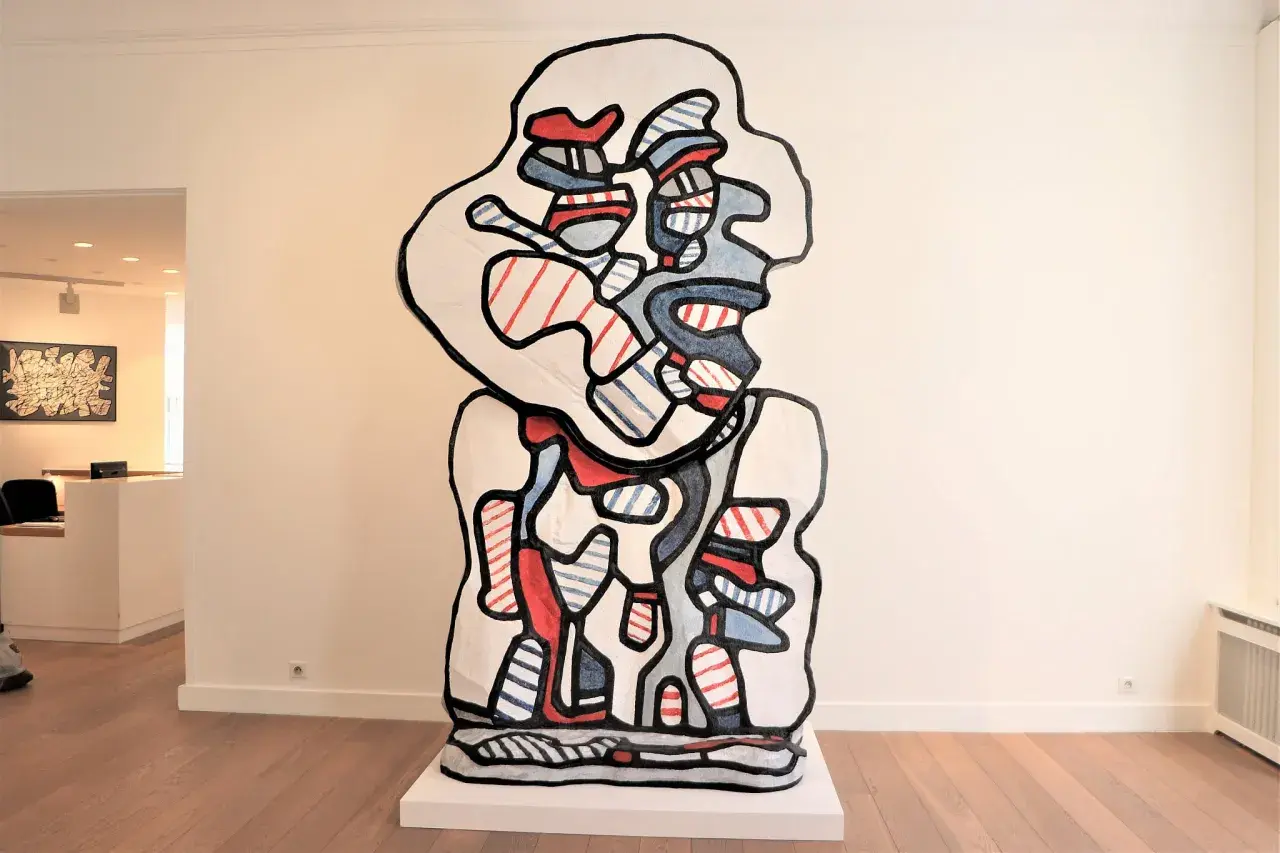
Jean Dubuffet art is best read as a challenge to polished taste: he turned abrasion, imbalance, and childlike drawing into a serious aesthetic position. In this article I break down the phases of his career, the signature series to know, the materials that make his surfaces so distinctive, and the preservation issues that matter when you evaluate a real work. That matters because Dubuffet is one of those artists whose ideas and objects are inseparable; if you miss the material logic, you miss the work.
The essentials at a glance
- Dubuffet coined art brut to defend raw, self-taught expression against academic polish.
- His best-known work moves from rough early figures to soil-like textures, then into the blue-red-black world of L'Hourloupe.
- Materials such as sand, pebbles, rope, vinyl paint, and heavy line are not decoration; they are part of the meaning.
- For authentication, series logic, provenance, and surface condition matter more than a signature alone.
- His work rewards close looking because humor, distortion, and texture all carry information.
Why Dubuffet still matters
I read Dubuffet as a disciplined rebel. He began making art in earnest at 41, after a career outside the studio world, and that outsider distance never disappeared from his work. What he built was not a single style but a position: distrust the polished norm, distrust inherited taste, and look for energy in what academic art usually excludes.
That is why his impact reaches beyond painting history. He helped define art brut, defended the work of self-taught makers, and made a convincing case that rawness could be intellectually serious rather than merely expressive. For a museum-minded reader, that matters because Dubuffet also complicates the usual categories: he is anti-academic, yet deeply strategic; anti-beauty, yet formally rigorous; anti-system, yet intensely systematic in how he repeats and varies motifs.
- He made refusal productive by turning anti-finish into a method rather than a gimmick.
- He blurred painting and sculpture so that surface, relief, and objecthood kept crossing over.
- He changed how institutions look at outsider practice by forcing the question of what counts as legitimate art in the first place.
Once you see that refusal as a method, the visual language becomes easier to decode, which is exactly where I want to go next.

How his visual language turns roughness into meaning
Dubuffet did not simply make things look rough. He used roughness to attack the idea that seriousness has to look smooth, balanced, or technically invisible. In practice, that means his paintings often feel like surfaces you could almost touch: crusted, scratched, clogged, or drawn over until the image seems to fight its own completion.
| Visual cue | What to look for | Why it matters |
|---|---|---|
| Heavy contour | Thick black lines enclosing cells or shapes | Turns the surface into a system and keeps the image from dissolving into loose abstraction |
| Granular surface | Sand, pebbles, rope, or visible buildup in paint | Lets matter do the storytelling instead of illusionistic depth |
| Naive drawing energy | Childlike marks, blunt proportions, awkward anatomy | Undermines academic finish and pushes the viewer to read attitude, not accuracy |
| Humor and distortion | Beards, bulges, masks, and unstable faces | Prevents the work from becoming purely theoretical or grim |
The useful habit here is to stop asking whether the image is pretty and start asking what kind of looking it demands. Dubuffet is never just about content; he is about the pressure of making, the friction of materials, and the way a line can behave like a manifesto. Once you learn those signals, the chronology becomes easier to read, because each period changes the balance between figure, surface, and system.
The main periods in his career
Dubuffet’s career is not a straight line from figuration to abstraction. It is more like a series of tactical turns, each one solving a different problem while keeping the same anti-polished attitude. The table below gives the clearest map of how the work changes.
| Period | What changes | Why it matters |
|---|---|---|
| 1940s early figures and portraits | Earthy materials, distorted bodies, blunt silhouettes, rough handling of paint | Establishes his rejection of academic modeling and polished likeness |
| 1950s landscapes and texturologies | Repeated marks, crusted surfaces, skin-like or soil-like fields | Makes texture the main subject rather than a supporting effect |
| 1962 to 1974 L'Hourloupe | Ballpoint doodles become a system of red, blue, black, and white cells | His most famous cycle, expanding into painting, sculpture, and theatrical form |
| 1974 to 1985 late monumental work | Larger installations, sculptural environments, and very high output | The late years push his ideas into public scale; the Fondation Dubuffet notes more than 1,500 paintings and 1,000 drawings in that final stretch |
What I find most important is that the shifts are conceptual as much as stylistic. He is not chasing novelty for its own sake; he is testing how far a visual language can go before it becomes architecture, performance, or pure sign. That makes the strongest works easier to identify, because they tend to sit at the moment when one system is still visible and the next one is already emerging.
The works and series that define his reputation
If you want to understand Dubuffet quickly, do not start with a generic survey. Start with a handful of works that show the different jobs his art can do: provoke, satirize, texture, systematize, and expand. I would group them this way.
Will to Power
This early mixed-media canvas is useful because it shows how quickly Dubuffet refused a clean separation between image and matter. Oil, pebbles, sand, glass, and rope create a surface that feels assembled rather than painted in the classical sense. The point is not simply roughness; it is the sense that the work is built from physical stuff, not illusion.
Joë Bousquet in Bed
Here the figure is present, but it is stripped of academic elegance and pushed toward emotional compression. I would describe it as portraiture under pressure: the body becomes psychologically charged, flattened, and slightly defiant. That is a recurring Dubuffet move, and it is one reason the work stays compelling rather than merely eccentric.
Beard Garden
The Beard series is one of the clearest places to see his humor. The beard becomes both motif and texture field, so the image is funny, grotesque, and formally controlled at the same time. You can feel the artist testing how far a single recurring form can carry personality.
The writing on the wall
In his printmaking, line often becomes a grammar rather than a contour. This kind of work shows how Dubuffet could generate a whole visual environment from repeated marks, while still keeping the image restless and handmade. It also reminds us that his reputation is not built on painting alone; his prints are central to the story.
Read Also: Kusama's Pumpkins - Art or Decoration? Find Out Now
L'Hourloupe
This is the cycle most people recognize, and for good reason. What began as a casual ballpoint doodle during a phone call became an entire visual universe built from black outlines, red and blue compartments, and white voids. I think its lasting power comes from scale: an accidental scribble is turned into a rule set, then that rule set spills into sculpture and performance.
These examples also show why the materials deserve their own discussion, because in Dubuffet's hands technique is never neutral.
Materials, technique, and the texture problem
If I had to reduce Dubuffet to one technical idea, it would be this: the surface is never just a carrier for the image. In his work, paint can behave like soil, skin, plaster, handwriting, or relief. That is why he uses such a wide range of media, from oil and ink to sand, pebbles, rope, vinyl paint, collage, and printmaking.
- Impasto means thickly built paint that stands off the surface; Dubuffet uses it to make the image tactile.
- Support means the physical base, such as canvas, Masonite, or paper; it matters because each support ages differently.
- Found objects let the work borrow texture and density from the real world instead of simulating them.
- Ballpoint line becomes a structural system in L'Hourloupe rather than a casual sketch.
- Relief appears when paint, construction, or sculpture rises off the flat plane and behaves almost like architecture.
This technical freedom is also why Dubuffet is so interesting from a preservation angle. A smooth painting can tolerate a certain amount of routine handling; a Dubuffet surface often cannot. The work may look rough on purpose, but roughness is not the same thing as durability, and that distinction is crucial.
How to authenticate and preserve Dubuffet works
Authentication is rarely about one dramatic clue. I would start with series logic, provenance, and medium, because Dubuffet was experimental but not random. If a work claims to be from a known cycle, it should behave like that cycle in palette, scale, support, surface construction, and date range.
| What to check | Why it matters |
|---|---|
| Provenance | Shows ownership history and helps reduce the risk of misattribution |
| Series placement | Dubuffet often worked in named cycles, so the wrong series can be a red flag |
| Surface condition | Texture, relief, and granular buildup are integral and easy to damage |
| Medium and support | Canvas, board, paper, vinyl, and collage age differently and leave different traces |
| Edition information | Crucial for prints and portfolios, where state and impression matter |
For preservation, I would keep the basics strict: stable humidity around 45 to 55 percent, restrained light for works on paper, archival framing, and no aggressive cleaning of textured surfaces. Raking light, which means light aimed across the surface at a low angle, is especially useful because it reveals relief, repairs, and abrasions that frontal light can hide. The biggest mistake I see is treating a rough Dubuffet surface like a dirty one that needs polishing; in many cases, the grit is the point.
For prints, I would be especially alert to plate state, paper tone, and impression quality. For mixed-media works, I would check whether the physical build-up is stable or whether earlier consolidation has flattened the original tactility. That is where Dubuffet becomes an excellent test case for fine-art conservation, because the visual effect depends on material honesty. From there, the final question is not just how the work was made, but what kind of looking it asks from us now.
What his work still teaches about looking differently
For me, Dubuffet remains useful because he breaks a habit that never fully goes away in art viewing: the habit of assuming that refinement equals seriousness. He asks viewers to value abrasion, improvisation, and awkwardness as deliberate artistic tools, and that lesson still travels well across postwar painting, outsider art, and the history of material experimentation.
If you return to his work with that in mind, the right question is not whether it looks finished. It is whether the work has trained your eye to accept another kind of order, one built from texture, repetition, humor, and resistance to polish. That is the clearest way to read his legacy, and it is also the safest way to handle his objects: follow the surface, respect the system, and let the work keep its rough edge.
