
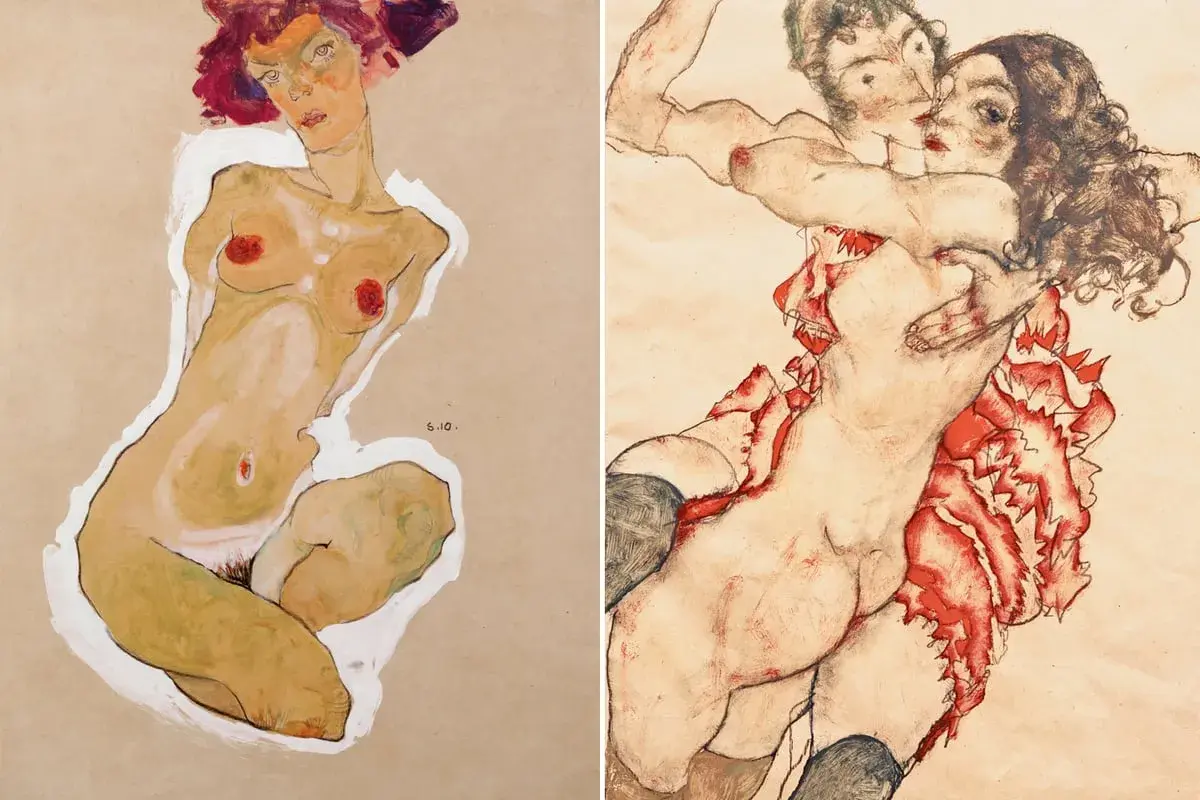
What matters most in Schiele's nude figure work
- Schiele uses nudity as a psychological and formal study, not as classical idealization.
- Most of the strongest examples are works on paper, where line carries more weight than polish.
- Reclining, crouching, bent, and cropped poses are the recurring visual grammar.
- Authentication depends on provenance, signature habits, paper, and technical comparison.
- Condition matters because charcoal, watercolor, chalk, and gouache on paper are fragile by nature.
Why Schiele's nude figures still matter
I read Schiele as a figure artist who stripped away the safety net of academic beauty. He keeps the body, but he removes the flattering finish, so the viewer is left with bone structure, pose, and nervous energy. In early 20th-century Vienna, that was a sharp break from decorative elegance, and it still feels modern because it treats the body as evidence rather than ornament.
According to The Met, Schiele made more than 300 paintings and around 3,000 drawings and watercolors in a brief life. That matters because the nude body was not a side theme for him, it was a repeated studio problem he kept testing from different angles, sometimes with erotic force, sometimes with near-clinical restraint.
The result is work that is never neutral. Even when the pose is simple, the figure tends to look strained, alert, or psychologically self-aware, which is why these sheets still hold up under close looking. The next question is what visual habits make that effect so consistent.
The poses and body language that define the work
Schiele's nude figures repeat a small set of body configurations, but he uses them to very different ends. I usually start by reading the contour line, the outline that carries form, because in Schiele the line does much of the emotional work that painters might otherwise hand to shading or background.
- Reclining bodies often look less restful than exposed. The torso may open while the limbs remain tense, which keeps the image suspended between surrender and control.
- Crouching poses compress the figure into a compact knot of knees, elbows, and spine. They sharpen the sense of vulnerability because the body seems to protect itself even while it is fully visible.
- Back views and turned heads reduce easy identification. They push attention toward structure, balance, and the relationship between flesh and empty space.
- Cropped torsos appear especially in the late work. Removing limbs or part of the body increases concentration and can make the image feel almost abstract.
- Nude self-portraits turn the body into both subject and instrument. Schiele is testing the same visual grammar on himself, which is one reason his figure studies feel so inward.
What gives these images their charge is not pose alone, but the way pose interacts with blank paper, abrupt angles, and often a very narrow palette. Once you recognize that grammar, individual works become much easier to read.
A handful of key nudes worth knowing
If you want a compact map of the subject, I would start with a few works that show how Schiele shifts from paired figures to pared-down late sheets. They are useful not because they are the only important examples, but because each one isolates a different part of his method.
| Work | Date and medium | Why it matters |
|---|---|---|
| Two Reclining Nudes | 1911, watercolor and graphite on paper | An early example of paired bodies; the composition turns contact into friction rather than comfort. |
| Crouching Nude in Shoes and Black Stockings, Back View | 1912, watercolor, graphite, and gouache on paper | The black stockings and shoes create a sharp visual counterpoint to bare skin; the back view adds distance. |
| Crouching Female Nude | 1914, black chalk and gouache on paper, verso self-portrait head | A reminder that Schiele often linked figure study to self-study and used both sides of the sheet. |
| Female Nude Bending to the Left | 1918, chalk on buff wove paper | Late, direct, and spare; the pose and line do most of the expressive work. |
| Torso of a Nude | 1918, charcoal on paper | The cropping makes the body feel fragmentary and severe, almost on the edge of abstraction. |
The pattern is hard to miss. Early sheets are often a little more descriptive, while the late works become leaner and more unforgiving, as if Schiele is testing how little he needs in order to make the body feel present. That shift leads directly into how I think about interpretation.
How to read the images without flattening them into scandal
When I look at these works, I do not start with provocation. I start with what the image is doing to the body, because Schiele is usually more interested in structural truth than in sensational display. That is why the same sheet can feel erotic, anxious, and painfully direct all at once.
There is a useful distinction here: erotic charge is not the same thing as simple erotica. Schiele often gives you exposure without comfort, which means the viewer is aware of flesh, but also of fragility, line, and the artist's control over the pose.
When I slow down, I ask a few practical questions:
- Where is the body most tense, and where does it relax?
- Does the line enclose the form cleanly, or does it leave the body open to space?
- Are the hands, feet, ribs, or knees exaggerated for emphasis?
- Is color supporting flesh, or is it acting as a stain, accent, or compositional break?
- Does cropping make the figure feel incomplete, or more concentrated?
Those questions keep the image from collapsing into a single moral label. The stronger the work, the more it resists that shortcut, and the more it rewards a slower, more exact reading. From there, the conversation naturally shifts to how these pieces are authenticated and documented.
Authentication and provenance are part of the story
For Schiele, attribution is never just about a signature. I look at the whole stack: provenance, signature habits, paper stock, line behavior, and whether the work sits comfortably inside the artist's chronology. The Kallir Research Institute treats connoisseurship, meaning trained visual judgment, documentation, and technical review as the core of Schiele authentication, which is a sensible model for an artist whose market has attracted plenty of imitation.
Provenance is the ownership history of an artwork. For Schiele, that history matters because many works on paper circulated widely, and some have complicated exhibition or wartime histories. A clean paper trail does not prove authenticity by itself, but it makes an attribution far more believable.
What specialists compare
- the pressure, speed, and hesitation of the line
- the type of paper and the tone of the support
- the relationship between signature, date, and composition
- the historical record of ownership, exhibitions, and sales
- the way watercolor, gouache, chalk, or charcoal sits on the sheet
Read Also: Pompeii's "Inappropriate" Art - Beyond the Shock Value
What should raise caution
- a drawing that feels generic even if the pose is familiar
- a signature that looks pasted on stylistically, not integrated into the work
- paper that seems inconsistent with Schiele's known supports
- an unexplained gap in provenance where one would expect a record
- heavy restoration that blurs the original handling of the line
I would treat any of those as reasons to ask for deeper expert review, not as proof of a problem on their own. The next layer is material, because Schiele's sheets are only persuasive when the support survives well enough to let the drawing speak.
Why the paper and conservation history matter
Most of Schiele's nude figure works are not large oils, they are works on paper, and that changes everything. Charcoal, graphite, chalk, watercolor, and gouache, an opaque water-based paint, are all vulnerable to light, abrasion, staining, and poor framing. A sheet that has browned, faded, or been overhandled can still be authentic, but it may no longer read the way the artist intended.
Schiele also used modest and sometimes rough supports, including ordinary buff-colored packing paper in some early drawings. That choice gives the work immediacy, but it also makes preservation more delicate. In practice, I care about acid-free mounting, UV-filtering glazing, and stable storage conditions because the image can lose legibility faster than an oil painting would.
For collectors and institutions, the practical rule is simple: do less, and document more. Keep handling to a minimum, avoid direct sun, record condition before any loan or move, and consult a paper conservator before attempting any cleaning or repair. Overrestoration is one of the few things that can damage both appearance and value at the same time.
That material fragility is not a side note. It is part of why these images feel so immediate, and it is also why they need careful looking long after they leave the studio.
What to remember when you encounter one up close
The best way to approach a Schiele nude is to read it in layers. Step back first and let the silhouette, posture, and cropping register; then move in to see the pressure of the line, the tone of the paper, and the small decisions that make the figure feel alive. I find that the closer one looks, the less these works resemble simple provocations and the more they resemble exacting studies of presence.
If you are viewing one in a museum, compare it with another Schiele work from a different year and you will see how quickly the language tightens, sheds detail, or turns more severe. If you are evaluating one in a sale room, ask for the provenance chain, the condition report, and any authentication reference before you let the image itself do all the convincing. The body may be the subject, but the evidence sits in the paper, the line, and the history around the sheet.That is why Schiele's nude figures still matter: they unite psychology, draftsmanship, and material fragility in a way that almost no other modern artist manages with the same force.
