
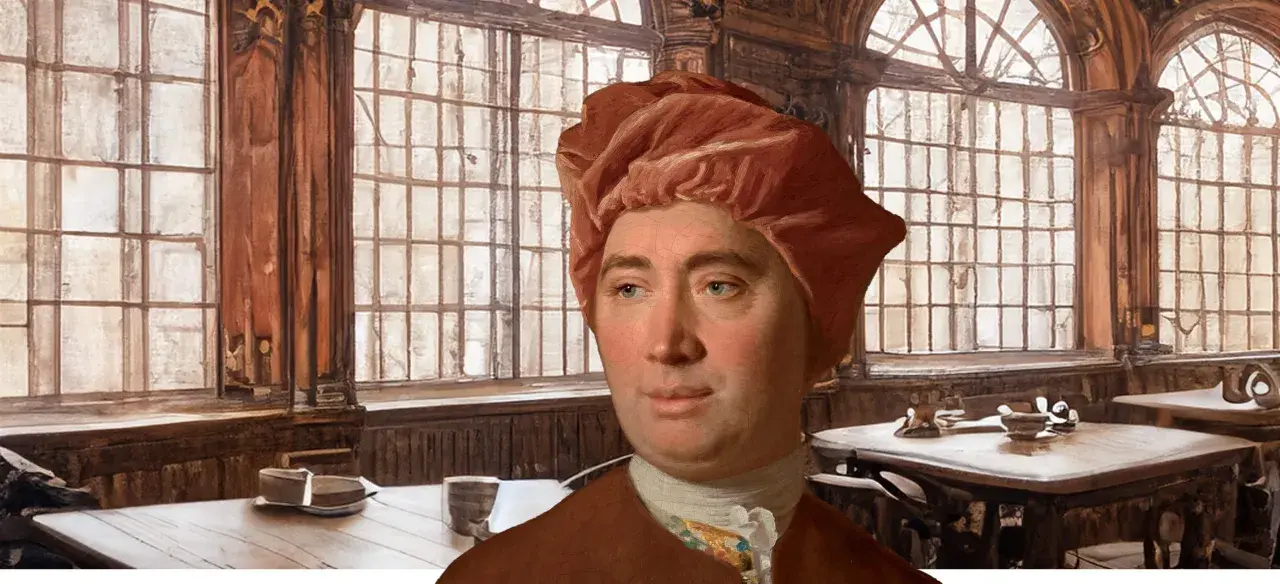
A David Hume portrait is more than a likeness of an eighteenth-century philosopher; it is a carefully built image of intellect, sociability, and public standing. The best-known version, painted by Allan Ramsay, shows Hume with a calm directness that still reads clearly today, and the details around him tell us as much as the face itself. In this article I look at the main versions, what the composition is really doing, and how to separate the original oil painting from later reproductions and prints.
Key facts that frame Hume’s portrait
- The canonical image is Allan Ramsay’s 1766 oil painting, not a later engraving.
- Ramsay also painted Hume in 1754, and that earlier portrait helps explain how the later one develops the sitter’s image.
- The scarlet coat, relaxed pose, and books are deliberate visual signals, not decorative extras.
- A 1767 mezzotint by David Martin helped spread the likeness far beyond the original canvas.
- If you need an accurate reproduction, always confirm the medium, date, and whether you are seeing the oil or a print after it.

Why Allan Ramsay’s portrait became the standard image of Hume
When I look at Ramsay’s portrait, I do not see a philosopher posed like a monument. I see a man presented as alert, cultivated, and socially at ease, which is exactly why the image endured. According to the National Galleries of Scotland, the 1766 painting was conceived as a companion to Ramsay’s portrait of Jean-Jacques Rousseau, and that pairing matters: it places Hume inside the visual culture of the Enlightenment rather than in a generic pose of authority.
The composition is balanced but not stiff. Hume sits turned slightly toward the viewer, his body relaxed, his face open, and the clothing rich enough to signal status without drowning out personality. That combination gives the portrait a double function: it records how Hume looked, and it argues for how he should be read. He is not presented as a distant abstract thinker. He is presented as a public intellectual with weight, confidence, and polish.
That is why this image became the standard one. It does not merely identify Hume; it defines the mood in which later audiences encounter him. From here, the question becomes less “what does it look like?” and more “which version are we actually looking at?”
The main versions and how to tell them apart
There are three forms I would keep separate from the start: the 1754 oil portrait, the 1766 oil portrait, and the 1767 mezzotint after Ramsay. They are related, but they do different work, and confusing them is the fastest way to flatten the history.
| Version | Date | Medium | What to look for | Why it matters |
|---|---|---|---|---|
| Ramsay’s first Hume portrait | 1754 | Oil on canvas | Earlier, more restrained presentation of the sitter | Shows Hume before the later image became the widely recognized one |
| Ramsay’s best-known Hume portrait | 1766 | Oil on canvas, 76.2 x 63.5 cm | Scarlet coat, books, relaxed pose, and a confident frontal presence | This is the version most people mean when they refer to Hume’s visual identity |
| David Martin mezzotint after Ramsay | 1767 | Smaller scale, print texture, and the translation of paint into engraved tone | Helped circulate the likeness beyond the original painting | |
| Later engravings after Ramsay | Later 18th and 19th century | Different linework, cropping, and editorial emphasis | Useful for reception history, but not interchangeable with the original oil |
The National Portrait Gallery lists several later interpretations after Ramsay, and that is a useful reminder that portraits do not stop at the first canvas. Once an image becomes canonical, it is copied, translated, abbreviated, and republished. For research and cataloguing, that means I always ask one simple question first: am I looking at the source image, or at one of its descendants?
What the image is saying about Hume
The portrait works because its symbolism is subtle. Ramsay does not overload the canvas with allegory. Instead, he uses a few disciplined cues to shape meaning, and those cues are strong enough that they still read well without explanation.
The clothes signal intellect and status at once
The scarlet coat is not a random flourish. It gives the sitter presence, but it also creates a tension that makes the portrait memorable: Hume appears both scholarly and worldly. Contemporary reaction noticed that tension. George III reportedly found the likeness convincing, while thinking the dress a little too fine. That response is telling, because it confirms what the painting is doing. It lets Hume look like a man of ideas without stripping away the social confidence that ideas had earned him.
The books are part of the argument
Books in portraiture are easy to read lazily. In a weaker painting they become generic proof of learning. Here they do more than that. They anchor Hume’s identity as a writer and thinker, and they keep the viewer from reading the image as a fashion plate. I would treat them as a visual shortcut for authorship, argument, and intellectual labor.
Read Also: Rembrandt Self-Portraits - A Visual Diary Revealed
The pose makes the sitter feel present
Hume’s posture is relaxed enough to feel human, but composed enough to feel deliberate. That balance is crucial. If the body were too formal, the painting would feel like an official likeness. If it were too casual, it would lose authority. Ramsay keeps it in the middle, which is exactly why the portrait still feels modern. It gives the viewer access without collapsing into intimacy.
Once you start reading the clothing, books, and posture together, the portrait stops being a single image and becomes a carefully staged statement. That leads naturally to a more practical question: if you need to use or evaluate a reproduction, how do you avoid the common mistakes?
How to verify a reproduction before you publish or buy it
For editorial work, museum labels, or any kind of acquisition review, I would not rely on the first image search result. A clear reproduction is useful, but it is not proof of identity, date, or medium. The details below are the ones I check first.
- Confirm the medium - oil painting, mezzotint, or later engraving each tells a different story.
- Check the date - 1754, 1766, and 1767 are not interchangeable.
- Read the attribution chain - “after Allan Ramsay” means the maker is translating an existing painting, not creating the original composition.
- Look at cropping - a tight crop can remove books, sleeve, or hand placement, which changes how the portrait reads.
- Prefer institutional records - museum catalogues are usually better for identification than commercial image thumbnails.
- Inspect the print logic - mezzotints and engravings often have tonal and line differences that make them easy to distinguish from painted surfaces.
When the question is authenticity, provenance matters more than convenience. A reproduction can be visually faithful and still be the wrong object for the job. If the use case is publication, I would choose the clearest full-frame institutional image available. If the use case is scholarship, I would go one step further and document how the image was transmitted, because the print history is part of the portrait’s meaning.
What this portrait still teaches about reputation and likeness
Hume’s portrait remains useful because it shows how visual identity is built, not merely recorded. Ramsay gives us a philosopher who looks composed enough to be trusted, elegant enough to be noticed, and thoughtful enough to be remembered. That is not accidental composition; it is visual rhetoric.
For me, the most important lesson is practical. If you are writing about Hume, choosing artwork for an exhibition note, or comparing reproductions, do not collapse every version into a single generic image. The 1754 painting, the 1766 canvas, and the 1767 print each serve a different purpose. The original oil establishes character, the later oil refines public image, and the print extends that image into circulation.
That is the real value of this portrait today: it is both a likeness and a case study in how art shapes historical memory. When you understand that, you read the face more carefully, and you read the culture around it with much sharper eyes.
