
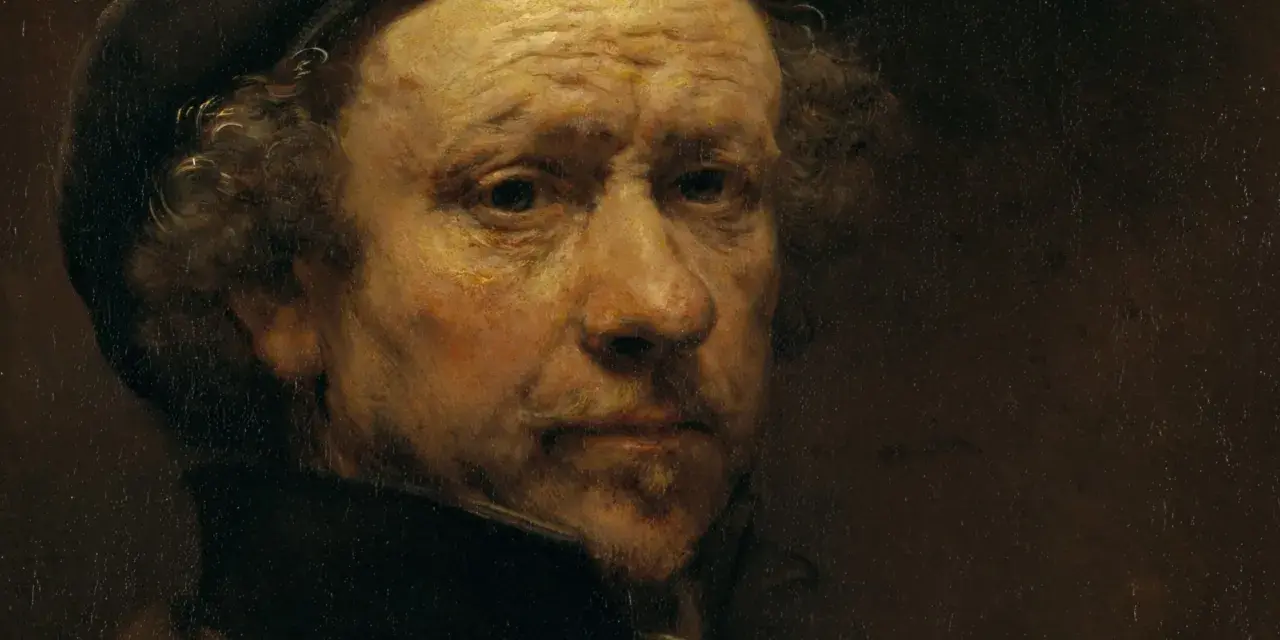
Rembrandt’s self-portraits are one of the clearest records we have of an artist thinking in public about age, status, light, and identity. The appeal of rembrandt self portraits is that they read like a visual diary, but one that is always being staged, revised, and tested against the mirror. In this article I look at how the works change across his career, which examples matter most, and why attribution and conservation still shape how we read them.
The essentials at a glance
- Depending on how broadly you count, roughly 40 to about 80 self-portraits survive across paintings, prints, drawings, and related studies.
- Early works are experimental; they test light, emotion, and expression more than they present a fixed public image.
- Middle-period works become more self-conscious and status-driven, often using costume, pose, and theatrical framing.
- Late self-portraits are the most direct: they are less flattering, more compressed, and unusually frank about aging.
- Attribution is still an active issue because workshop practice, later reworking, and conservation history can alter what viewers think they are seeing.
- The strongest reading comes from looking at image, surface, medium, and condition together rather than treating the face alone as the whole story.
Why Rembrandt kept returning to his own face
I would not reduce these works to vanity. Rembrandt used his own face the way other painters used hands, drapery, or plaster casts: as a reliable subject for testing how light lands, how emotion reads, and how paint behaves on a surface. In the early years especially, the self-image is close to a tronie, a character study rather than a formal likeness, which explains the strange expressions, theatrical caps, and exaggerated shadows.
That practical use never disappears, but it gets layered with something more ambitious. He is also building an artistic identity, deciding how much of himself to reveal, and later, how much authority a seasoned master can project without slipping into flattery. That tension is what keeps the series alive for viewers today, and it leads directly to the question of how the images change over time.
How the self-portraits change from experiment to statement
The broad arc is easy to see, but the details matter. Early works probe expression and visibility; middle-period pieces test costume, pose, and professional status; late works become calmer, heavier, and more unsparing. The shift is not a straight line, but a recurring habit of revisiting the same face under different pressures.
| Phase | What changes visually | Why it matters | Representative works |
|---|---|---|---|
| c. 1628-1630 | Dramatic shadow, close framing, startled or exaggerated expressions | These works function as exercises in seeing and recording emotion | Early painted self-portrait; Self-portrait in a Cap, Wide-eyed and Open-mouthed |
| 1634-1648 | More composed poses, richer dress, greater theatrical control | He begins presenting himself as a public master, not only a studio experimenter | Self-Portrait with Raised Sabre; Self-Portrait Drawing at a Window |
| 1659-1669 | Thicker paint, older features, less theatrical staging, more direct gaze | Age becomes part of the subject rather than something to disguise | Self Portrait at the Age of 63; Self-Portrait with Two Circles |
The chronology is broad because Rembrandt often reused ideas across media. The point is the change in purpose: from testing a face, to presenting a persona, to confronting time itself. That is easiest to see when the key works are put side by side.
The self-portraits worth knowing first
If I were building a compact reference set, I would start with these works because each one adds a different layer to the story. Together they show not just a changing face, but a changing idea of what a portrait can do.
- Early self-portrait, c. 1628. A young Rembrandt works in shadow, using light almost like a laboratory tool. The face is partially veiled, which makes the image feel experimental rather than ceremonial.
- Self-portrait in a Cap, Wide-eyed and Open-mouthed, 1630. This etched head looks startled, even comic at first glance. That exaggerated expression matters because it shows Rembrandt testing how far emotion can be pushed before likeness collapses.
- Self-Portrait with Raised Sabre, 1634. Here he adopts a more performative identity, dressing himself with a swagger that edges toward historical role-play. It is useful because it shows him shaping a persona, not just recording features.
- Self Portrait at the Age of 34, 1640. This is one of the clearest statements of status in the series. The clothing, stance, and controlled expression make the image feel closer to a court portrait than to a private study.
- Self-Portrait Drawing at a Window, 1648. This print matters because it presents the artist at work, interrupting the old ideal of a flawless studio self-image. The pose is direct and confident, but not decorative.
- Self Portrait at the Age of 63, 1669. Late Rembrandt is often praised for honesty, but what I see first is restraint. The paint is thicker, the face more weathered, and the image refuses the kind of polish that would make age easier to digest.
- Self-Portrait with Two Circles, c. 1665-69. The unfinished-looking background turns the painting into a question instead of an answer. That ambiguity is part of its power, and part of why it still anchors debates about late style.
These are not the only important examples, but they are the ones that best show his range: expressive, theatrical, professional, and finally unsparing. From here, the collector’s and conservator’s question becomes harder: which versions are secure, and what has altered their appearance?
Why attribution and conservation still change the story
Rembrandt is one of the artists most affected by attribution debates, and self-portraits are no exception. Some works survive as paintings, others as etchings or drawings, and some have been reworked, copied, or confused with studio products over time. That means a label is not just a label; it is the result of evidence, comparison, and periodic revision.
When I assess a Rembrandt image, I look for four things before I trust the romance of the picture: provenance, technical evidence, surface condition, and comparative style. X-radiography and infrared reflectography can expose underdrawing or changes; pigment and support analysis can confirm period materials; and provenance helps separate an autograph work from a later copy. None of those methods is decisive on its own, but together they are far stronger than connoisseurship by eye alone.
Conservation can also change what viewers think they are seeing. A removed varnish may recover the coolness of skin tones, reveal brush direction in the curls, or flatten nothing less than the whole mood of the work. On one famous late self-portrait, the removal of a synthetic varnish made the raised paint and incised texture much easier to read, which is a reminder that restoration can sharpen understanding without changing authorship.
That matters because the visual argument of a self-portrait can hinge on small things: a softened outline, a later repair across the cheek, or a darkened surface that makes the face seem more severe than it originally was. The next step is knowing how to look past those distortions.
How to read one closely without getting fooled by the surface
When I stand in front of one of these works, I try to slow down in the same order every time. First I look at the light, then the pose, then the costume, and only after that do I let the expression take over. That sequence keeps the portrait from collapsing into a quick emotional reaction.
- Check the light source. Rembrandt uses it not only to model the face but to decide what should remain uncertain.
- Study the costume. A cap, cloak, sabre, or rich garment is rarely neutral; it often signals status, role, or artistic ambition.
- Compare the medium. An etching can feel more immediate and experimental than an oil painting, but it also has its own state history, which can matter a great deal.
- Watch the edge of the face. In the best examples, the boundary between flesh and surrounding darkness is carefully controlled, not accidentally vague.
- Read the age honestly. Late Rembrandt does not smooth time away. Wrinkles, sagging skin, and tired eyes are part of the meaning, not flaws in the execution.
If you are studying reproductions rather than originals, this is even more important. Digital images often compress the shadow range and hide the thickness of paint or the bite of a drypoint line, which can make an intricate work look flatter and less considered than it really is. That limitation leads naturally to the practical question of what these portraits still teach us now.
What a careful viewer should take from the series now
For anyone researching, collecting, or simply looking better, the main lesson is that Rembrandt’s self-portraits reward methodical attention. I would compare date, medium, inscription, state, and condition before I compare mood. That order matters because the image you see is often the result of both the original hand and everything that happened afterward.
For museum visitors, the most productive habit is simple: spend longer with fewer works. A self-portrait from the 1620s and one from the final year of his life tell different truths, but they only become legible when you let the contrast settle. The earlier images show an artist learning how to make a face read; the late ones show a master deciding that honest aging can be more powerful than polish. That is why these paintings and prints remain central not just to portrait history, but to the larger problem of how art preserves identity without freezing it.