
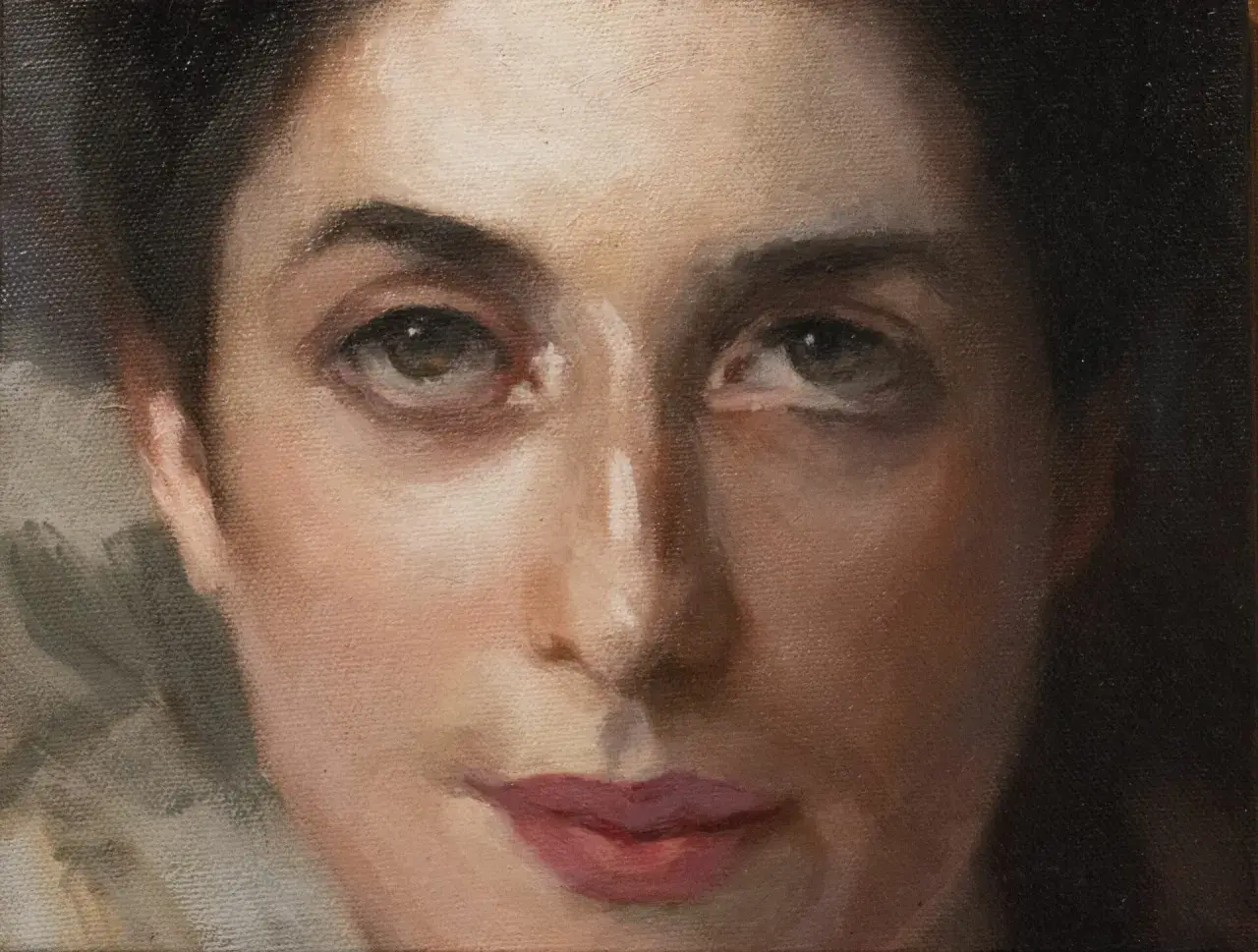
John Singer Sargent’s Lady Agnew of Lochnaw is one of the clearest demonstrations of how a portrait can look relaxed while being carefully engineered. This article looks at the sitter, the composition, the brushwork, and the documented history of the painting so you can understand why it remains a benchmark for society portraiture. I also focus on what the work reveals when you study it as an object rather than just as a famous image.
What matters most at a glance
- The painting was completed in 1892 in oil on canvas and now belongs to the Scottish National Gallery.
- Its power comes from the direct gaze, the relaxed pose, and the contrast between soft fabric and structural form.
- The portrait helped establish Sargent’s reputation in London and quickly made the sitter a society figure.
- The documented record is strong, which makes it useful for art-historical study and authentication work.
- Its best qualities are easiest to read in person, where the brushwork and surface transitions stay intact.
The facts that anchor the work
Before reading the image psychologically, I like to pin down the record. The portrait is an oil on canvas from 1892, measuring 127 by 101 cm, and it is cataloged by the Scottish National Gallery under accession number NG 1656. It shows Gertrude Vernon, who had recently become Lady Agnew through marriage, and the work was acquired by the gallery in 1925.
| Fact | What it tells us |
|---|---|
| Artist | John Singer Sargent, whose society portraits were already gaining authority in London |
| Subject | Gertrude Vernon, later Lady Agnew, a figure whose identity is tied to both family and social rank |
| Date | 1892, placing it at the moment Sargent was consolidating his British reputation |
| Medium and size | Oil on canvas, 127 x 101 cm, a format large enough to carry presence without becoming monumental |
| Current home | Scottish National Gallery, Edinburgh, where the surface can still be studied as a physical painting |
Those baseline facts matter because they frame the portrait as more than an elegant image: it is a documented, exhibition-ready object with a stable institutional history. Once that is clear, the next question is how Sargent made the painting feel so direct without flattening its sophistication.
Why the portrait feels so immediate
What strikes me first is the sitter’s frontality without stiffness. She looks straight out at the viewer, but her body does not lock into a formal display; instead, the chair, the drape of the gown, and the angled pose all soften the encounter. That balance is rare, because portrait painters often lose either liveliness or control when they try to do both at once.
The setting works just as hard as the face. The Louis XVI chair and the patterned Chinese silk backdrop are not random decorations; they create a framework of luxury that supports the figure without overpowering it. Sargent lets the white silk dress and lilac accents carry most of the visual charge, so the eye keeps moving between skin, fabric, and background rather than settling on one single effect. The result is a portrait that feels conversational but never casual.
According to the studio record, Sargent finished the portrait in six sittings, and that pace shows. The image has the fluency of something kept moving just long enough to stay alive, which is part of why it still feels fresh. That painterly freedom becomes even more interesting when you look at the sitter’s social world, because the portrait is as much about status as likeness.
Gertrude Vernon, social ambition, and the making of a public image
Gertrude Vernon married Andrew Noel Agnew in 1889, and by the time Sargent painted her, the family’s position had recently risen even further when her husband succeeded to the baronetcy in 1892. The exact route to the commission is not fully documented, but the fit between artist and sitter makes sense: Sargent was becoming the preferred portraitist for elite clients who wanted refinement, modernity, and a flattering but not empty likeness.
The portrait’s social intelligence is easy to miss if you focus only on beauty. It does not simply record a woman in fashionable dress; it constructs a public identity. Her gaze is alert, slightly amused, and self-possessed, which gives the viewer the sense that she is aware of being seen and is choosing how to be seen. That distinction matters in portraiture, because the best society portraits do not only represent rank, they stage it.
There is also a human note that prevents the image from becoming mere glamour. Contemporary accounts suggest she had been in fragile health and was still recovering from exhaustion when she sat for Sargent. I would not force a medical reading onto the painting, but the pale, luminous quality of the face and the ease of the pose do seem to support a quieter, more intimate mood than a triumphal one. That tension between vulnerability and prestige is part of what keeps the portrait from feeling generic, and it leads directly into the technical side of the picture.
How to read the surface like a conservator
If I were studying this painting for preservation or attribution purposes, I would pay close attention to how Sargent distributes finish. The face is handled with more control than the surrounding fabrics, while the gown, chair, and backdrop are allowed a freer, more fluid treatment. That separation is deliberate: it guides the eye and keeps the sitter psychologically present even when the decorative elements become visually active.
The portrait is a strong reminder that a finished work is not always a smooth one. Reproductions often compress the subtle changes in tone that make the white dress feel breathable rather than flat. In the original, the handling of highlights, shadows, and reflected color gives the costume weight without making it heavy. For anyone interested in conservation, that means the work depends not just on color values but on the legibility of brush edges and the balance between thin and dense paint passages.
I also think this is where viewing conditions matter. Good gallery lighting lets the viewer notice how the painting alternates between polished description and visible paint application. A digital image can still teach you the composition, but it will not fully preserve the surface hierarchy, which is one reason portrait study is always better when the object itself is available. From there, the next layer to consider is the work’s exhibition and ownership history, because that record explains how the picture became famous.
Provenance and exhibition history that researchers should note
The portrait was shown at the Royal Academy in London in 1893 and was an immediate success. That public reception mattered a great deal: it helped solidify Sargent’s reputation in Britain and turned the sitter into a recognizable society hostess. In practical terms, the exhibition debut is one of the reasons the painting is now treated as a key example of late nineteenth-century portrait culture rather than just a beautiful likeness.
The title history also matters. The work was first listed more simply and later adopted the fuller form now associated with her status, which is a small but revealing example of how portrait titles can track social identity as much as biography. That may seem like an archival detail, but in authentication and cataloging work, these shifts are exactly the kind of thing that separate a clean record from a confusing one.
The object history is unusually solid: a known commission, a documented exhibition, and an institutional purchase all give the painting a stable paper trail. For authentication work, that kind of chain is useful because it leaves fewer gaps for speculation. The same is true of the later sale, which appears to have been driven by the cost of sustaining the social life the portrait itself helped project. In other words, the painting’s biography is not just administrative trivia; it is part of its meaning. The final question, then, is why the portrait still feels so relevant to modern viewers.
Why this portrait still sets the standard for society portraits
What keeps this painting fresh is the way it refuses the old trade-off between elegance and personality. Too many society portraits become polished surfaces with little emotional charge, or expressive likenesses that lose their ceremonial force. Here, Sargent keeps both. The sitter is composed, fashionable, and legible as a social type, yet she also feels singular and alive.
That is why I return to this work when thinking about portrait standards. It gives a clear lesson in how pose, costume, and brushwork can cooperate instead of competing. It also shows that the strongest portraits do not shout their symbolism; they make the viewer discover it through looking. If you are comparing portraits across periods or evaluating how an image handles presence, this one remains a remarkably efficient model.
For me, the lasting value of the painting is simple: it turns status into atmosphere, and atmosphere into character. That is a difficult thing to do without slipping into sentiment or stiffness, and this portrait manages it with unusual confidence.
