
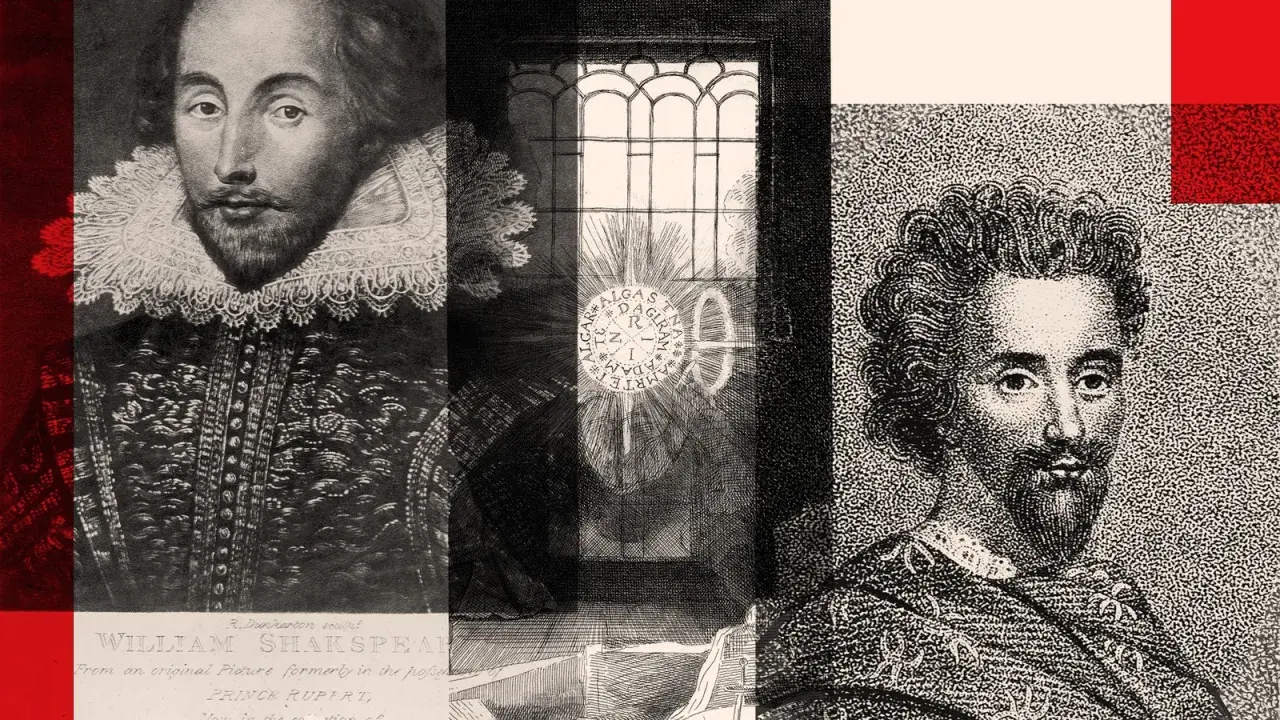
The christopher marlowe portrait question is less about a single face than about how historians weigh evidence, style, and institutional caution. The best-known image linked to Marlowe is a 1585 panel portrait associated with Cambridge, but its identity is still debated. In this article I look at what the image shows, why the attribution remains uncertain, and how I would describe it responsibly in a catalogue, caption, or editorial note.
The main facts to keep in view about Marlowe’s attributed portrait
- The most discussed likeness is a 1585 panel portrait long associated with Christopher Marlowe.
- It shows a young man with long hair, a light beard, folded arms, and a costly dark doublet.
- The age inscription, set at 21, makes the identification tempting because it fits Marlowe’s birth year.
- The attribution is still uncertain because the documented ownership trail is thin and late.
- For publication, the safest wording is usually “attributed to” or “possibly Christopher Marlowe.”
What the portrait actually shows
The image most people mean is a half-length panel portrait of a young man with long hair, a trimmed beard, folded arms, and a dark, expensive-looking doublet. The paint handling and costume give him a deliberate, self-possessed air, and the Latin inscription with the date 1585 and the age 21 makes the panel feel biographically neat in a way that is hard to ignore. The motto, usually read as “What nourishes me destroys me,” adds another layer: it turns a portrait into a statement, almost a warning.
That is why the image has had such staying power. Even before anyone argues about attribution, it behaves like a strong portrait should: it gives the sitter an identity, a mood, and a memorable visual grammar. I think that combination explains why it is so often reproduced as if it were settled fact. The visual appeal is real, but the next question is whether the evidence supports the name attached to it.
Why the attribution remains uncertain
The core problem is provenance. The panel reappeared in the 20th century, not in a continuous early record, and that gap matters more than the attractive date on the surface. Corpus Christi College does not vouch for the sitter, and that caution is exactly what a careful institution should say when the documentation does not close the case. The Marlowe Society, for its part, treats the image as a possible likeness rather than a confirmed one, which is the right level of restraint.
| Evidence | What it suggests | What it does not prove |
|---|---|---|
| 1585 date and age 21 inscription | A man born in 1564 could fit the age neatly | Many educated young men of that age could fit just as well |
| Connection to Cambridge | Marlowe studied there, so the setting is plausible | Institutional proximity is not identity |
| Costly dress and confident pose | The sitter looks like someone who wanted to be seen | Style and status do not name the sitter |
| Late rediscovery | Modern scholars had a reason to revisit it | A late rediscovery weakens the chain of custody |
That table is why I resist any caption that states the identity too strongly. A portrait can be historically interesting without being securely named, and in Marlowe’s case the strongest case is still circumstantial. The challenge, then, is not just to identify the face, but to understand why later viewers wanted this face to be Marlowe’s in the first place.
Why the image shaped Marlowe’s public image
Marlowe is one of those writers whose life already feels partly mythic because the documentary record is fragmentary and dramatic. When a playwright survives in legal records, rumors, and literary traces, a portrait becomes more than a likeness: it becomes a shortcut to narrative. This panel offers exactly the kind of image people want for Marlowe, because it looks intelligent, sharp, a little insolent, and self-aware.
That is not the same as proof, of course. But it explains why the portrait has become so embedded in Marlowe’s visual identity that many readers never stop to ask whether the sitter is really him. I read that as a lesson in reception history: sometimes an image tells us as much about later desire for a face as it does about the original subject. From there, the question shifts from “Is this Marlowe?” to “What do we need to check before calling any early modern portrait authentic?”
What I check before accepting a likeness
When I evaluate a disputed portrait, I start with the boring parts first, because they usually tell the truth sooner than style alone does.
- Provenance - I look for an unbroken ownership trail, or at least something better than a rediscovery story.
- Inscription - I ask whether the date, age, and motto are original to the surface or added through later restoration or retouching.
- Material history - I want to know how the support, ground, and paint layers behave, especially if the work was cleaned, relined, or repaired.
- Iconography - I compare the pose and clothing with portraits of the same period, but I do not let costume masquerade as identity.
- Documentary cross-checks - I look for references in inventories, college records, correspondence, or early catalogues.
The important point is that none of those checks works in isolation. A convincing age inscription can still sit on the wrong sitter; a plausible college connection can still be coincidence; a beautiful face can still be anonymous. In practice, I downgrade certainty as soon as the chain of evidence starts to thin. That is why the language of attribution matters so much in print.
How I would caption it responsibly in publication
For an educational article, a museum label, or a heritage blog post, I would not present the panel as a confirmed portrait of Marlowe unless the evidence were much stronger than it is now. I would use wording that leaves room for the uncertainty without making the image sound vague or irrelevant.
| Context | Caption I would use | Why |
|---|---|---|
| Careful catalogue entry | Attributed to Christopher Marlowe, panel portrait, 1585 | Signals a traditional identification without overstating certainty |
| Conservative editorial use | Possibly Christopher Marlowe | Works well when the attribution is debated or the image is secondary to the text |
| General audience feature | A portrait traditionally associated with Christopher Marlowe | Readable for non-specialists and still honest about the evidence |
| What I would avoid | Portrait of Christopher Marlowe | Too definite for a likeness that remains unconfirmed |
That may sound strict, but it is the difference between scholarship and repetition. Once a caption goes too far, the certainty starts to travel faster than the evidence. In art history, especially with early modern portraits, I would rather be slightly cautious than accidentally authoritative. That discipline is what protects both the object and the reader.
Why this likeness still matters in 2026
As of 2026, the real value of this portrait is not that it settles Marlowe’s face once and for all. It is that it shows how a persuasive image can outrun its documentation and still shape cultural memory for decades. For readers, teachers, editors, and collectors, the lesson is practical: a strong visual impression is not the same thing as authentication.
If I were using the portrait on Muses-et-Art.org, I would present it as a compelling but unconfirmed likeness, explain the 1585 date and age inscription, and keep the provenance caveat visible. That gives the reader the right level of confidence and preserves the historical honesty that serious portrait work depends on. In a field where images are often repeated faster than they are checked, that is the standard I would keep.
