
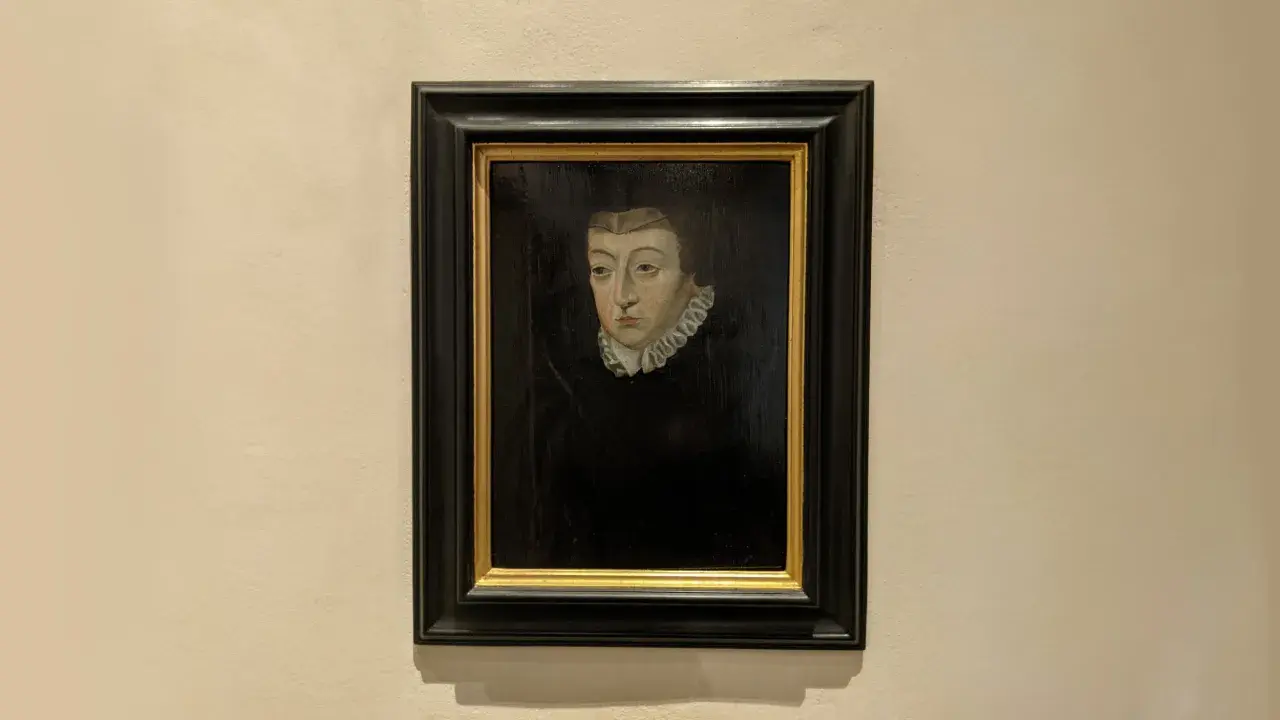
What matters most when you look at these portraits
- There is not one fixed image. The surviving record includes drawings, small portrait miniatures, oil paintings, and workshop copies.
- The earliest surviving Clouet likeness is a drawing. It helps explain how later painted versions were built.
- Dress is evidence, not decoration. Widow’s cap, mourning clothes, and court costume all help date the image and explain Catherine’s public role.
- Many versions are copies or workshop works. That does not make them useless; it tells you how widely the image circulated.
- Provenance and condition matter. In old portraits, later retouching, cleaning, and ownership history can be as informative as the paint layer itself.
What people usually mean by a Catherine de Medici portrait
In practice, the phrase covers a small family of related likenesses rather than a single canonical image. Some are formal paintings, some are portrait drawings, and some are tiny, closely viewed miniatures meant for private handling. The British Museum identifies one chalk drawing as the earliest surviving portrait associated with François Clouet, and that matters because it shows the visual language that later versions repeat and modify.
When I study this group of works, I think less in terms of “the” portrait and more in terms of a visual timeline. Early images present Catherine as a young court figure; later ones emphasize widowhood, regency, and dynastic control. That shift is the key to understanding why the same sitter can appear so different from one work to another. From there, the real question becomes why the image changed, which leads straight into its political role.
Why the image became a political tool
Renaissance portraiture was never neutral, and Catherine’s likeness is a good example of that. The image had to do more than record facial features. It needed to communicate legitimacy, stability, and the continuity of the Valois line at a moment when France was under severe strain. Her portrait could function like a political argument in paint: this is the queen, this is the regent, this is the mother of heirs, this is the center of power.
That is why costume and posture carry so much weight. A widow’s cap is not just a fashion note; it marks a public identity after Henry II’s death in 1559. A carefully structured hand pose, a reserved gaze, or a formal seated arrangement all help turn likeness into authority. In other words, the image is persuasive by design, not accidental. Once you read it that way, the surviving variants start to make much more sense.
The surviving versions you should compare
The most useful way to approach the material is to compare the main formats side by side. Each one tells a slightly different story, and the differences are often more revealing than the similarities.
| Version | Approximate date | Medium and scale | Why it matters |
|---|---|---|---|
| Early court drawing | c. 1547–1550 | Black and red chalk on paper, about 308 x 322 mm | Likely the earliest surviving Clouet-related likeness; it records costume details with unusual care and helps explain later painted versions. |
| Portrait miniature | c. 1555 | Watercolour on parchment, about 6 x 4.4 cm | Shows how intimate these images could be. A miniature was made to be held close, not seen across a room. |
| Oil portrait after Clouet | c. 1580 | Oil on panel, about 33.7 x 25.4 cm | Demonstrates how widely the image circulated in copy form, especially for courtiers and family members. |
| Group portrait with her children | 1561 | Monumental workshop painting | Shifts the focus from an individual likeness to dynastic identity, which is exactly what Catherine needed at court. |
What stands out in these versions is not inconsistency but adaptation. The same sitter is reshaped to suit different audiences and moments in her life. The miniature compresses status into a private object; the panel painting makes the image more shareable; the group portrait turns Catherine into the center of a dynasty. The V&A describes portrait miniatures as small, portable works invested with political and personal significance, and that is exactly the right frame for this type of image.
When I compare the versions, I also pay attention to how they age visually. Early likenesses tend to be cleaner and more idealized, while later ones often show stronger markers of maturity and widowhood. That brings us to the practical question of how to read the image itself without overclaiming what it proves.
How to read the visual clues without overinterpreting them
The safest reading starts with three things: dress, medium, and attribution language. A buttoned gown, an open sleeved mantle, or a widow’s cap can help place the image in a particular stage of Catherine’s public life, but none of those details alone proves authorship. Similarly, a label that says “after François Clouet” means the composition follows his model; it does not necessarily mean Clouet painted the object in front of you. In museum practice, that distinction matters more than most people realize.
I also look for signs that the image was meant to be replicated. Carefully described costume details, crisp contours, and flattened tonal transitions often suggest a work designed as a model for copies. That is not a flaw. It is a clue that the image functioned as a reproducible court type. If you are trying to distinguish an autograph work from a workshop version, this is where the evidence usually starts to separate.
One more point is worth stressing: the purpose of the portrait affects how literal the likeness is likely to be. Court images were expected to project authority and recognizable identity, not modern photographic exactitude. That is why the sitter can look more static, more formal, or more idealized than a viewer might expect. Once you accept that premise, the portrait becomes easier to read on its own terms. From here, the next issue is not style but physical survival.
What conservation and provenance can tell you
For a work this old, condition is part of the history. Old panel paintings may have been cleaned, varnished, inpainted, or structurally altered many times. Inpainting means new paint used to fill losses, usually so the image reads coherently again from a normal viewing distance. That is standard conservation practice, not automatically a red flag. But it does mean that the visible surface may reflect several centuries of intervention rather than one untouched moment.
Provenance is equally important. It is the ownership history of the object, and for Catherine-related portraits it can be remarkably revealing because these works were often preserved, copied, or circulated among court families, collectors, and later connoisseurs. A strong provenance does not prove autograph status on its own, but it does help you judge whether the object’s history is consistent with a 16th-century court portrait. If the ownership trail is thin, the attribution should be treated with caution rather than assumed to be secure.
I would also be wary of over-reading surface finish. A portrait may look “fresh” because it has been restored, or it may look dull because it has been overcleaned. Either condition can distort the artist’s original handling. That is why serious attribution work depends on the full package: support, paint layer, inscriptions, old restorations, and documented ownership. Those details matter because they separate a surviving court object from a later romanticized copy. Once you have that framework, the portrait’s broader art-historical value becomes much clearer.
Why this portrait still matters to historians and collectors
Catherine de Medici’s image remains important because it sits at the intersection of power, gender, and visual strategy. It helps explain how Renaissance courts used portraiture to construct legitimacy, how women in power were represented, and how repeated copies could keep an image alive long after the sitter’s public circumstances changed. I find that especially useful for readers interested in authentication, because it shows why a “copy” is not always a lesser object in historical terms. Sometimes it is the best evidence that an image mattered.
For collectors and researchers, the lesson is practical. If a portrait is offered as Catherine de Medici, you should ask three things immediately: which version does it follow, who is actually credited, and what is the object’s ownership and condition history. Those questions usually tell you more than a polished sales description ever will. The portrait’s value lies not only in its subject but also in what it reveals about the machinery of court image-making.
What I would keep in mind, above all, is that the safest way to read this material is as a visual family, not as a single fixed face. Once you compare medium, attribution, dress, and provenance, the portrait stops being mysterious and starts becoming legible in the way Renaissance images were meant to be read.
