
Marie Bracquemond was one of the most distinctive painters in French Impressionism, and her career makes sense only if you look at both the pictures and the circumstances around them. This article traces her training, the works that best show her range, and the reasons her reputation stayed smaller than it should have. It also gives you practical clues for reading, studying, and assessing her art with more confidence.
What matters most about her career and work
- She moved from academic training to Impressionism rather than appearing as a fully formed “modern” painter.
- Her strongest works balance structure and light, which is why they feel more precise than a quick glance suggests.
- She worked across painting, drawing, ceramics, and decorative design, so her corpus is broader than many readers expect.
- Her exhibition history is small but important: she showed with the Impressionists in 1879, 1880, and 1886.
- Her record is fragmented, which makes provenance, museum history, and preparatory material especially important.
From academic training to an Impressionist voice
I read her early career as a reminder that Impressionism did not come out of nowhere. She studied drawing, received advice from Ingres, and later worked as a copyist at the Louvre, which gave her a strong command of line, form, and composition before her style opened up. That matters, because even her most luminous paintings still feel built rather than merely observed.
Before the fully Impressionist phase, she exhibited portraits and historical or literary subjects at the Salon. She also worked in decorative art, including ceramics, and collaborated in the Haviland context with Félix Bracquemond. A major ceramic panel project, Les Muses des arts, is now lost, but the surviving drawings show that she thought in ambitious, spatial terms, not just in small easel pictures.
The key shift came when her palette brightened and her brushwork loosened. Her subjects moved away from historical narration and toward modern life, outdoor light, and domestic scenes. That transition is the backbone of her artistic identity, and it sets up the works that most clearly define her style.

The paintings that define her style
The easiest way to understand her art is to look at a small group of works rather than trying to summarize the whole career in one sentence. The paintings and drawings below show the range I would expect a serious reader, collector, or museum visitor to know first.
| Work | Date | Why it matters |
|---|---|---|
| The Lady in White | c. 1880 | A large, confident figure painting that shows how she handled fabric, vertical structure, and light without losing clarity. |
| Three Women with Parasols | 1880 | One of her most celebrated Impressionist canvases, with an outdoor setting and a visibly freer handling of color. |
| Lunch in the Countryside | 1881 | A drawing rather than a painting, but it is useful because it shows how carefully she organized figures and atmosphere. |
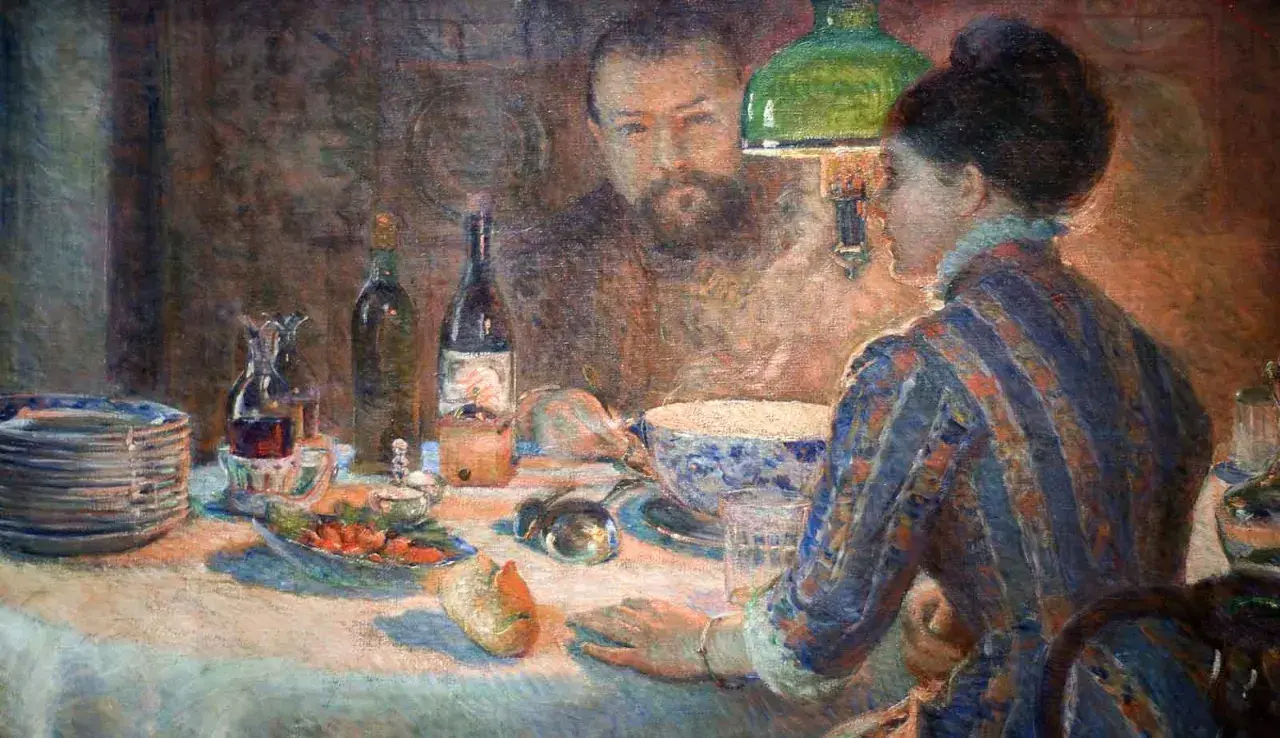
| Under the Lamp | 1887 | A later interior scene that moves the focus from daylight to intimate artificial light, which expands how we read her range. |
| Les Muses des arts | c. 1878 | A lost decorative project that survives through preparatory drawings and helps explain her ambition beyond easel painting. |
The Met records Lunch in the Countryside as a plein-air scene built around fleeting light, which is exactly the kind of detail that helps separate her from artists who used Impressionism only as a surface effect. Her best work is never vague. It is airy, yes, but the figures, edges, and spatial decisions stay legible. That combination is what gives her paintings their quiet authority.
If you compare these works side by side, a pattern appears: she prefers scenes where the modern world is ordinary rather than theatrical. That includes women at leisure, family life, gardens, terraces, and interiors. The point is not just subject matter. It is the way she turns everyday life into a controlled visual structure.
Why her career was interrupted and then overlooked
Her career was not erased for a single reason, and I think it is more accurate to describe it as a convergence of limits. She worked in a period when women artists had fewer routes into lasting visibility, and her own professional path passed through media that are easier to lose than oil on canvas. Decorative panels could be damaged, dispersed, or simply forgotten. Drawings could remain in family hands. Ceramics could disappear into the history of design rather than painting.
The exhibition record is also small but meaningful. She showed with the Impressionists in 1879, 1880, and 1886, and The Met notes that she was one of only three women to do so under her own name. That is a striking fact, but it should not be read as a mere statistic. It tells you how rare her public visibility already was, even at the time.
More recently, the archive has begun to look less thin. A major donation to the Musée d’Orsay brought in 173 works by Félix and Marie Bracquemond’s descendants, including paintings, drawings, and preparatory material. For me, that matters because it shows the story is still being reconstructed from fragments rather than from a neat, finished corpus. Her reputation has grown, but the body of evidence is still being reassembled in public view.
The larger lesson is simple: when an artist’s surviving work is dispersed, later interpretation can lag badly behind actual quality. That is exactly what happened here, and it is why her name now belongs in any serious account of Impressionism.
How I would study and authenticate her work
From a preservation and authentication angle, her work needs a careful, slightly skeptical eye. I would not rely on style alone, because her range is broad: academic portraits, decorative designs, plein-air studies, interiors, drawings, and works on paper do not all look identical. A confident attribution should be built from several layers of evidence, not just a general “Impressionist feel.”
- Check the medium first. A painting, drawing, watercolor, ceramic design, and preparatory study each need a different standard of comparison.
- Look for exhibition history. Work linked to the Salon or the Impressionist exhibitions is easier to place historically than an untitled family piece.
- Trace provenance carefully. Family descent, museum records, and old sale documentation can be far more useful than a later dealer label.
- Separate finished works from studies. Preparatory drawings for Les Muses des arts are valuable, but they are not the same thing as the finished decorative project.
- Examine the handling of light and edges. Her brushwork is freer in the mature phase, but it usually remains structured rather than dissolved.
- Use technical analysis when the stakes are high. Support, pigments, paper stock, and inscription work can clarify a doubtful attribution more reliably than instinct.
I would also be cautious with overly neat stories. Her surviving output includes both public and private contexts, and the archive is incomplete enough that uncertainty is normal. That is not a weakness in the scholarship; it is the real condition of studying an artist whose work was scattered, partly lost, and only later restored to view.
What her surviving legacy still changes for readers and museums
Bracquemond now matters for more than recovery alone. She helps explain what Impressionism looked like when it was not reduced to a single formula. Her work includes outdoor leisure, domestic interiors, decorative ambition, and carefully built figures, which makes the movement feel broader and more technically demanding than the usual shorthand suggests.
She also sits in an important triangle with Berthe Morisot and Mary Cassatt, but I would resist treating her only as a corrective footnote. The better reading is more specific: she was a painter with strong draftsmanship, a clear eye for modern life, and a visual intelligence that worked across media. That is why her best works reward slow looking, and why institutions continue to acquire and recontextualize them.
For anyone studying women artists, Impressionism, or the preservation of incomplete archives, her career is a useful model. Reputation can lag behind quality for decades, but the work itself remains a better record than the literature around it. In her case, that record is finally becoming easier to see.
