
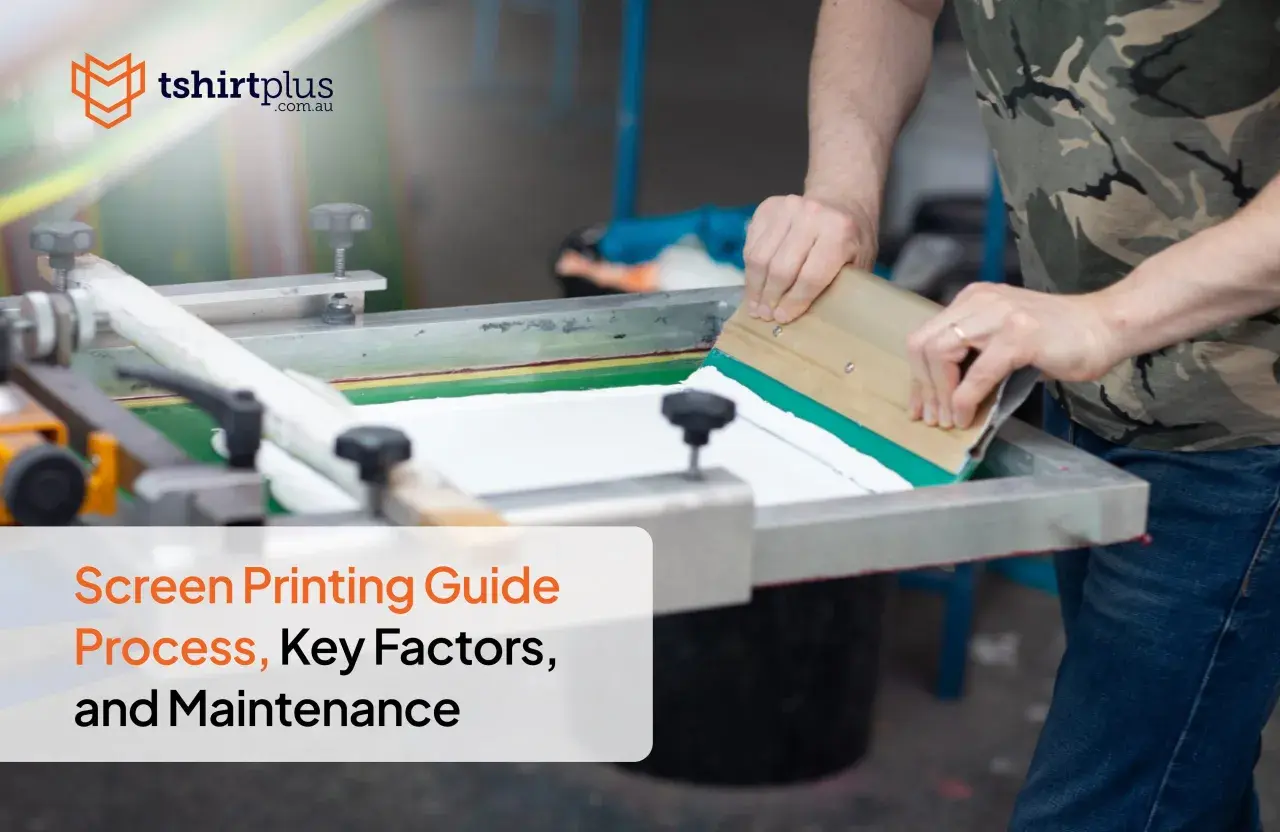
Screen printing works best when the artwork, mesh, emulsion, ink, and drying stage all support one another. This guide walks through the practical side of how to screenprint for shirts, paper, and other flat surfaces, with the choices that actually affect clarity, durability, and repeatability. I am focusing on the steps that save time and prevent the usual beginner mistakes, not on theory for its own sake.
The few decisions that make the print work
- Mesh count changes everything. Lower mesh lays down more ink; higher mesh holds finer detail.
- Clean coating matters. A thin, even emulsion layer is easier to expose and rinse correctly.
- Exposure should be tested. A step wedge beats guesswork every time.
- Pressure should be controlled. A firm stroke is better than forcing the squeegee.
- Full cure is non-negotiable. A print that feels dry can still fail later.
Choose a setup that matches the print
Before I pull ink through a screen, I decide what the print needs to do. A bold poster, a one-color shirt, and a fine-art edition on paper all ask for different mesh counts, inks, and drying habits, and those choices matter more than most beginners expect. In printmaking studios, I still hear the process called serigraphy, but the workflow is the same: the substrate, stencil, and ink all have to fit the job.
Screenprinting.com notes that 110 and 156 mesh are the most common starting points for garment work, and that matches my own experience with simple spot-color jobs. If I need more detail, I move upward in mesh count; if I need a heavier ink deposit, I move downward. That simple tradeoff is the first thing to understand.
| Mesh count | Best use | What it gives you | Main tradeoff |
|---|---|---|---|
| 110-156 | Spot colors, bold type, opaque apparel prints | Thicker ink deposit and an easier starting point | Less detail than finer mesh |
| 195-230 | Line art, halftones, cleaner detail | Sharper edges and a more refined print | Less ink through the screen |
| 305 | Very fine detail and process work | Excellent image control | More sensitive setup and lighter ink deposit |
Mesh is only part of the equation. For paper editions, I think about absorbency and flatness; for shirts, I think about fiber type and how much ink the garment can hold without feeling stiff. That is why a setup that works for poster paper can feel completely wrong on cotton. Once the mesh and substrate make sense together, the next step is preparing the art and the stencil.
Prepare the artwork and coat the screen evenly
I always start with the artwork at final size and in strong contrast. If the image has more than one color, I separate the colors before I touch the screen. If it is a line drawing or a simple logo, I keep the positive crisp and clean, because any softness in the file usually shows up later in the print.
The screen itself should be clean, degreased, and coated with emulsion in a thin, even layer. I prefer a coat that is consistent on both sides of the mesh rather than one that feels heavy and wet. A thick, uneven coat can make exposure less predictable and washout messier. The screen should then dry completely in the dark, dust-free, and with enough airflow to finish the job properly.
- Use high-contrast artwork with the final dimensions already set.
- Degrease the mesh before coating so the emulsion bonds evenly.
- Apply the emulsion in smooth, even passes instead of trying to build a heavy layer.
- Let the screen dry fully before exposure, not just until it feels dry at the edges.
I treat this stage as the foundation of the print. If the coating is uneven, the rest of the process becomes a series of workarounds. Once the screen is dry, exposure is where the stencil becomes real.

Expose and wash out the stencil cleanly
I clamp the film positive tight to the screen, expose for a tested time, and then wash out gently so the image opens without tearing the stencil. Screenprinting.com makes an important point here: exposure is never universal, so I use a 21-step wedge or a similar exposure calculator whenever I change emulsion, mesh, or light source. That one habit saves a lot of ruined screens.
- Place and tape the positive flat against the coated mesh.
- Expose the screen for the time your test tells you to use.
- Let the emulsion rest briefly if your system calls for a rest before washout.
- Rinse from both sides with light pressure first, then increase only as needed.
- Dry the finished stencil completely before printing.
If fine detail disappears, I check exposure and washout pressure first. If pinholes appear, I look for dust, poor degreasing, or a screen that was not fully dried before exposure. The stencil stage is where most beginners either gain control or lose it, which is why I take it slowly. Once the stencil holds, the actual printing stage becomes much easier to manage.
Pull the print with control instead of force
A clean pull depends on two things: a stable screen and a consistent stroke. I like a small off-contact gap, usually around 1/16 to 1/8 inch when the press allows it, because the mesh snaps back more cleanly after the squeegee passes. My first pass is a flood stroke to fill the image; my second is the print stroke, usually with the squeegee held around 45 degrees and enough pressure to move the ink without burying the detail.
If I am printing on shirts, I keep the fabric smooth and lightly secured on the platen so it does not shift. If I am printing on paper, I want the sheet flat, dry, and free of curl. For edition work, that small consistency is everything, because the best-looking print in a run is usually the one where registration, pressure, and ink deposit all stayed predictable.
| Ink type | Best use | Strengths | Tradeoffs |
|---|---|---|---|
| Plastisol | Apparel and opaque spot colors | Forgiving, stable on screen, strong coverage | Heavier hand and full cure is essential |
| Water-based | Paper, soft-hand apparel, edition work | Softer feel and a cleaner surface | Can dry in the screen if the run pauses too long |
| Discharge | Soft cotton garment prints | Very soft hand and a vintage look | Less predictable and not right for every design |
The ink choice changes the whole workflow. Plastisol is usually easier to control for beginners because it sits on the surface and gives strong coverage, while water-based ink is often better when I want a softer finish or a more printmaking-like look on paper. The tradeoff is simple: plastisol is more forgiving, but water-based ink rewards speed, good drying, and a cleaner setup.
Dry and cure the print all the way through
Surface-dry is not cured, and that is where a lot of good-looking prints fail later. For many plastisol systems, the print needs to reach the ink manufacturer’s cure temperature, often around 320°F; many water-based systems cure in the 300-320°F range after moisture has been driven off, though the exact number depends on the formula. In a forced-air conveyor dryer, some water-based prints can finish in roughly 1.5 to 2 minutes once they are at temperature, but I still trust the ink spec sheet and a proper wash or stretch test more than any rule of thumb.
If I am working on paper, I still keep the prints flat and dust-free while they dry, because marks and curl are the enemy of a clean edition. I also prefer to test one sample before a long run. A print that survives the first inspection but cracks after stretching or washing is a curing problem, not a printing problem. That distinction saves time, money, and a lot of unnecessary reprints.
Fix the mistakes that keep showing up in beginner prints
- Blurry edges usually mean the stencil was underexposed, the mesh was too loose, or the substrate moved during the pull.
- Patchy coverage often comes from too little ink, a mesh count that is too high for the artwork, or a weak flood stroke.
- Worn-out detail can happen when the squeegee is pushed too hard and the image widens instead of staying sharp.
- Pinholes and specks usually point to dust, poor degreasing, or emulsion that dried unevenly before exposure.
- Ink drying in the screen is common with water-based systems when the run pauses too long or the room is too warm and dry.
The fix is rarely to add more force. More often, I slow down, check the exposure, clean the screen, and reduce the variables one by one. That boring discipline is what turns screen printing from trial and error into a repeatable process. It also makes the difference between a passable first print and one you would actually keep.
Keep notes if you want the next print to match
For a one-off shirt, intuition is often enough. For an edition, a client reorder, or any print you may want to revisit later, I record the mesh count, emulsion type, exposure time, ink, substrate, off-contact gap, and cure settings. Those notes matter more than they sound, especially in fine-art or archival work, because repeatability is part of the value.
I also reclaim the screen fully and store it dry so the next job starts with clean mesh, not leftover residue. When a print run goes well, the temptation is to move on quickly; I prefer to leave the bench in a state where I could reproduce the same result tomorrow without guessing. That is the real advantage of a disciplined screen-printing workflow.
