
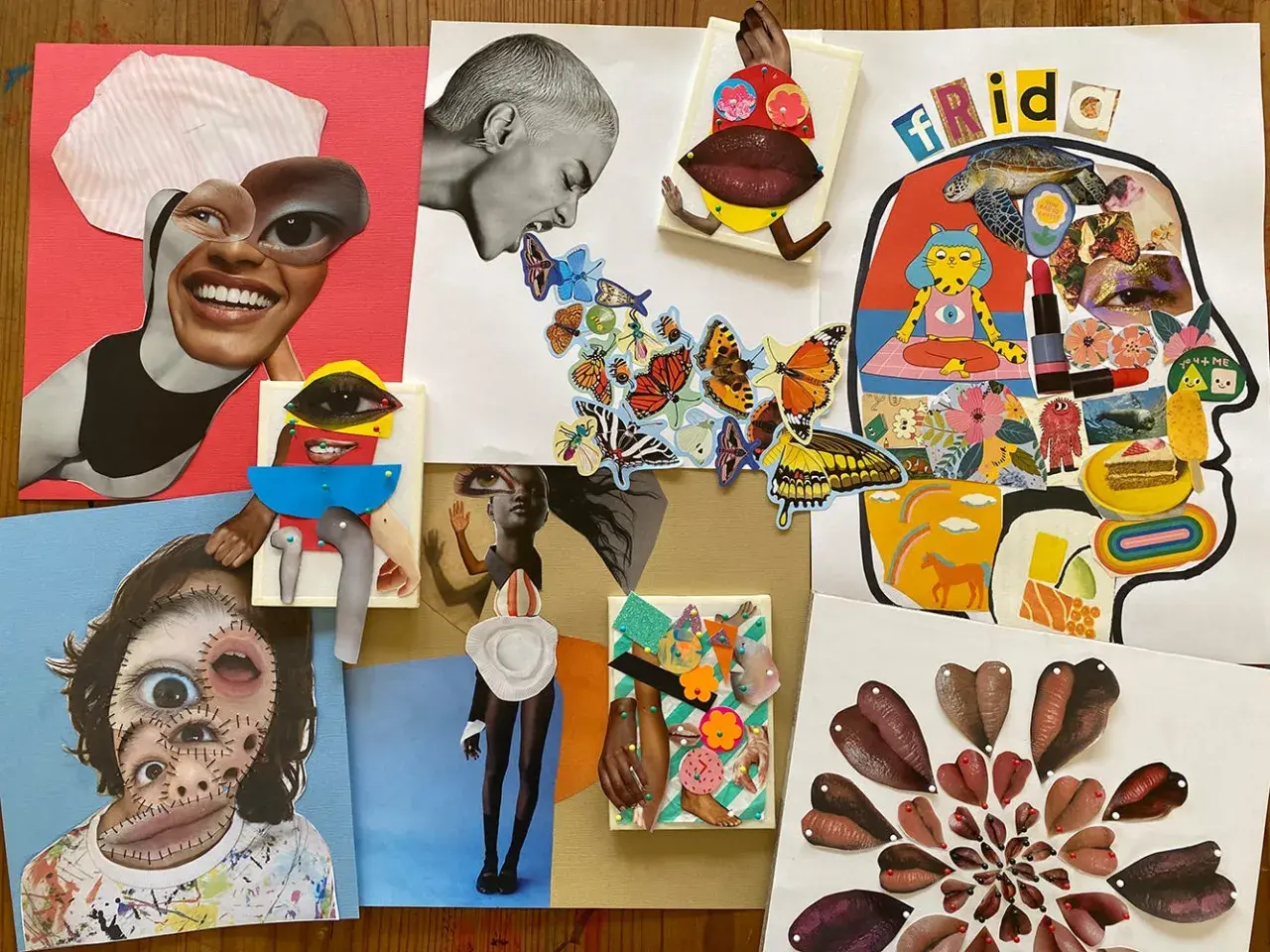
I keep coming back to collage because it is one of the few art techniques where the surface openly shows how it was built. The strongest collage examples show how paper, photographs, fabric, newsprint, and paint can carry meaning as much as line or color. In this article I look at the historical works that shaped the medium, the materials that change its appearance, and the preservation issues that matter when those materials start to age.
The main things to know before you study collage closely
- Collage is both a technique and a finished artwork built by attaching different materials to a surface.
- The most important early models come from Cubism, especially works by Picasso, Braque, and Juan Gris.
- Paper, photographs, fabric, and printed matter each change the mood, meaning, and durability of the work.
- The seams, layering, and scale shifts are not secondary details; they are part of the visual argument.
- Collage is often harder to conserve than it first appears because mixed materials age at different rates.
- A strong collage is usually more than an arrangement of scraps. It is a disciplined composition with a clear material logic.
What collage is in practice, not just in definition
As Tate describes it, collage is built by arranging and fixing different materials to one support, but that description only gets you to the threshold. In practice, collage is a way of thinking with materials: a photograph can function as evidence, a torn edge can suggest movement, and a strip of printed text can shift a picture from private to public. I find that the medium becomes easiest to understand when you separate it from the broader categories around it.
| Technique | What defines it | Why it matters |
|---|---|---|
| Collage | Different materials are attached to a flat or mostly flat surface. | The joins, edges, and layering are part of the image. |
| Photomontage | Photographs or photographic fragments dominate the composition. | It often carries a sharper documentary or political tone. |
| Assemblage | Objects are built into a more three-dimensional structure. | The work moves closer to sculpture than to drawing or painting. |
| Mixed media | Any combination of materials in one work. | Collage can sit inside this category, but not all mixed media is collage. |
That distinction matters because it helps you read intent correctly: a collage is not just a surface covered with bits, it is a structure built from visible decisions. Once that is clear, the historical works make much more sense.

Historic works that shaped the medium
The early 20th century is still the best place to study collage because that is where the medium became serious, not merely decorative. The Met’s discussions of Cubist collage make a useful point here: the materials are never neutral, and the fragments often carry multiple meanings at once. These are the collage examples I return to most often because they show how flexible the form can be without losing discipline.
| Work or group | Materials | Why it matters |
|---|---|---|
| Pablo Picasso, Pipe and Wineglass (1914) | Cut-and-pasted paper with graphite | It shows how ordinary fragments can interrupt and rebuild a still life at the same time. |
| Georges Braque’s early papier collé works | Printed papers, simulated wood grain, and other paper surfaces | Braque pushed collage toward texture and illusion, making the material itself part of the image language. |
| Juan Gris’s Cubist collages | Layered paper, printed matter, and painted passages | Gris is valuable because his work shows that collage can be precise, elegant, and highly structured rather than chaotic. |
| Victorian photocollage from the 1860s and 1870s | Photographic cutouts arranged into albums and social scenes | This proves that collage was not only a modernist invention; it already served wit, memory, and social play. |
| Anne Ryan’s small-scale collages | Paper fragments, threadlike elements, and delicate surfaces | Her work shows how restraint can be more memorable than visual overload. |
| Lorna Simpson’s screen-printed collages | Found imagery, ink, acrylic, and supports such as fiberglass or wood | Her work shows how collage can carry contemporary themes of identity, archive, and disappearance. |
The lesson from these works is simple: collage changes character depending on what is cut, what is printed, and what is left exposed. From here, the next step is to look at the materials themselves, because that is where the visual personality of the work really forms.
Which materials do the most work in a collage
In collage, material choice is never cosmetic. A newspaper clipping feels different from handmade paper; a photograph feels different from a strip of fabric; a glossy magazine page behaves differently from matte watercolor paper. The support also matters, because a fragile sheet can create a very different reading from a rigid panel.
| Material | What it adds visually | Typical limitation |
|---|---|---|
| Handmade or cotton paper | Soft edges, depth, and good tearing qualities | It can wrinkle if the adhesive is too wet. |
| Newsprint and book paper | Speed, texture, typography, and a direct sense of time | It often yellows and becomes brittle more quickly. |
| Photographs | Documentary force and strong tonal contrast | The image can fade, abrade, or discolor under light. |
| Fabric and textile fragments | Pattern, tactility, and a stronger physical presence | Edges can fray, and different fibers age differently. |
| Printed ephemera | Public language, cultural reference, and a sense of place | Inks may offset, bleed, or lose contrast. |
| Paint, ink, and acrylic | Unifies the surface and controls transitions between fragments | Wet layers can stress delicate papers and adhesives. |
The adhesive matters almost as much as the surface. A weak glue can allow lifting and detachment, while an overly wet adhesive can warp paper or stain it. When I look at a collage, I always ask not only what the artist added, but how those additions were physically persuaded to stay in place. That question leads naturally to the way a viewer should read the work up close.
How to read a collage like a curator
The easiest mistake is to treat collage as a decorative style. I read it more like a record of decisions, and the best way to do that is to slow down. First, step back and look at the overall structure. Then move close enough to notice edges, overlaps, abrasions, and the places where one material interrupts another.
- Follow the seams. Clean cut edges suggest control, while torn edges often create tension or softness.
- Check the layer order. In many strong collages, the sequence of layers matters as much as the elements themselves.
- Watch the scale shifts. A tiny photo beside a large field of paper can create drama without adding much material.
- Read text as image. Headlines, numbers, and fragments of type often act as shapes before they act as language.
- Notice surface contrast. Matte against gloss, rough against smooth, and flat against raised all help organize the composition.
- Ask what is hidden. Underlayers can reveal revision, hesitation, or the artist’s desire to keep part of the process visible.
This is where collage becomes especially rewarding for art history and authentication work. A viewer who can describe the visible joins, not just the subject matter, is already looking at the object more seriously. That seriousness matters even more when the work enters a collection and has to survive over time.
Why collage is difficult to preserve and authenticate
Collage looks simple until you have to conserve it. Different papers expand and contract at different rates. Photographic emulsions behave differently from ink, and fabric responds differently from pasted paper. That mix can create real problems over time, especially if the work has been exposed to light, humidity swings, or poor framing.
In conservation, I would watch for a few recurring issues. Acidic paper turns yellow and brittle. Certain adhesives darken or stain. Tapes can fail at the edges first, which makes the loss look minor until a fragment lifts completely. If the work includes photographs, those images may fade faster than surrounding paper, which can make the composition look uneven even when nothing has been physically removed.
- Light sensitivity is a major concern for paper and photographs, so display time often has to be limited.
- Humidity changes can create cockling, curling, and separation between layers.
- Mixed supports are vulnerable because each material expands and contracts at a different pace.
- Repair work has to respect the original construction, or the surface can quickly lose its intended roughness.
- Authentication depends on more than a signature; paper stock, adhesive behavior, image sources, and documented provenance all matter.
I am also skeptical of collages that look too evenly aged. If paper, photo, and adhesive all appear to have weathered in exactly the same way, the object deserves closer scrutiny. Real works usually show uneven change, because the materials are never equally stable. Once you know that, the final step is to judge not only what the collage is made from, but how well those parts still hold together as an idea.
What I look for when a collage really works
The strongest collages do three things at once: they organize visual surprise, they make the materials feel necessary, and they keep enough structure that the eye can move through them. When any one of those pieces is missing, the work starts to feel either overworked or empty. I usually trust a collage more when I can see a clear relationship between its content and its construction.
That means I pay attention to restraint. Not every surface needs to be crowded. Some of the most convincing works leave space for the support to breathe, or they let a single strip of paper carry the weight of the whole composition. Others rely on contradiction, such as pairing a fragile scrap of newsprint with a dense painted field. The point is not abundance; the point is control.
If you want one practical rule to keep in mind, use this: a memorable collage should feel assembled, not merely accumulated. When the materials seem to justify one another, the work holds up visually, historically, and materially. That is the standard I return to whenever I study the form.
