
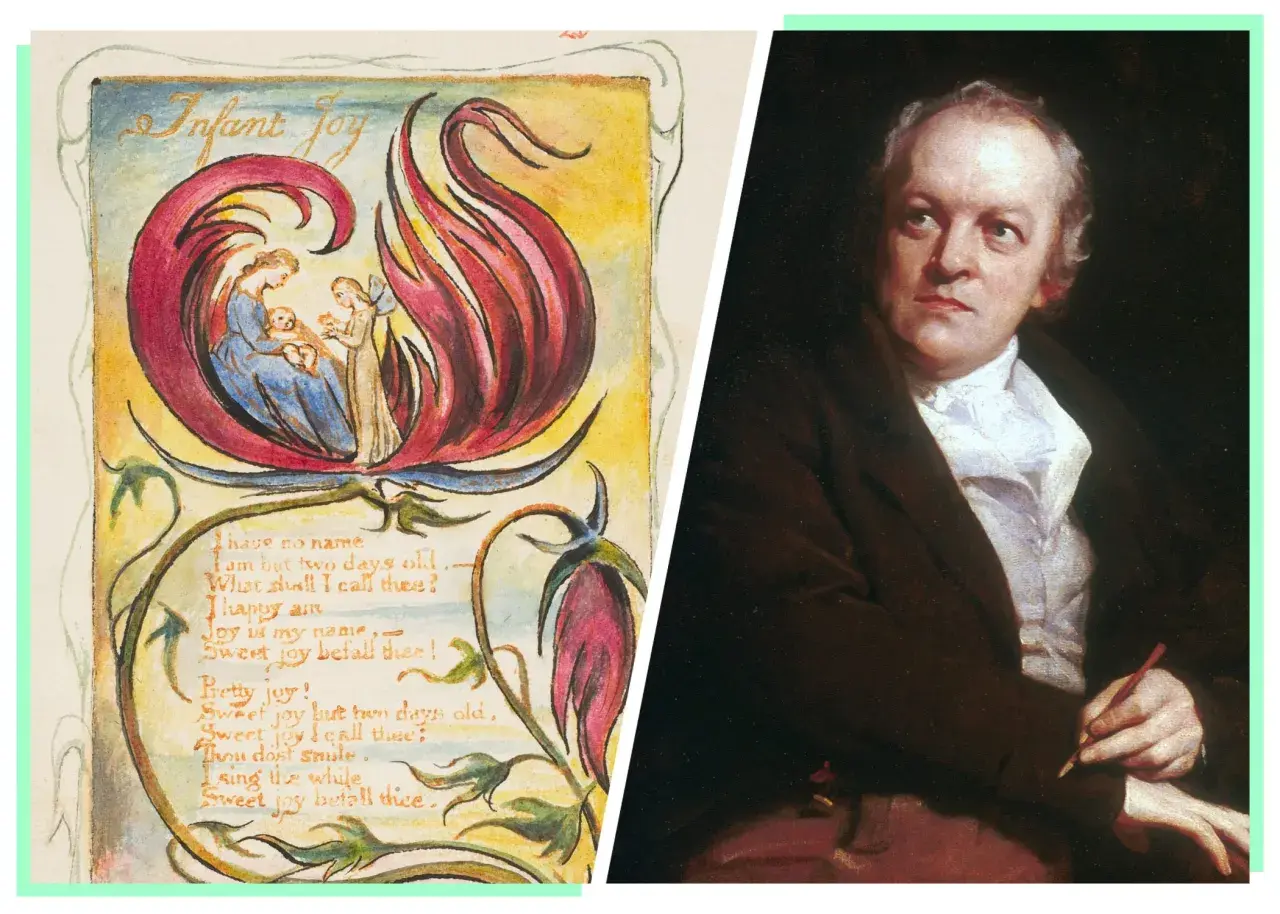
The William Blake portrait most readers have in mind is Thomas Phillips’s 1807 oil, but that single image only tells part of the story. Blake survives in a small cluster of likenesses, each one revealing something different about how he saw himself and how later viewers wanted to see him. For anyone reading a museum label, checking a reproduction, or comparing versions, the real question is simple: which image are you looking at, and what can it honestly prove?
What matters most when reading Blake’s likenesses
- Phillips’s 1807 oil is the canonical public image: seated, upward-looking, and more visionary than conventional.
- Blake’s c. 1802 self-portrait is usually treated as his most intimate likeness, and the one that feels closest to observation rather than staging.
- Later engravings, replicas, and casts shaped the way Blake was remembered, so medium and provenance matter.
- If you are choosing a reference image, match it to the job: biography, exhibition text, conservation, or publication.
- The strongest portraits do not simply look like Blake; they explain the myth that grew around him.
The portrait most people recognize
The National Portrait Gallery’s 1807 oil on canvas is the image most people mean when they think of Blake, and it has become the default face of the poet for a reason. Phillips shows him three-quarter length, seated on a Regency mahogany bench, pencil in hand, head turned slightly right and lifted as if he has just noticed something beyond the room. The effect is not social polish; it is inward concentration, the sort of stillness that makes Blake look like a man thinking in images.
I read this portrait as a carefully managed public likeness. The dark coat, white waistcoat, and restrained palette keep the figure grounded, but the upward gaze and the looseness of the pose push the image away from ordinary studio portraiture. The story attached to it, that Phillips prompted Blake to speak about the Archangel Gabriel, matters less as gossip than as evidence of how strongly the sitter’s visionary reputation already framed the sitting.
This is also why the image traveled so well: an 1808 etching after Phillips made the face familiar in print, and that reproduction helped fix Blake in the public imagination. Once a likeness becomes the reference point, it starts doing double duty as biography and symbol, which is where things get more complicated. To understand that complication, I look at what the face itself is doing.
What the face and posture communicate
The strongest feature here is not the hair or the coat; it is the direction of attention. Blake does not confront the viewer, which is unusual for a portrait of intellectual authority. Instead, the head tilts upward and the eyes open the image toward an unseen space, making the portrait feel closer to contemplation, audition, or vision than to self-display.
That matters because Blake’s work was never ordinary in the first place. He was a poet, engraver, painter, and printmaker, and the portrait acknowledges all of that without cluttering the canvas with props. The pencil in his right hand is a small detail, but it tells you he is presented as a working artist, not a decorative gentleman. I do not read this as a court portrait trying to elevate rank; I read it as a working artist being visually dignified without being turned into a nobleman.
There is a useful caution here: viewers often read this image as proof that Blake was eccentric in the theatrical sense. I think that is too simple. The portrait is more disciplined than that. It gives you seriousness, inwardness, and creative alertness at the same time, which is exactly why it still feels credible.
That reading becomes clearer when you compare the painting with Blake’s other surviving likenesses.
Other likenesses that change the picture
The broader portrait record is small. The National Portrait Gallery’s catalogue lists Blake in 10 portraits and associates him with 5 more, which is not much for a figure whose image has circulated so widely. That scarcity is part of the problem: a few works have been overused until they seem interchangeable, even though they do very different things.
Tate describes the c. 1802 drawing as probably Blake’s own self-portrait, and I find that version especially important because it strips away the later stagecraft. It is more exposed, less polished, and probably closer to the way Blake wanted to study his own face than to how a patron wanted to see him.
| Work | Date | Medium | Why it matters | What to watch |
|---|---|---|---|---|
| Thomas Phillips portrait | 1807 | Oil on canvas | The canonical public likeness and the basis for many later reproductions | It is a finished studio portrait, so it reflects interpretation as much as observation |
| Blake self-portrait | c. 1802–4 | Graphite and gray wash with white heightening | Likely his only self-portrait and the most introspective likeness | It is smaller, quieter, and more vulnerable than the Phillips canvas |
| Schiavonetti etching after Phillips | 1808 | Etching | Helped make Blake’s face widely recognizable in print | Useful for reception history, but not the same thing as the original oil |
| John Linnell replica | 1861, based on a work of 1821 | Watercolour replica | Shows the lasting effort to preserve or restage Blake’s image | Secondary status means it should not be treated as an original sitting |
| James Deville cast | 1823 | Plaster cast of head | Gives a later, more literal record of Blake’s head and age | Its phrenological context shapes how it should be read |
What I take from this table is simple: Blake’s face was never fixed in one authoritative form. Every version tells you something, but each one also has a different distance from the man himself. That distance is exactly what matters when a portrait is used as evidence, which leads into the question of authenticity.
How to judge a Blake portrait as an object
When I evaluate a Blake likeness, I start with three questions: who made it, when was it made, and how far is it from the sitter’s own hand. A later etching after Phillips can be historically valuable, but it is not the same kind of object as a first-hand drawing or a studio oil. That distinction is basic, yet it is the one most often blurred in online captions.
- Check whether the work is autograph, after an original, or a later replica.
- Look at medium first. Graphite, oil, plaster, and engraving each change what the image can claim.
- Read the provenance. A clean ownership trail often tells you more than the image alone.
- Watch for retouching, cropping, and modern color correction in digital reproductions.
- Separate likeness from interpretation. A polished portrait may be truer to reputation than to facial detail.
In conservation terms, the surface matters too. Brush handling, paper tone, plate wear, and later reprinting can all alter what a viewer thinks they are seeing. That is why I prefer precise labels over loose language like “portrait of Blake” when the object is actually a copy, an engraving, or a posthumous interpretation. Once you know how to read the object itself, the final step is deciding which image works best for a given purpose.
Why Blake’s image still works in scholarship and display
Blake’s image matters because it sits at the junction of object history and reputation. A portrait can be used as a face for a label, a chapter opening, or a social post, but if it is detached from medium and date, it quickly becomes a vague symbol rather than evidence.
I would argue that the best uses of Blake’s likeness keep two ideas in view at once: he was a working artist in London, and he was also building a private symbolic universe that no ordinary portrait could fully contain. The Phillips canvas captures the first fact and hints at the second; the self-portrait gets closer to the private self; the engravings show how quickly an image can become public property.
For museums, cataloguers, and writers, that means the safest approach is not to hunt for one definitive face. It is to use the version that matches the argument you are actually making, and to be honest about what kind of evidence the image can provide.
The best reference image depends on the job you need it to do
If I were choosing a single image for a general audience, I would start with Phillips’s 1807 portrait because it is the most legible and the most influential. If I needed a more intimate view of Blake as an individual, I would use the c. 1802 self-portrait. And if I wanted to show how his likeness circulated and acquired authority, I would pair the oil with one of the early engravings.
- Use the Phillips portrait for biography, exhibition labels, and broad public reference.
- Use the self-portrait for discussion of self-image, technique, and psychological tone.
- Use later engravings or replicas when the topic is reception history rather than direct likeness.
- Be explicit about status when the image is a reproduction, not an original work.
That is the practical rule I keep returning to: a Blake portrait is only as useful as the question you ask of it. Choose the image that answers that question cleanly, and the rest of his visual record becomes much easier to read.
