
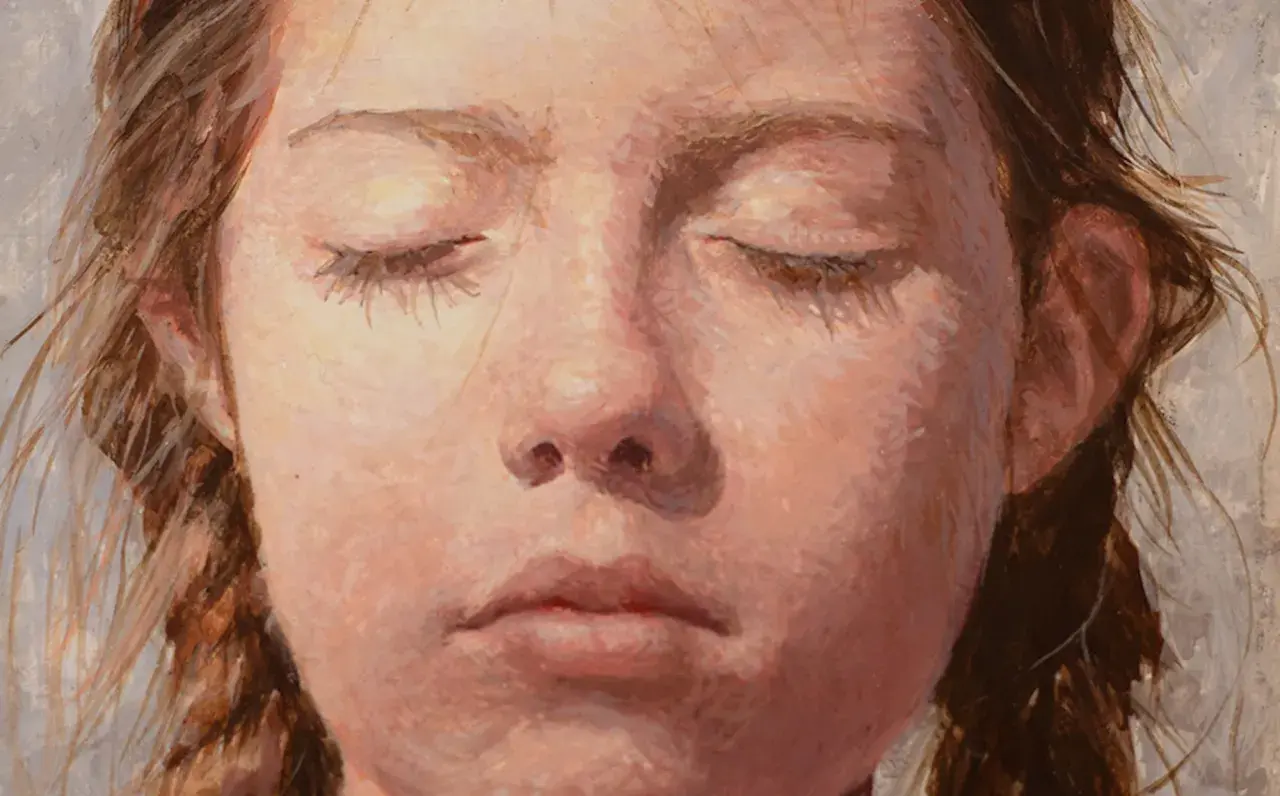
Egg tempera paint is a demanding medium, but that is exactly why it still matters: pigment is bound with egg yolk, the film dries quickly, and the finished surface stays precise, matte, and luminous. In this article I explain how it is made, how it behaves on the support, which materials matter most, and what to watch if you care about longevity and conservation. If you want a medium that rewards control rather than speed, this is the one to understand first.
The medium rewards precision, thin layers, and a rigid support
- It is built from pigment, egg yolk, and water, with no real room for improvisation once the paint is on the panel.
- Drying happens in seconds, so the look comes from planned strokes and layered passes rather than wet blending.
- A rigid, well-prepared ground matters more here than in many other media; flexing supports are a real risk.
- The surface is usually matte to satin-matte, which gives the color a clean, controlled clarity.
- For conservation, the big issues are humidity, abrasion, and patience during the curing period.
What makes it behave so differently
I think of tempera as a drawing medium disguised as paint. The binder is a simple egg emulsion, but the way it dries and hardens changes everything: the brushwork stays visible, corrections are limited, and the finished film becomes thin, hard, and surprisingly durable when it is handled well.
| Property | What it means in practice | Why it matters |
|---|---|---|
| Drying speed | Seconds to minutes | You work in short, deliberate passes rather than waiting for wet paint to blend itself. |
| Surface finish | Matte to satin-matte | Detail reads clearly and glare stays low. |
| Paint film | Thin and hard | It is excellent for line and layer building, but poor for thick impasto. |
| Support tolerance | Low flexibility | Rigid boards and panels are far safer than movable surfaces. |
| Reworking | Limited | Planning matters more than correction. |
That is why the medium has always felt close to discipline rather than spontaneity. It rewards a clear value plan, a stable surface, and a hand that is willing to build slowly. Once you accept that logic, the preparation stage starts to make sense, because the materials have to support that kind of control.
How I mix and prepare it
The recipe looks simple on paper, but the handling is where the quality is won or lost. I want fresh, clean ingredients, a stable ground, and only a small amount of paint mixed at a time, because the emulsion changes quickly once it is exposed to air.
| Material | Role | Practical note |
|---|---|---|
| Egg yolk | Binder | It holds the pigment in a drying film. |
| Dry pigment | Color source | Fine pigment gives cleaner, more even handling. |
| Water | Diluent | It controls flow and transparency. |
| Rigid panel or board | Support | A stable, non-flexing surface reduces cracking risk. |
| Small brushes | Application | Fine brushes help keep the stroke controlled before the paint sets. |
- Separate the yolk carefully and remove the membrane so the emulsion stays clean.
- Lightly dilute the yolk with water. I usually treat this as an adjustable starting point rather than a fixed formula, because different pigments change the feel of the paint.
- Make a paste with the dry pigment first, then combine it with the yolk mixture in small amounts.
- Mix only what you can use in the session. Fresh batches behave better than paint that has sat around for hours.
- Test the mixture on a scrap panel before committing to the final surface.
Some painters add a trace of vinegar or alcohol to slow spoilage, but I treat that as a handling choice rather than a universal rule. The real discipline is making just enough paint, then using it before it loses clarity. Once that mixture is ready, the next challenge is learning how to place it before it outpaces you.

How I build it up on the surface
This medium is at its best when it is built, not pushed. I lay it down in thin strokes, let each pass settle, and then return with the next layer. That can sound restrictive until you see what it gives back: crisp edges, luminous layers, and a surface that feels carefully composed rather than mechanically blended.
Work in short, deliberate strokes
Because the paint sets so quickly, broad wet blending is a weak strategy. I get better results when I think in hatching, cross-hatching, and tiny directional marks. The individual strokes stay part of the image, which is one reason tempera can feel so alive under close viewing.
Let layers do the blending
If I want a softer transition, I do not try to force it in one pass. I build it through translucent layers. That is slower, but it produces a cleaner, more stable surface than repeatedly brushing into half-set paint.
Read Also: What Is Tone? Art vs. Literature Explained
Avoid the temptation to make it behave like oil
Thick impasto is a mismatch here. Overworking the same area can disturb earlier layers, and heavy buildup tends to sit awkwardly on the ground. If I need texture, I usually choose a different medium or rethink the image so the medium’s own strengths can do the work.
That logic leads directly to the question of support, because the surface you choose determines how much of that controlled layering survives over time.
Why the support matters more than people expect
For this medium, the support is not just a background. It is part of the chemistry of the painting. A rigid, absorbent, well-grounded surface lets the paint film bond properly, while movement in the support can telegraph straight into the layers above it.
| Support | How it behaves | My take |
|---|---|---|
| Gessoed wood panel | Rigid, stable, traditional | Best choice for finished work and the safest archival option. |
| Board, Masonite, or MDF | Can work if properly sealed and prepared | Fine for studio work and some finished pieces, but preparation has to be careful. |
| Thick watercolor paper backed to board | Possible for studies | I would reserve it for experiments or practice, not for works that need to last. |
| Canvas | Flexes and moves | I would avoid it for traditional tempera because the paint film does not like movement. |
If paper is used, I prefer something substantial, at least 300 gsm, and I still back it to a board. That extra rigidity is not a luxury here; it is insurance. Compared with oil, tempera is less forgiving on a weak support, and compared with acrylic it offers far less flexibility once dry. That tradeoff is part of the medium’s character, not a flaw in it, but it has direct conservation consequences.
What conservators watch for after the paint dries
The moment the surface looks dry is not the moment it is fully safe. The paint may set within seconds, but the film continues to harden for months. During that curing window, I treat the work as vulnerable to abrasion, humidity shifts, and careless handling. Even after that, the film is water-resistant rather than waterproof, so moisture control remains important.- Keep the panel flat and protected until the film has had time to harden properly.
- Avoid rapid swings in humidity, because movement in the support can stress the paint and ground layers.
- Use glazing only with a spacer if the work truly needs it; the surface must not touch the glass.
- Be cautious with varnish. It can deepen color, but it also changes the matte character and can complicate future treatment.
- Do not scrub the surface with liquid cleaners. If grime or damage is present, I would involve a conservator rather than improvise.
For anyone documenting a new work, the material record matters too. I would note the support, ground, pigments, and any additives while the information is fresh. That helps future conservation decisions, and it also supports authentication work if the painting ever enters a collection. Once those limits are understood, choosing the medium becomes a practical decision instead of a romantic one.
When I would choose it and when I would not
I would choose tempera for portraits, icons, botanical studies, and any subject that benefits from line, layering, and a calm, low-glare finish. It is especially strong when the image needs to read with precision under museum lighting or in close viewing, because the surface stays disciplined and clear rather than glossy or theatrical.
I would not choose it for large wet-in-wet passages, heavy texture, or a painting that must live on a flexible support. If I want broad blending and a slower, more revisable surface, I reach for oil. If I need speed and flexibility on a less rigid support, acrylic is the easier fit. Tempera asks for patience, but it gives back a visual clarity that very few other media can match.
