
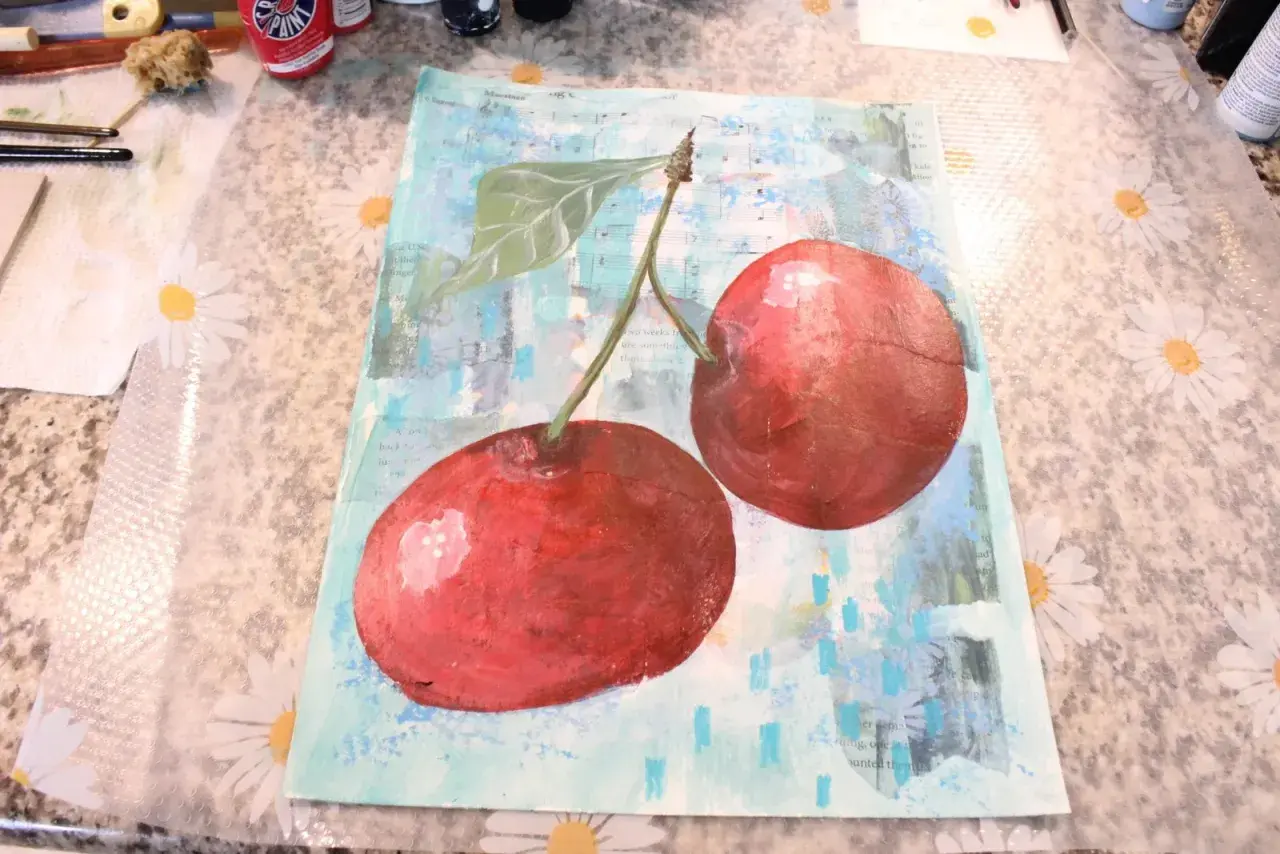
The overlap between collage and painting creates a surface that can feel immediate, tactile, and surprisingly durable when the materials are chosen well. In this article I focus on the practical side: support selection, adhesives, paint behavior, drying time, finishing, and the conservation issues that matter once paper, fabric, or found images enter the composition. I also show where the technique succeeds, where it fails, and why the best results usually come from a few disciplined choices rather than from piling on more material.
The practical takeaways at a glance
- Use acid-free paper or rigid archival panels when the collage becomes part of the structure, not just a decorative layer.
- Reach for tested acrylic gels, mediums, or other archival adhesives instead of craft glues that dry brittle or unpredictable.
- Let each layer set fully before adding the next; thick acrylic passages can need at least 48 hours before final varnish.
- Keep the image readable by alternating opaque passages, thin glazes, and dry textures rather than flooding the surface with liquid.
- For storage, stay below 50% relative humidity when possible and avoid direct pressure on raised elements.
- Surface testing on scraps is not optional if you want predictable drying, sheen, and adhesion.
Where collage and painting meet
When I think about this hybrid language, I do not think of collage as an accessory to paint. I think of it as a second logic inside the same work: one part image, one part object. That is why the strongest pieces often feel physically convincing even before you read them conceptually. The torn edge, the pasted scrap, the overpainted photograph, and the brushed field all do different jobs at once.
The Met’s discussion of Robert Rauschenberg’s Combines is useful here because it shows how found materials can stop behaving like mere illustration and start acting like structure. Matisse’s cut-outs point in another direction: he cut painted paper into forms, then arranged and mounted them so that color, shape, and support became inseparable. Those examples still matter because they prove a practical point, not just a historical one: the material system has to be designed as carefully as the image.
That is the real appeal of the method. It lets me build depth without relying on illusion alone, and it lets texture carry meaning instead of functioning as decoration. Once that is clear, the next question is not style but compatibility.
Choose supports, papers, and adhesives that stay compatible
If a mixed-media work is going to last, I start by deciding how much physical stress the surface will hold. Lightweight paper can work beautifully, but it changes quickly when it gets wet. Heavy collage, fabric, or dimensional fragments usually belong on something more rigid. In practice, I prefer a support that resists warping before I decide how bold the surface treatment should be.
| Material | Best use | Why I choose it | Main caution |
|---|---|---|---|
| Heavy cotton rag paper | Light collage, drawing, acrylic washes, gouache | Stable, absorbent, and familiar to work on | Too much liquid can cause cockling and edge lift |
| Archival board | Flat collage with moderate paint layers | More rigid than flexible paper, easier to frame | Needs clean priming and careful sealing |
| Cradled wood panel | Heavier collage, sanded texture, repeated reworking | Strong support with less movement over time | Unsealed wood and poor priming can create staining |
| Stretched canvas | Large, lighter collage with gestural paint | Flexible and lightweight for big formats | Too much paper weight or paste can stress the stretch |
| Acrylic gel or medium | Bonding paper, building low relief, glazing | Clear, flexible, and dependable for many studio applications | Sheen and drying behavior should be tested first |
For paper elements, I want an adhesive that grips without becoming brittle. For that reason, acrylic gels and mediums are often my first choice for paper collage on painted ground, while other archival adhesives make sense when paper is the dominant structure. The Smithsonian conservators who work with modern and contemporary art have made the underlying problem plain: different materials change at different rates, so the surface can fail if the support system is careless.
That is why I keep the material list short. Every extra product adds another variable, and every variable makes long-term behavior harder to predict. Once the material set is under control, the workflow becomes much easier to manage.
Build the surface in the right order
The most common mistake I see is a good idea executed in the wrong sequence. Artists rush the adhesive, flood the paper, or paint over a section before the first layer has actually stabilized. The result is often not a dramatic failure at once, but a surface that slowly loses clarity and adhesion.
- Prime or seal the support first. I want a surface that does not drink moisture unevenly or stain the collage layer from below.
- Sort collage pieces by absorbency and thickness. Thin paper, magazine fragments, fabric, and printed matter do not behave the same way, so I treat them separately.
- Place the largest structural fragments first. These are the pieces that set the composition. Smaller scraps and painted accents can respond to them later.
- Apply adhesive sparingly and evenly. A thin, consistent layer usually holds better than a heavy one that soaks the paper.
- Press, dry, and inspect before overpainting. I look for lifted corners, trapped air, and areas that still read wet under the surface.
- Paint from thin to thick unless the medium demands otherwise. Acrylic dries quickly, but dry-to-touch is not the same as fully cured. Thick passages need patience.
When I need more open time for blending, I extend it with a compatible medium rather than drowning the surface in water. That keeps the collage layer from swelling and reduces the risk of staining or delamination. For acrylic-heavy work, I also respect the cure time before any final coating: thick passages can need at least 48 hours, and sometimes longer if the studio is humid or the application is dense.
The order matters because it keeps the piece legible. If every layer is trying to do the same job, the surface turns muddy. If each layer has a distinct role, the work gains depth without losing control. That brings us to the failures I see most often.
The mistakes that cause lifting, cracking, and muddy color
Too much moisture too early
Paper is the first thing to betray impatience. If I soak a collage element with adhesive or watery paint, it expands, buckles, and can pull away from the support as it dries. The fix is simple, although not always easy in the moment: use less liquid, work in smaller zones, and allow partial drying between passes.
Weak or incompatible adhesives
Craft glues can look fine on day one and fail later by yellowing, embrittling, or losing grip. I avoid any adhesive that I would not trust to behave consistently under stress. A collage piece can survive a bad color choice; it rarely survives a bond that starts to fail at the edges.
Painting over every fragment
Some artists cover the collage so completely that the material structure disappears. That can work if the goal is a unified painted field, but it defeats the point if the cut edge, print, or fiber is supposed to remain visible. I usually leave some fragments untreated so the eye can still feel the difference between pasted surface and brushed passage.
Ignoring sheen and transparency
Glossy adhesive, matte paper, and semi-opaque paint can create patchy reflections that read as accidental rather than intentional. I test the finish on scraps because sheen changes the way a work reads in real light. What looks rich on the bench can turn muddy under gallery lighting if the surface values were never checked.
Read Also: Giclée Meaning Explained - What Makes a True Fine Art Print?
Varnishing before the work has stabilized
With acrylic surfaces, premature varnish is a problem because moisture can still be trapped below the skin. Golden’s varnish guidance is explicit that an isolation coat is meant for acrylic paintings and that it should be tested carefully, because it is permanent and changes surface qualities. I treat that as a reminder to slow down, not as a decorative option to be added automatically.
When these mistakes are avoided, the surface becomes much easier to live with. The final challenge is not making the piece look finished; it is making sure the finish survives handling and display.
Protect the work once the image is finished
Mixed-media surfaces need more care than a simple flat painting because they carry physical relief. The raised edge of a pasted paper scrap, a fabric seam, or a textured paint ridge can be damaged by pressure long before the color itself fades. If I know the piece will be framed, stored, shipped, or exhibited, I think about that from the start rather than as an afterthought.
| Condition | What I do | Why it helps |
|---|---|---|
| Flat paper-based work | Mat it with acid-free materials and keep it off the glazing with spacers | Reduces abrasion and protects fragile collage edges |
| Raised or dimensional surface | Use a deeper frame or shadowbox | Prevents the surface from touching glass or being crushed |
| Storage | Keep it in acid-free folders, mats, or boxes in a clean, dust-free space | Limits dust, pollutants, and accidental abrasion |
| Humidity | Aim for under 50% relative humidity and avoid swings above 60% | Helps slow deterioration and reduces distortion in paper |
| Temperature | Keep conditions cool and steady; 21°C is a practical upper limit in many settings | Slows deterioration without making handling unsafe |
| Light | Restrict exposure, especially for sensitive papers and photos | Protects color, binder, and paper fibers from photochemical damage |
Those numbers are not abstract museum habits; they are the difference between a surface that stays readable and one that fades, curls, or becomes brittle too quickly. For sensitive works, 50 lux is a sensible light target, and direct sunlight is simply not worth the risk. If the piece includes photographs, delicate paper, or flaking paint, I become even more conservative.
One more practical point: if you use acrylic and want a varnished finish, test the surface first and understand that an isolation coat changes the look even when it protects the piece. I would rather accept a slightly less glossy surface than create a future conservation problem that no one asked for. From there, the last step is deciding what I want to document before the work leaves the studio.
What I check before I call the piece finished
Before I consider a mixed-media painting complete, I do three things every time: I look at it under raking light, I test the most vulnerable edges with a clean fingertip, and I record the materials on the back. That last step sounds minor, but it matters later if the work is framed, sold, authenticated, or conserved. A future conservator can make much better decisions when the support, adhesive, and paint system are known instead of guessed.
I also keep one principle in mind: the strongest pieces are rarely the most overloaded. They are the ones where each fragment still belongs to the same physical system, so the work can survive handling, framing, and time without losing the tension that made it compelling in the first place.
