
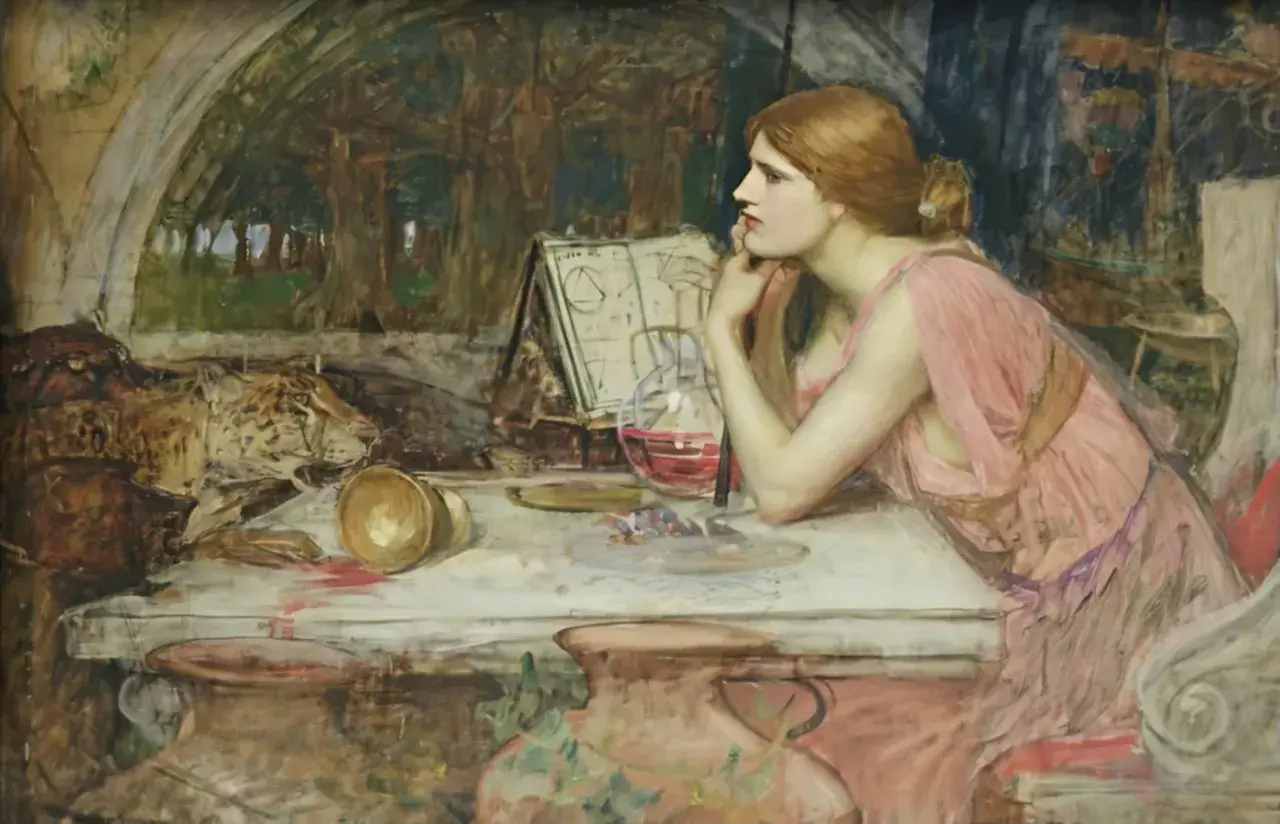
A painting of Circe is rarely just a mythological illustration. It usually combines seduction, punishment, metamorphosis, and isolation in a single image, which is why the best examples reward slow looking rather than a quick glance. In this article, I focus on the visual clues that identify the subject, the symbols that shape its meaning, and the practical details that help you read the scene with more confidence.
The core clues that define a Circe scene
- Circe usually comes from Homer’s Odyssey, though later painters often borrow extra meaning from Ovid.
- The most reliable markers are the cup, wand or staff, transformed animals, and a coastal or island setting.
- Her symbolism often shifts between temptation, control, dangerous knowledge, and female autonomy.
- Late Victorian and Symbolist painters use Circe to stage moral tension as much as myth.
- For attribution and conservation, the title, palette, and surface condition matter as much as the subject.
What the myth gives the image painter to work with
Circe is one of those classical figures whose story can be frozen at several different moments, and each choice changes the whole reading. In Homer, she is the enchantress who turns Odysseus’ men into swine and keeps the hero on her island; in later retellings, especially Ovid, she also becomes a figure of jealousy, rejection, and revenge. That matters because an artist is not simply illustrating a myth, but deciding which emotional register to emphasize: seduction, threat, punishment, or self-possession.
I usually start by asking a simple question: is the painting about what Circe does to others, or about what others fear in her? That distinction separates a narrative scene from a psychological portrait, and it often tells you more than the title alone. Once that is clear, the symbolic language in the image becomes much easier to decode.

How to read a Circe painting through its symbols
When I look at a Circe image, I look first for the objects that carry the story without words. A single cup, a staff, or an animal can do a lot of work, but the strongest paintings stack several signs together so that the subject becomes unmistakable.
| Motif | What it usually signals | What I look for |
|---|---|---|
| Cup, bowl, or vessel | Potion, temptation, ritual, or hidden intention | Whether the object is offered, withheld, or already in use |
| Wand or staff | Spell-casting and controlled transformation | Whether the figure directs the wand toward people, water, or animals |
| Animals, especially pigs | Transformed men, instinct, or civilization undone | Whether the animals feel comic, tragic, or threatening |
| Coast, island, or open sea | Liminal space between human order and the unknown | Whether the setting feels inviting, hostile, or uncanny |
| Fixed gaze and upright posture | Authority, refusal, or calculated command | Whether Circe is shown as hostess, judge, or sovereign |
The key point is that these symbols rarely work in isolation. A cup by itself can read as hospitality; animals by themselves can read as decorative nature. The subject becomes Circe when the objects, pose, and setting all point in the same direction. That is why iconography matters so much in mythological painting: it keeps the image from drifting into generic fantasy.
Why artists keep returning to her
Circe is durable because she can carry contradictory meanings without breaking. In late nineteenth-century painting, she often becomes a femme fatale, but that label only explains part of the attraction. Artists also use her to stage the tension between knowledge and danger, between female authority and male anxiety, and between beauty and destruction.
For a painter working in the Pre-Raphaelite or Symbolist mode, Circe offers something unusually rich: a classical subject that can be drenched in mood. She lets color become moral language. She lets landscape become psychology. And she lets the figure herself remain ambiguous enough to be interpreted as seductive, cruel, wounded, or wholly self-possessed. I think that ambiguity is the real reason the motif stays alive.
The same flexibility also explains why different viewers walk away with different impressions. One person sees a warning about temptation. Another sees a woman who has learned how to defend her own space. Both readings can be supported by the right visual choices, which is why the next step is to look at the most common scene types.
The main scene types and what each one emphasizes
Most Circe paintings fall into a few recognizable narrative patterns. Each one highlights a different part of the myth, and each one changes the symbolism in a subtle but important way.
| Scene type | Visual cues | Symbolic emphasis | Why it matters |
|---|---|---|---|
| Offering the cup to Odysseus or Ulysses | Seated or standing Circe, a vessel, a tense visitor, often a richly staged interior or terrace | Temptation, test, controlled hospitality | Shows Circe as both host and threat, which is one of the oldest ways the myth is visualized |
| Transformation of men into animals | Startled bodies, animal forms, gesture-heavy action | Metamorphosis, humiliation, loss of human status | Pushes the scene toward drama and moral punishment |
| Poisoning or revenge against Scylla | Watery setting, green or acid tones, isolated figure near the sea | Jealousy, retaliation, destructive intelligence | Moves Circe away from seductress stereotypes and into a colder, more calculated register |
| Portrait-like Circe among animals | Figure-centered composition, little narrative action, lions or other beasts nearby | Power, sovereignty, enchanted stillness | Lets the artist present her as a symbolic presence rather than a scene from a story |
What changes when color becomes part of the myth
Color does more than make a Circe painting beautiful. It often tells you how the artist wants the myth to feel. Green can suggest poison, envy, or corruption, but that reading depends on the surrounding palette; if the green is set against milky water or a drained sky, it becomes even more unsettling. Red tends to sharpen the sense of danger and appetite, while gold can push the figure toward divinity, luxury, or dangerous allure.
The Art Gallery of South Australia describes Waterhouse’s Circe Invidiosa as a scorned witch poisoning the sea, and that description is useful because the painting’s aquamarine water is not neutral background color. It is part of the meaning. The elongated format, the watery surface, and the unnatural chromatic balance all create a world that feels displaced from ordinary reality. In other words, color is not decorative here; it is the atmosphere of the myth itself.
That is also why later cleanings or harsh varnish removal can matter so much in this kind of work. If a poisoned green has been dulled into brown or the contrasts have collapsed, the symbolic reading becomes weaker even when the image survives physically intact.
What I check when a Circe work needs attribution or conservation context
When a Circe-related painting comes up in a collection, I do not trust the subject title alone. Mythological images are frequently copied, adapted, or retitled, and the same story can be painted in ways that look similar at a distance but are very different in value and authorship.
- Title and scene - “Circe,” “Circe and Odysseus,” and “Circe Invidiosa” point to different mythic moments, so the title should match the visual evidence.
- Palette and varnish - If the palette has shifted under age or cleaning, the emotional reading can change dramatically, especially in works that rely on green, blue, or gold contrasts.
- Surface handling - Glazing, fine detail, and soft transitions are common in mythological painting; abrasion can make a sophisticated work look flat or later than it is.
- Composition - Original paintings usually organize the figure, animals, and setting with more precision than decorative reproductions do.
- Iconographic completeness - A single animal or vessel is not enough on its own; I want to see whether the whole composition supports the Circe identification.
The Smithsonian American Art Museum records Frederick Stuart Church’s Circe with subjects that include a lion, a coastal landscape, and a siren reference, which shows how layered these works can be even when the title is short. That is the sort of detail I like to check before I make any confident claim about attribution, because iconography and physical evidence should support one another, not compete.
Why this motif still rewards a close look
Circe remains compelling because she lets an artist hold several tensions in one image: beauty and threat, hospitality and coercion, knowledge and punishment, solitude and authority. A strong painting does not flatten those tensions into a simple moral lesson. It lets them coexist in posture, lighting, and the relationship between the figure and the space around her.
For a reader, that means the best way to approach the subject is slowly. Start with the mythic scene, then test the symbols, then ask how the artist uses color and composition to steer interpretation. When those layers align, the painting becomes more than a literary reference; it becomes a visual argument about power and transformation. And if one layer feels off, that is often the clue that the work is paraphrasing Circe rather than fully speaking her language.
