
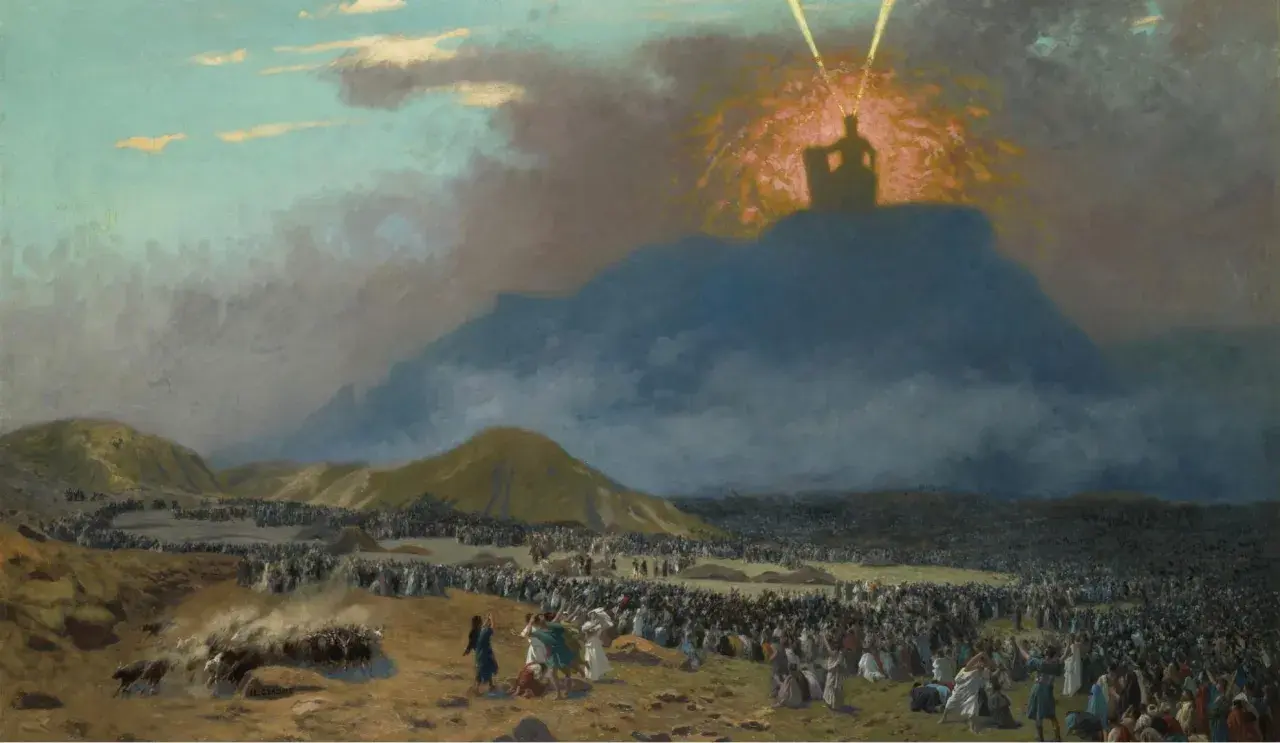
A Moses on Mount Sinai painting is rarely just a biblical illustration. It turns revelation into visible form: stone tablets, blinding light, weather, and human scale all have to carry the weight of divine law. In this guide, I focus on the iconography and symbolism that make the scene readable, plus the practical clues I use when judging whether a work feels historically convincing.
What matters most in a Sinai scene is how artists make revelation look real
- The subject is about covenant and authority, not just a mountain landscape.
- Tablets, light, cloud, and scale do most of the visual work.
- Horns or twin rays usually signal radiance in Western art, not literal anatomy.
- Older works often use a scroll or God’s hand; later works favor the tablets and a more dramatic summit.
- For identification and attribution, subject matter matters less than period-specific iconography, medium, and provenance.
What the Sinai scene really communicates
The biblical event is a theophany, which simply means a visible manifestation of divine presence. That matters because painters are not depicting a normal exchange of objects; they are trying to make invisible authority feel tangible. In the best versions, the mountain is not scenery. It is a threshold between heaven and the people below.
I usually read the composition as a hierarchy: revelation above, mediation in the middle, human response below. Moses stands where that pressure is highest, because he is the one who receives the law and brings it back to the camp. If the artist includes the golden calf, or even a hint of the crowd below, the painting is doing more than telling a story. It is contrasting obedience with idolatry in the same frame.
That is why these paintings often feel tense rather than triumphant. The scene is about obligation as much as revelation. Once you see that, the repeated visual symbols start to make sense.
The symbols that carry the story

Iconography is the visual vocabulary of a subject, and symbolism is the meaning that vocabulary carries. In Sinai paintings, a few details do most of the work, and they are worth reading carefully rather than casually. The table below is the fastest way I know to decode them.
| Visual detail | Common meaning | What I check |
|---|---|---|
| Stone tablets | Divine law, covenant, permanence | Whether they are blank, inscribed, broken, or held like an offering |
| Light, fire, smoke, or cloud | The presence of God and the danger of holiness | Whether the light has a source, or whether it is deliberately supernatural |
| Mountain peak | Ascent, separation, revelation | Whether the mountain is realistic or reduced to a steep visual shorthand |
| Horns or twin rays on Moses | Radiance and authority in Western art | Whether the feature belongs to the descent scene, not just the receiving scene |
| Staff or rod | Leadership, miracle-working, continuity with the Exodus narrative | Whether the artist is combining several Moses episodes in one image |
| Golden calf or anxious crowd below | Idolatry, human failure, moral contrast | How strongly the lower half of the painting pushes against the revelation above |
| Scroll instead of tablets | Earlier or more schematic visual tradition | Whether the work belongs to manuscript culture or an older narrative convention |
One convention deserves special caution: the horned or radiant Moses. The Fitzwilliam Museum has a useful way of framing this issue in its Moses material, and the short version is simple: what looks like literal horns often belongs to a long Western tradition of reading Moses as visibly marked by divine radiance. In many later works, those horns are softened into twin beams of light. I would not read them as anatomy; I would read them as glory.
Another detail people miss is the scroll. In older Christian art, Moses is sometimes shown receiving a scroll or holding one in place of the tablets. That is not a mistake. It is an earlier visual shorthand for revealed law, before the stone tablets became the dominant symbol. Once you understand that, even the most compact medieval scene becomes much easier to interpret.
Why artists do not paint Moses the same way
The same subject changes shape depending on the period, the viewer, and the artist’s theological goal. A medieval illustrator, a Baroque painter, and a modern Jewish artist are not trying to solve the same problem, even when they all paint the summit of Sinai.
| Period | Typical visual language | What it emphasizes | Why it matters |
|---|---|---|---|
| Early medieval and manuscript art | Schematic mountain, small figures, God’s hand, scrolls | Revelation as authority and text | The image functions like a visual gloss rather than a theatrical scene |
| Renaissance and Baroque | Monumental figures, dramatic diagonals, intense light, crowd below | Drama, typology, and emotional force | The composition turns the mountain into a stage for law and crisis |
| 19th-century academic painting | Epic landscape, polished anatomy, atmospheric spectacle | The sublime and the historical imagination | The setting becomes as important as Moses himself |
| Modern Jewish art | Expressive color, abstraction, floating symbolism | Memory, identity, and covenant | The scene becomes personal and symbolic rather than strictly literal |
Michael Wolgemut’s 1493 woodcut is a good reminder that early prints often used clear narrative shorthand rather than atmospheric drama. By contrast, Tintoretto’s 1563 treatment stretches the scene vertically, with an ecstatic Moses at the luminous top, cloud in the middle, and the golden calf darkening the bottom. That vertical split is not decoration. It is the moral logic of the image made visible.
At the other end of the timeline, Jean-Leon Gerome pushes the scene toward monumentality and spectacle, which is exactly what 19th-century academic painting often does with biblical history. The mountain becomes a theater of scale, light, and distance. And in modern Jewish art, Marc Chagall’s 1966 lithograph keeps the subject alive without relying on literal realism. It is a reminder that the scene can remain legible even when the style becomes lyrical or symbolic.
That range is why I never judge a Sinai painting by one isolated detail. I judge it by the visual language of its period, because that language tells me what the artist thought the scene was for.
How I read a specific painting in practice
When I look at a Sinai image in a museum, gallery, or private collection, I start with a simple question: does the composition make revelation believable? The answer usually comes from five checks.
- Find the source of light. If the glow comes from above, from the tablets, or from Moses himself, the artist is assigning divine weight to the scene.
- Decide which moment is shown. Is Moses receiving the law, descending with it, or being shown in both moments at once? Many paintings blend these stages, and that blending changes the meaning.
- Read Moses’s body language. A raised arm, turned torso, bowed head, or defensive grip on the tablets tells you whether the emphasis is awe, obedience, anger, or burden.
- Check for narrative compression. If the golden calf, the crowd, the tablets, and the shining face all appear together, the artist is collapsing Exodus into a single moral image.
- Separate subject from object. A famous subject does not make a work authentic. Medium, support, brushwork, inscriptions, and provenance matter far more than the biblical title on the label.
That last point is especially important in the U.S. market, where biblical imagery gets reproduced constantly. A devotional print, a later studio version, and an old-master painting can all show the same subject while belonging to completely different categories of object. If the iconography feels wrong for the claimed date, I treat that as a real clue, not a footnote.
I also pay attention to whether the work feels over-illustrated. A strong Sinai painting leaves some tension in place. A weak one often turns the subject into generic religious scenery, with clouds, glow, and tablets added simply because they are expected.
Why the Sinai image still matters in American collections
In the United States, this subject usually reads as more than a biblical episode. It also carries ideas about law, memory, and public morality, which is why it appears comfortably in churches, museums, and civic spaces. The scene can speak to Jewish viewers, Christian viewers, and secular viewers at the same time, but for different reasons.
What keeps it alive is the balance of forces inside the image. Moses is elevated, but not detached. The law is absolute, but not abstract. The mountain is remote, but it is still bound to human failure below. When a painting gets that balance right, it does not feel like a relic. It feels like a visual argument about responsibility.
If I had to reduce the whole subject to one test, it would be this: does the painting make revelation look costly? If it does, the work probably understands Mount Sinai well. If it does not, then it may still be decorative, but it has missed the central drama of the scene.
