
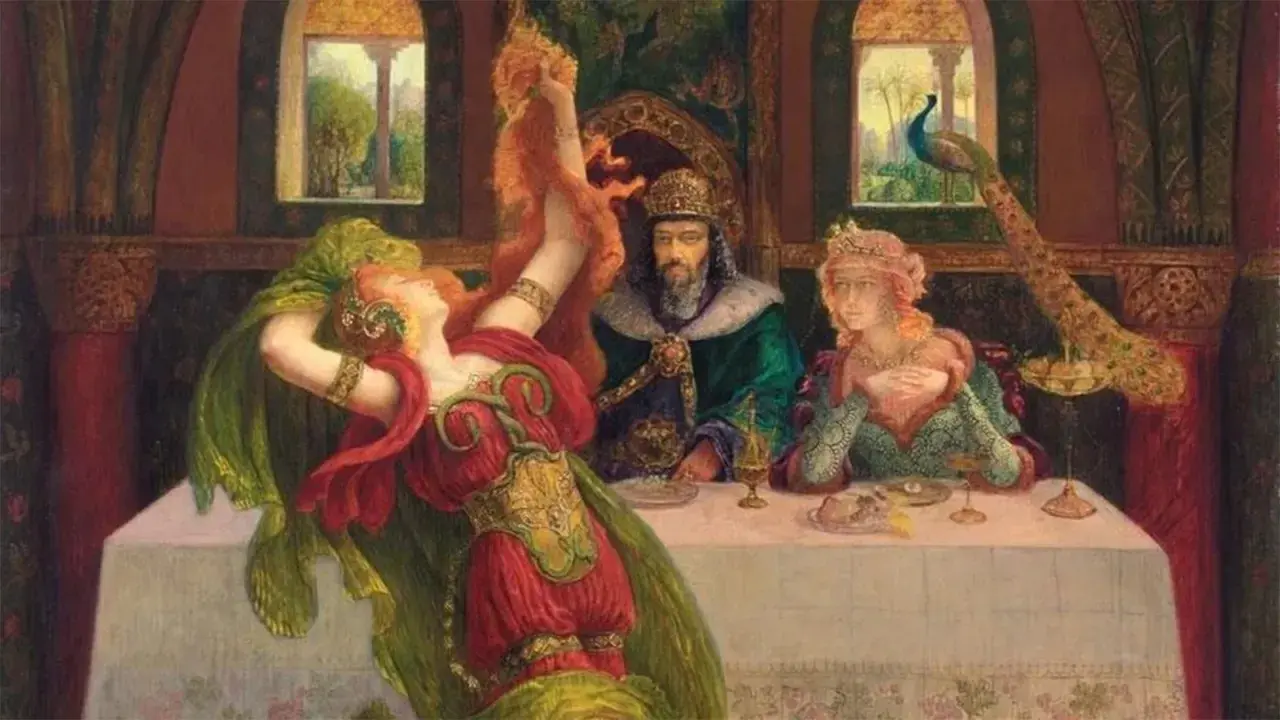
The image of Salome dancing before Herod survives because it compresses a complete drama into one charged moment: performance, power, seduction, and violence. In art history, the subject is never just a biblical illustration; it becomes a way to test how artists portray the female body, moral tension, and the gaze of authority. Here I focus on the iconography, the symbolic language, and the visual choices that turn a brief Gospel scene into one of the most persistent images in Western art.
What this scene reveals at a glance
- The biblical text is spare, so artists supply the costume, choreography, and mood themselves.
- Medieval images often make Salome an acrobat, not a graceful court dancer, to signal instability and danger.
- Symbolist art turns her into a figure of desire, ritual, and fatal beauty rather than a literal historical performer.
- Objects matter: the platter, veil, throne, jewels, and flowers carry most of the meaning.
- For museum viewers and researchers, the chosen moment in the story is often more revealing than the title.
What the biblical scene actually shows
The New Testament version is deliberately sparse. In Mark and Matthew, the girl is Herodias’s daughter, not named Salome in the text, and the dance itself is never described in any detail. The story gives us the chain of events, not the choreography: she dances, Herod is pleased, a promise is made, the mother intervenes, and John the Baptist’s head is demanded.
That sparseness is the reason the subject became so visually fertile. Once the text withholds the costume, the music, and the steps, artists are forced to decide what kind of event this is. Is it court entertainment, a trap, a ritual performance, or the first visible sign of violence? I read that choice as the real iconographic core of the subject.
- Herod watches, which turns the scene into a performance under authority.
- Herodias intervenes, which makes the moment politically charged rather than merely erotic.
- John’s execution follows, which gives the dance its moral and narrative weight.
Because the biblical account is so compact, the image can swing from warning to spectacle without changing the underlying story, and that flexibility is what the next centuries exploited.
Why medieval artists made Salome an acrobat
In medieval art, Salome is often not shown as a refined court dancer but as an acrobat, sometimes balancing on her hands or folding her body backward into a near-impossible pose. That visual choice is not decorative. It turns motion into a moral signal. An exaggerated body suggests an unstable soul, and an unstable soul, in this context, helps explain how a feast becomes a murder scene.
Medieval viewers would have recognized this kind of body from jugglers, acrobats, and festive performers, so the image works on two levels at once. It is entertainment, but it is also a warning. The point is not realism; the point is to make the dance look socially and spiritually suspect. I would call that a visual shorthand for temptation under pressure.
This is also why the medieval Salome often feels harsher than the later literary Salome. The focus is less on erotic allure and more on the danger of disorder. That shift sets up the larger transformation that happens in Renaissance, Baroque, and Symbolist art.
How the image shifts from warning to desire
Once the subject moves beyond the Middle Ages, artists start emphasizing different parts of the story. The same biblical episode can read as cautionary morality, courtly drama, decadent fantasy, or psychological theater. The Metropolitan Museum of Art describes Symbolist art as a place where figures from biblical stories become part of dream worlds, and Salome becomes one of its most useful female emblems.
| Period | What artists emphasize | Typical visual cues | What the image is really doing |
|---|---|---|---|
| Medieval | Moral warning and bodily instability | Handstands, backbends, banquet settings, clear narrative sequence | Shows dance as a dangerous force that disturbs order |
| Renaissance and Baroque | Court drama and emotional consequence | Throne rooms, attendants, stronger naturalism, the platter or head | Balances spectacle with the fallout of the promise |
| Symbolist and fin-de-siècle | Desire, ritual, and fatal beauty | Heavy ornament, stillness, jewel-like surfaces, exotic architecture | Turns the dancer into a psychological and symbolic figure |
| Modern stage and film | Performance as unveiling | Veils, spotlight choreography, heightened sensuality | Makes the dance itself the center of the drama |
The important thing is that none of these versions is “more correct” in a simple sense. They are different readings of the same textual gap. The scene keeps attracting artists because it lets them project their own anxieties about sexuality, authority, and spectacle onto a story that never fully explains itself.
How Moreau turned the banquet into Symbolist theater
Gustave Moreau’s Salome Dancing before Herod is the decisive shift from biblical narrative to Symbolist image. The Hammer Museum notes that Moreau painted the work between 1874 and 1876 and that it caused a sensation at the Salon of 1876. That matters because the painting was not just admired for its finish, but for the way it staged Salome as a mystery rather than an illustration.
What I find most striking is the stillness. Moreau does not give us a dancer in motion so much as a figure frozen into ritual. The body is ornate, the setting is dense, and the whole composition feels overdetermined in the best Symbolist sense. Every surface seems to mean something. Even the architectural fantasy, which mixes references into an imagined court, pushes the image away from historical reconstruction and toward symbolic invention.
Moreau also built the composition through studies, variants, and related drawings, which is useful not only for art history but for connoisseurship. When you can see the preparatory layers, you can trace how the pose, the placement of the figures, and the decorative elements were refined. That paper trail tells us the symbolism was constructed deliberately, not added as afterthought.
In practical terms, Moreau is not asking the viewer to follow a plot. He is asking the viewer to read atmosphere. That is why his version became so influential: it turns Salome into a symbolic center of gravity instead of a narrative accessory.
The symbols that carry the scene
When I read Salome images, I usually start with objects, because the objects do most of the interpretive work. The face may be beautiful, but the symbols tell you how the artist wants beauty to be understood.
| Symbol | What it usually suggests | Why it matters |
|---|---|---|
| The platter or charger | Violence already waiting at the end of the dance | It links performance to consequence before the beheading is even shown |
| Jewels and heavy ornament | Surface, luxury, seduction, and distraction | They make the body read as constructed image rather than natural portrait |
| The throne | Political authority and judgment | Her performance happens before power, not in private |
| Veils or layered fabric | Concealment and revelation | They turn the body into a sequence of withheld meanings |
| A lotus or stylized flower | Symbolic distance and imagined exoticism | In Moreau, I read it as a marker of ritualized otherness, not literal costume accuracy |
| Mixed architectural references | An invented sacred or imperial world | They signal that the setting is psychological and symbolic, not documentary |
| The absent head | Suspense and withheld climax | When the head is missing, the image dwells on anticipation rather than resolution |
These symbols work best when artists do not overload them. A strong Salome image usually chooses a few signs and lets them resonate. Too many literal details flatten the scene; too few and the picture stops reading as Salome at all. The balance between clarity and ambiguity is where the subject becomes compelling.
How I would read or authenticate a Salome image in a collection
For a museum label, catalog entry, or attribution file, I would not start with the title alone. I would start with the visual grammar. Different versions of the subject belong to different traditions, and the differences are legible if you know where to look.
- Check the moment shown. Dance, promise, request, beheading, and presentation of the head are not interchangeable scenes.
- Check the pose. An acrobatic body points toward medieval moralizing traditions, while a poised and ornamented body usually points toward later Symbolist or decorative readings.
- Check the object set. Platter, veil, flower, throne, and architectural fantasy all steer interpretation in different directions.
- Check the medium and technique. Oil painting, manuscript illumination, print, and stage design each solve the scene differently.
- Check the preparatory material. Studies, altered outlines, and related drawings can reveal how the artist built the iconography.
- Check the title history. Some works were named or renamed later, which can distort how they are understood now.
This is where iconography and authentication meet. A work is rarely understood correctly if its imagery is read without attention to process. In Salome images especially, the chosen pose, the supporting symbols, and the surviving studies often tell you more than the finished surface alone.
Why the image still unsettles viewers
Salome remains unsettling because the story sits at the intersection of desire and punishment. Artists can make her look guilty, powerful, tragic, ritualistic, or almost sacred, and each choice changes the moral temperature of the image. That is why the subject never really goes stale. It still offers a way to talk about the gaze, female agency, performance under surveillance, and the moment when beauty becomes dangerous.
If I were standing in front of a Salome image today, I would ask three questions: what moment is chosen, what does the body communicate, and what symbol is carrying the real meaning of the scene? Those questions are usually enough to separate a literal Bible illustration from a medieval warning, a Symbolist fantasy, or a modern erotic invention. That distinction is the key to reading the subject well, and it is the reason the image continues to matter in art history.
