
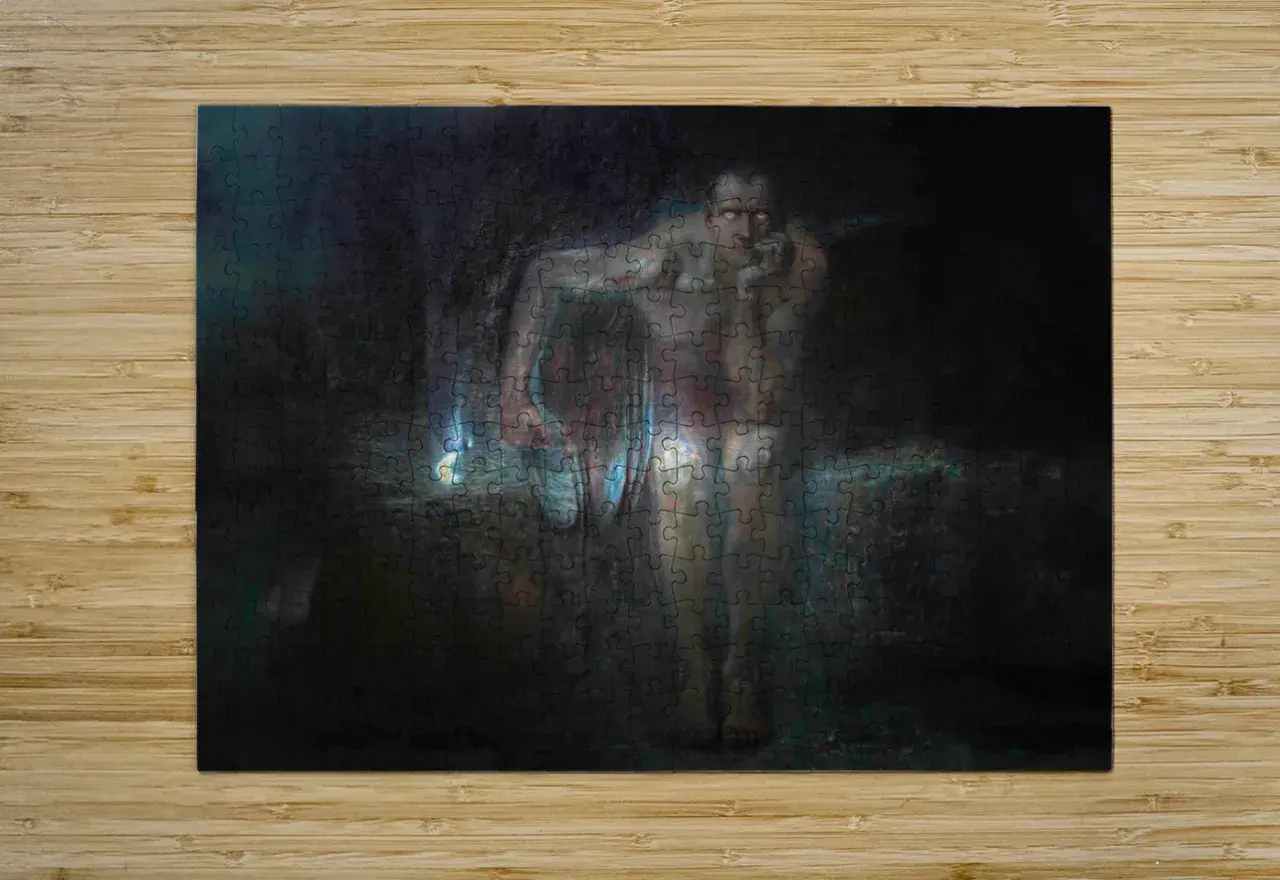
Franz von Stuck’s Lucifer is not a simple image of evil. It is a Symbolist portrait of a fallen angel that relies on posture, darkness, and restraint more than spectacle, which is why it still feels psychologically sharp. This article breaks down the painting’s iconography, explains how the symbols work together, and shows why the work matters both as an art-historical statement and as a carefully constructed visual object.
What the painting asks you to read first
- The figure is seated, frontal, and tense, so the image feels like a confrontation rather than a scene from a story.
- Black wings, a bare body, and a dark void turn Lucifer into a fallen angel, not a theatrical monster.
- The small light source is the key symbol: it can suggest revelation, heaven, or the residue of divinity.
- The work belongs to Symbolism, where mood and metaphor matter more than literal narrative.
- Its meaning becomes clearer when you place it beside The Guardian of Paradise, which Stuck intended as a dramatic counterpart.
What Stuck shows before the symbolism takes over
The National Gallery in Sofia lists the canvas at 161 x 152.5 cm and dates it to 1890-1891. That scale matters more than most people realize: the figure is close to life-sized, so Lucifer does not feel like a small emblem tucked into a corner. He occupies the viewer’s space.
Stuck strips the scene down to its essentials. There is no architectural setting, no narrative crowd, and no obvious moment of action. Instead, we get a seated naked man with wings, a fixed stare, and a compressed field of darkness. The result is less a story illustration than a visual confrontation.
| Visible feature | Immediate effect | Why it matters |
|---|---|---|
| Seated posture | Stillness and suspension | Removes the image from conventional action and pushes it toward reflection |
| Direct gaze | Intense viewer contact | Makes Lucifer feel conscious of being seen |
| Black wings | Preserved otherness | Signals a fallen angel rather than an ordinary human figure |
| Undefined dark background | No stable location | Turns the scene into a symbolic space instead of a literal one |
Once the basic structure is clear, the real work begins in the lighting, because Stuck uses illumination to split the figure emotionally as much as visually.
Why light and darkness do the heavy lifting
The painting’s title is already doing symbolic work. Europeana notes that lucifer literally means “morning star,” and that older meaning matters here because Stuck does not present darkness as total absence. He gives Lucifer a faint, almost phosphorescent light source to his right, which keeps the figure suspended between revelation and concealment.
I read that light as deliberately unstable. It can suggest divine truth, heavenly memory, or the last trace of Lucifer’s original radiance, but Stuck does not pin it down to one meaning. That ambiguity is central to the painting’s power. The light reveals the body while also refusing to redeem it, which is exactly the kind of tension Symbolist art likes to hold open.
The darkness around Lucifer is just as active. It does not simply describe Hell. It functions like a psychological field, making the figure feel inward, isolated, and closed off from the world outside the canvas. That is why the painting feels so modern: the moral drama is also an interior one.
With the light doing that much interpretive work, the figure’s pose becomes even more important, because Stuck uses body language to turn symbolism into thought.
Why the pose feels like thought rather than punishment
Lucifer does not collapse in agony. He sits, leans, and watches. His head rests on one hand, his body remains compact, and the wings are held in a way that suggests control rather than collapse. I would call that restraint one of the painting’s smartest choices, because it keeps Lucifer from becoming a melodramatic devil figure.
The pose has often been linked to Rodin’s The Thinker, and that comparison is useful even if one treats it cautiously. Stuck is not borrowing sculpture for the sake of imitation; he is adopting a modern visual language of introspection. The demon is not roaring outward. He is thinking inward.
That inwardness changes the moral tone of the image. A theatrical devil announces himself. Stuck’s Lucifer seems to contemplate his own condition, and that makes the figure more unsettling, not less. He feels self-aware, which is a far more disturbing kind of power.
Once you see the pose as psychological rather than merely descriptive, the whole painting starts to read as a Symbolist construction rather than a biblical illustration.
How Symbolism turns a biblical figure into a psychological image
Stuck’s preferred subjects came from mythology and religion, but he rarely treated them as simple narrative scenes. In the Symbolist mode, myth becomes a way to externalize desire, anxiety, pride, and spiritual fracture. Lucifer is therefore not only a named figure from Christian tradition. He is a visual idea about fall, consciousness, and self-possession.
That is why the painting’s iconography feels pared back but exact. A bare body suggests primal truth and vulnerability. Wings confirm celestial origin. The dark void removes the figure from history. The direct gaze turns the viewer into a participant rather than a spectator. Each element does symbolic work, and together they create a modern demon who is more psychological than grotesque.
| Symbol | Traditional association | Stuck’s effect |
|---|---|---|
| Nudity | Truth, innocence, exposure | Strips the figure of costume and makes the fall feel primordial |
| Wings | Angelhood, transcendence | Keep the figure tied to heaven even as he is cast out |
| Dark background | Night, exile, the unknown | Turns space into a mental and moral state |
| Light source | Truth, judgment, divine presence | Creates tension instead of resolution |
Seen this way, the painting is not trying to explain evil in a doctrinal sense. It is staging the condition of a being who remains powerful, self-aware, and estranged. That is a very different claim, and it leads directly to Stuck’s broader Symbolist context.
What the Munich Symbolist context adds to the image
Franz von Stuck was a co-founder of the Munich Secession, and that matters because the movement rejected academic stiffness in favor of more individual, psychologically charged work. Stuck’s mythological and religious subjects fit that climate perfectly. He was interested in images that could carry mood, desire, and tension without depending on literal storytelling.
In that setting, Lucifer becomes more than a devil. He becomes a fin de siècle symbol of resistance, pride, and inwardness. The late 19th century was full of artists and writers who treated the human psyche as a battlefield, and Stuck’s painting belongs to that same atmosphere. I think that is one reason the work remains persuasive: it feels both archaic and modern at once.
This context also explains why the painting avoids moral simplification. Instead of presenting Lucifer as a warning poster, Stuck gives him poise and gravity. That choice brings the image closer to allegory than to illustration, which is exactly where Symbolist art tends to live.
The painting becomes even more legible when it is read beside its intended counterpart, because Stuck did not build the meaning of Lucifer in isolation.
What changes when you read it beside The Guardian of Paradise
The exhibition record for the work describes a “dramatic dialogue” between The Guardian of Paradise and Lucifer, and that framing is useful. The pair works as a visual opposition: one figure stands for threshold, protection, and refusal; the other stands for exile, self-assertion, and fall. Once you know they were conceived as companions, the symbolism becomes more deliberate and less abstract.
I find this pairing especially revealing because it prevents a lazy reading of Lucifer as a standalone villain. The painting is part of a structure. It is about contrast, not just character. The more secure the guardian appears, the more intense Lucifer’s exclusion becomes. The more inward Lucifer feels, the more the idea of paradise outside the frame starts to matter.
| Companion work | Symbolic role | Viewing effect |
|---|---|---|
| The Guardian of Paradise | Threshold, defense, exclusion | Emphasizes what Lucifer has lost access to |
| Lucifer | Fall, self-conscious exile, resistance | Makes the spiritual conflict feel personal and embodied |
Reading the two together is the fastest way to understand Stuck’s method: he builds meaning through opposition, and he wants the viewer to feel that opposition before naming it.
What to check in reproductions and catalogue entries
For a painting like this, the basic catalogue facts are not trivia. They shape interpretation. Dates may appear as 1890 or 1890-1891, and that is not a real contradiction so much as a sign of how works from this period are often catalogued. The larger point is that the image belongs to a very specific moment in Stuck’s career, when he was refining his Symbolist language.
Medium and scale matter just as much. An oil on canvas of this size has a very different visual authority from a print or thumbnail reproduction. Stuck’s blacks, the subtle modeling of the body, and the controlled glow of the light all flatten quickly when the image is reduced. If you are studying the work for preservation, authentication, or even just honest visual reading, you need the full-scale relationship of body, light, and empty space.
There is also a later etching adaptation by Stuck himself, which can complicate online references because prints and paintings often get conflated. I would always check whether a caption refers to the painted original or to the etched version, because the surface handling, line, and spatial pressure are not the same thing at all.That distinction is practical, but it also protects interpretation: the meaning of Lucifer depends on how the figure is staged materially, not just on the subject name attached to it.
What this painting still teaches about reading images closely
Stuck’s Lucifer lasts because it refuses simplification. It is not content to be a picture of Satan, and it is not merely an exercise in dark atmosphere. It is a carefully balanced image in which light, posture, scale, and iconography all keep meaning in motion.
My own reading is that the painting works best when you slow down and look in this order: first the gaze, then the body, then the wings, and only then the religious label. That sequence matters because Stuck does not hand you a ready-made explanation. He stages a problem of seeing. And once you notice that, the work stops being a Gothic curiosity and becomes what it really is: one of the clearest Symbolist meditations on fall, self-awareness, and the uneasy beauty of the damned.
