
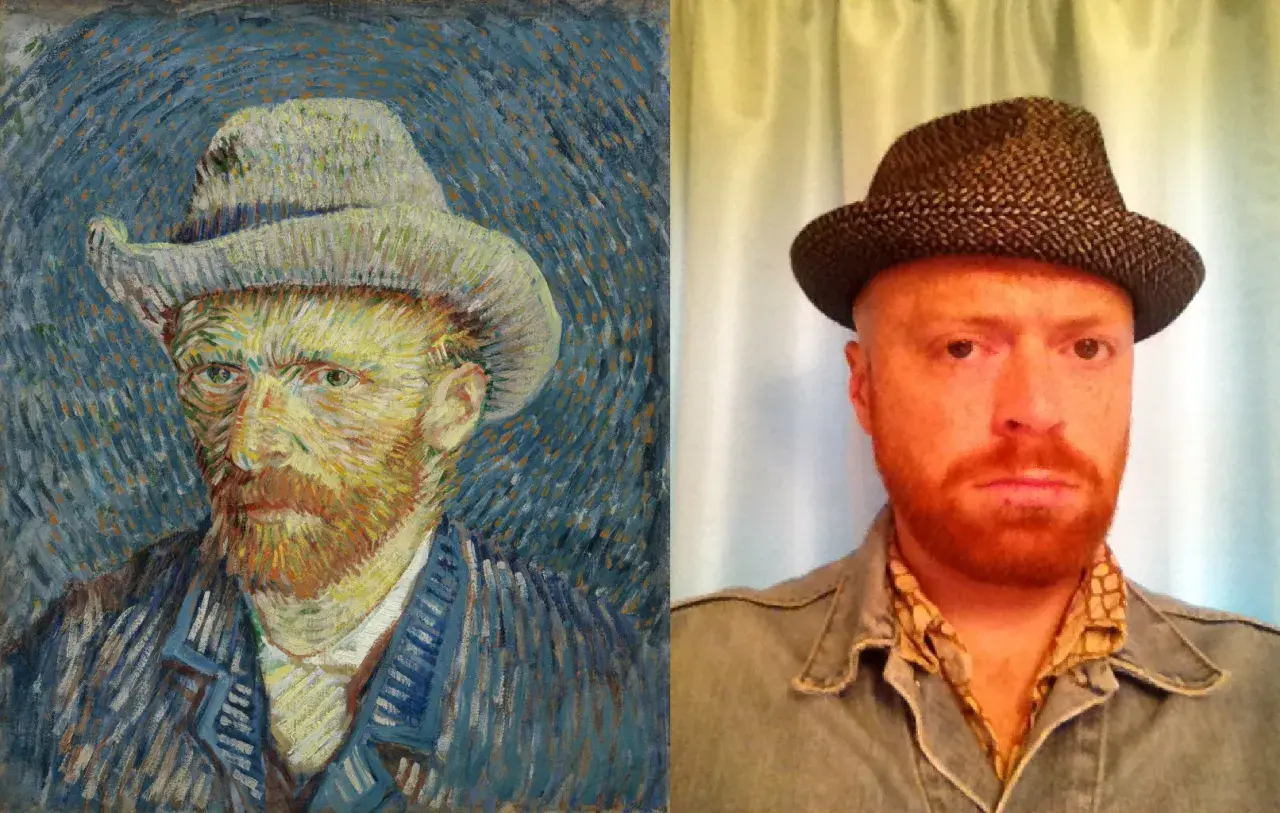
Vincent van Gogh’s straw-hat self-portrait is a compact lesson in portrait painting: it is a likeness, a studio exercise, and a record of how quickly he was changing as an artist in Paris. In this article, I look at what the work usually refers to, why the hat matters, how to read the color and brushwork, and what preservation details reveal about the object itself.
Key points that explain the painting fast
- Most searches for this subject point to Van Gogh’s Paris self-portraits from 1887, not a single fixed image.
- The straw hat is part of a working portrait strategy: it helps test light, color contrast, and brush handling.
- Several versions exist on different supports, including canvas and cardboard, and some were painted on the reverse of earlier studies.
- Material changes matter: fading pigments can alter the balance Van Gogh originally intended.
- For authentication, provenance, support, and paint structure matter more than the hat motif alone.
What this portrait usually refers to
When I see this subject, I usually think first of Van Gogh’s Paris-period self-portraits from 1887. The title can vary by museum, and that is important: one version is the Metropolitan Museum’s Self-Portrait with a Straw Hat, another is the Van Gogh Museum’s Self-Portrait with Straw Hat, and a closely related work is Self-Portrait with Pipe and Straw Hat. They belong to the same burst of portrait practice, but they are not interchangeable.
| Version | Support | Date | Why it matters |
|---|---|---|---|
| Met version | Oil on canvas | 1887 | Painted on the reverse of an earlier peasant study, which is a useful clue for dating and studio economy. |
| Van Gogh Museum version | Oil on cardboard | August-September 1887 | The support is cheaper and thinner, and the original color relationships have shifted as pigments faded. |
| Pipe and straw hat version | Oil on canvas | September-October 1887 | It shows the same self-portrait problem solved with looser, faster handling and a more openly experimental palette. |
The distinction is not academic hair-splitting. If you are studying, cataloging, or comparing reproductions, the title, date, support, and variant all change what you are actually looking at. That is the right place to start, because the next question is why Van Gogh kept painting himself this way at all.
Why Van Gogh painted himself in a straw hat
The short answer is practical. The Met notes that Van Gogh made more than twenty self-portraits during his Parisian years, and he did it because he needed practice, money was tight, and models were not always available. In other words, the self-portrait was not vanity; it was a workshop solution. He bought a mirror, used his own face as the subject, and turned limitation into method.
The hat itself also serves a painterly purpose. A straw hat gives him a bright, readable shape that can carry warm yellow notes into the composition. It helps him test how a light object behaves against skin, beard, background, and clothing. In that sense, the hat is not a costume detail. It is a color problem.
That is why this image belongs so clearly to portrait practice rather than casual self-display. He was using his own face to solve the same question he would later face with other sitters: how do you build a convincing head with paint, speed, and limited resources? Once you see the painting that way, the image opens up rather than shrinking into a simple likeness.
How the brushwork makes the hat do more than decorate the image
Van Gogh’s Paris portraits move away from the heavy, earthy surfaces of his earlier work. In this phase, he is working toward brighter color, sharper contrasts, and a more modern sense of pictorial rhythm. The straw hat helps him do all three at once. Its broad shape gives him a large field of color, while the brim and crown create edges that can be handled with quick, distinct strokes.
I read the composition as a controlled tension between the hat and the face. The hat expands outward; the face pulls inward. That contrast keeps the image from becoming decorative. It stays psychological because the eyes and beard remain anchored by a tighter, more carefully built passage. Van Gogh often lets the background and clothing stay open and sketchy, then concentrates detail where he wants attention to land.
This is also where Neo-Impressionist influence matters. Neo-Impressionism is the late-19th-century approach that uses small, separate touches of color so the eye blends them optically. Van Gogh never became a pure Neo-Impressionist, but he absorbed enough of the method to make the hat, face, and background vibrate against one another instead of sitting as flat blocks. The result is a portrait that feels immediate without looking unfinished.
The strongest reading, in my view, is that the hat is doing compositional labor. It frames the head, sets the temperature of the image, and helps Van Gogh test how far he can push brightness before the face loses structure. That leads directly to the conservation questions, because the image we see today is not exactly the one he painted.
What preservation details reveal about the object
For this kind of work, material evidence is not a side note. It is part of the meaning. The Van Gogh Museum explains that one self-portrait from this group was painted on cardboard with a purple priming layer, but the purple pigment has largely faded. That is a major conservation point, because the original background once set off the yellow hat much more forcefully than it does now. In other words, what looks like a subtle color scheme today may originally have been far more dramatic.
Support matters too. Canvas and cardboard behave differently over time. Cardboard is cheaper and more fragile, which tells you something about the conditions under which Van Gogh was working. It also affects cracking, warping, and long-term stability. When a painting is built on the reverse of an earlier study, as with the Met version, the object has two histories at once: the visible portrait and the earlier image underneath it. That is exactly the kind of layered evidence conservators and curators study closely.
For authentication, the important clues are not the hat motif or the subject name alone. They are the provenance chain, the support, the ground layer, the pigment behavior, the brushwork, and whether the work fits Van Gogh’s Paris technique. A convincing reproduction can copy the look of the hat. It cannot easily fake the full material logic of the painting.
- Check whether the listed date fits Van Gogh’s Paris self-portrait period in 1887.
- Look for the support type: canvas and cardboard can point to different studio conditions.
- Confirm whether the work is an obverse, reverse, or independent painting.
- Compare the color balance against known museum examples, especially where fading may have altered the original contrast.
That technical frame matters because the painting is not only an image of Van Gogh; it is also a record of what his materials could and could not survive. From there, the broader portrait tradition becomes easier to see.
How it fits the broader portrait tradition
Self-portraiture has always sat between document and performance, but Van Gogh makes that tension feel unusually direct. He is not dressing himself up to look grand, and he is not reducing the face to a neutral study. He is using his own features as a live test field for paint handling, light, and emotional presence. That makes the work feel modern even now.
In the late 19th century, many artists used portraiture to prove technical range, but Van Gogh pushes the genre in a more personal direction. He gives us an artist who is visibly working through color theory, financial limits, and self-observation at the same time. The straw hat is part of that story because it is ordinary, affordable, and visually legible. It keeps the image grounded in studio reality rather than theatrical symbolism.
That is also why these paintings remain useful for historians. They help establish facial features, track stylistic change across months, and show how quickly an artist can move from one formal solution to another. When I compare the Paris self-portraits with his earlier work, the shift is not just in brightness. It is in confidence, speed, and the willingness to let visible strokes carry meaning.
What to remember when you read or catalog the image
If you are studying a reproduction, museum label, or auction listing, the safest approach is to treat the hat as one clue among several. A good record should identify the exact variant, the date, the support, and the collection history. If that information is vague, the listing is already weaker than it should be.
There are also a few common mistakes to avoid. Generic labels often collapse several Paris self-portraits into one imagined image, which flattens the differences between canvas and cardboard, between one background color and another, and between a finished composition and a study painted on the back of an earlier work. That kind of shortcut matters, because interpretation changes once you know which object you are handling.
For museum visitors, the practical payoff is simpler: look first at the hat, then at the face, then at the paint surface. The hat tells you about color and composition. The face tells you about intention. The surface tells you about history. When those three agree, the portrait becomes much more than a recognizable Van Gogh image.
Why the hat is only the starting point
The lasting value of this portrait is not that Van Gogh wore a straw hat. It is that he used an ordinary prop to solve several painterly problems at once: how to build a head, how to organize color, and how to keep the portrait alive on a limited budget. That is why the image still rewards close looking.
If you keep one practical idea in mind, let it be this: the best reading of the work comes from combining iconography with material evidence. The subject matters, but so do the support, the pigments, and the studio context. That combination is what turns a familiar self-portrait into a serious object of art history and preservation.For anyone comparing versions, I would start with the museum record, then move to the surface, and only after that think about symbolism. In Van Gogh’s case, the technical facts usually explain more than the legend around the image, and that is exactly what makes the painting worth studying closely.
