
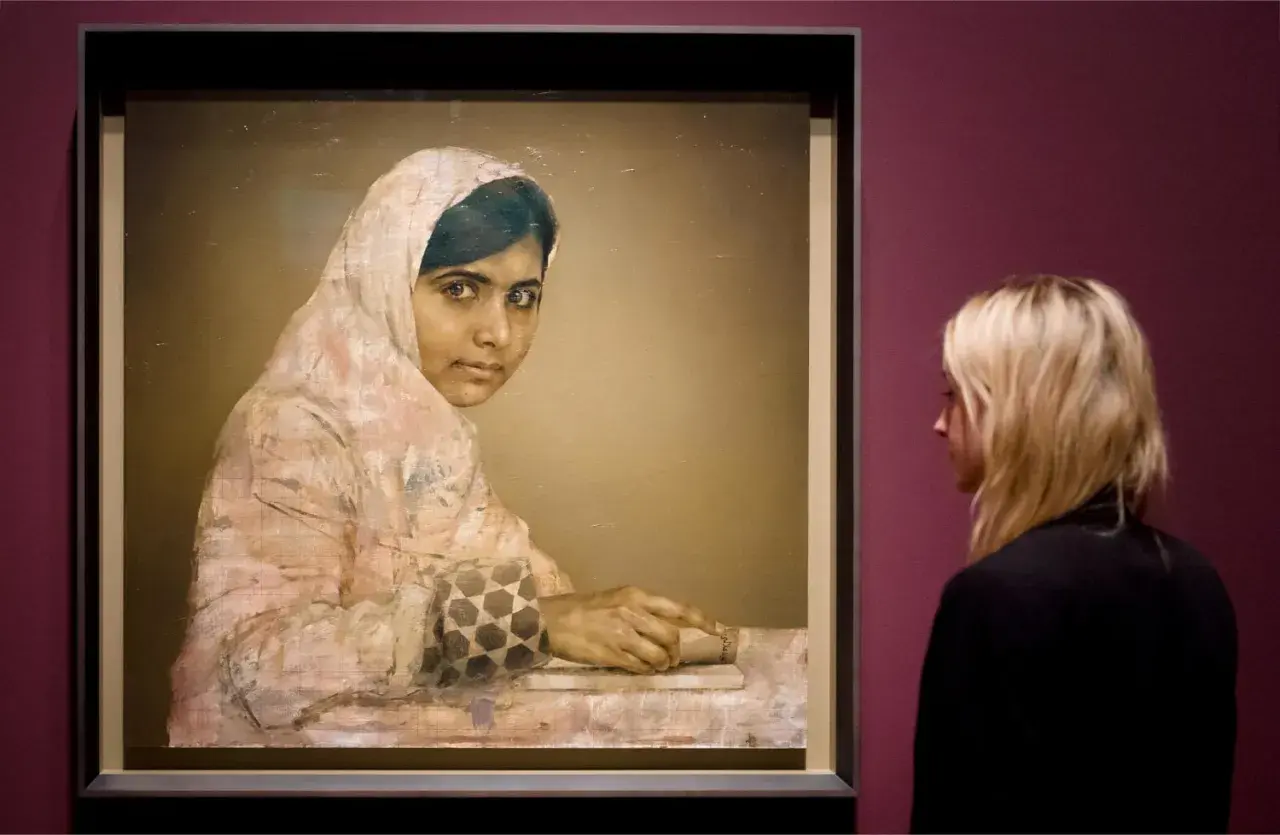
A Malala Yousafzai portrait works best when it does more than reproduce a face. The strongest images of her turn likeness into meaning, using pose, light, costume, and setting to show education, resilience, and public courage at once. In this article, I look at the most important portraits of Malala, how to read them, and what to check if you are evaluating one as an artwork rather than just an image.
What a strong portrait of Malala should tell you at a glance
- It should show more than resemblance and communicate Malala’s role as an activist and public figure.
- The most discussed portraits use different media, from oil on canvas to photographic print.
- Composition matters: gaze, cropping, and background shape the meaning as much as the face itself.
- Symbolic details, such as a book, a hijab, or overlaid text, often carry the portrait’s main message.
- If you are collecting or cataloguing, provenance, medium, and exhibition history matter as much as style.
Why a portrait of Malala feels bigger than a likeness
When I look at portraits of Malala Yousafzai, I do not see a conventional celebrity image. I see a sitter whose public identity is already deeply charged, so the portrait has to work harder: it must acknowledge her as a person, a student, a Muslim woman, an activist, and a Nobel laureate without flattening her into any one of those roles. That is why the best portraits of Malala are built around agency. They show her looking outward, not being looked at passively.
This is also why the format suits her so well. Portraiture has always been about more than physical resemblance. It records status, values, and the story a culture wants to tell about a person. In Malala’s case, that story usually centers on education and moral clarity, but the stronger works leave room for quietness too. That balance is what makes the image memorable rather than merely familiar, and it leads naturally to the question of which portraits matter most.
The portraits of Malala that are worth knowing
There are several public portraits of Malala Yousafzai, but a few works stand out because they show different ways of framing the same subject. I would group them like this:
| Work | Medium | What it emphasizes | Why it matters |
|---|---|---|---|
| Girl Reading (Malala Yousafzai) by Jonathan Yeo | Oil on canvas, 2013 | Malala as a student, absorbed and reflective | It captures her before the image hardened into global iconography |
| Malala Yousafzai by Shirin Neshat | Archival ink on gelatin silver print, 2018 | Activism, identity, and visual symbolism | It is one of the most layered and interpretive portraits of her |
| Portrait by Isabella Watling at Lady Margaret Hall | Oil portrait, unveiled in 2026 | Institutional recognition and lived achievement | It shows how Malala’s image continues to enter formal academic and civic spaces |
What I find useful here is the shift in emphasis. Yeo’s work feels intimate and pre-iconic. Neshat’s portrait is more conceptually dense, almost editorial in its visual intelligence. The 2026 Oxford commission is different again: it is honorific, measured, and tied to institution-building. Together they show that Malala is not represented by a single fixed image. She is represented through different visual arguments, and that distinction matters for anyone who wants to understand the portrait as art.
How to read the Shirin Neshat portrait closely
The Shirin Neshat portrait is the one I would spend the most time with if I wanted to understand how symbolism works without becoming heavy-handed. Malala is shown frontally, with a steady gaze and a calm expression. That directness matters. She is not posed as distant or heroic in the old monumental sense. Instead, she appears composed and alert, which gives the portrait its authority.
The black-and-white palette does a lot of work. It strips away visual distraction and pushes attention toward contrast, texture, and gaze. The black hijab blends into the dark ground, so the face stands out sharply. That contrast is not just formal; it also reinforces the sense that the sitter’s identity is both visible and self-possessed. The overlaid Pashto poem adds another layer. It does not simply decorate the print. It connects Malala to a wider cultural and literary lineage, and the clear eyes left uncovered by the writing keep the image open rather than sealed off.
In portrait terms, this is a smart choice. The work uses composition, lighting, and text to create meaning without losing the sitter. I think that is why it endures: it is not a portrait that explains Malala once and for all. It is a portrait that keeps asking the viewer to look again, which is exactly what strong portraiture should do and a useful bridge to the practical question of identifying or collecting one.
What to check if you want to identify or collect one
If you are assessing a portrait of Malala Yousafzai as an artwork, I would start with the basics: artist, date, medium, size, and context of creation. Those five details tell you far more than the image alone. A work on canvas behaves differently from a photographic print, and a commissioned institutional portrait means something different from an editorial or educational image. Medium changes both meaning and value.
Provenance, which is the ownership history of a work, is the next thing I would verify. For a serious purchase or cataloguing project, look for exhibition history, a signed label, a certificate, or documentation from the commissioning institution or gallery. If the work is a photographic print, ask whether it is an original print, a later reproduction, or an authorised edition, because those are not interchangeable. A number next to a print, or the absence of one, can change how the work is understood and valued.
For preservation, treat the material honestly. Paper-based and photographic works usually need stable light levels, low handling, and controlled humidity; oils are more tolerant but still dislike heat, damp, and poor framing. If the portrait is a reproduction rather than an original, the care rules may be different, but the ownership and attribution questions still matter. That distinction becomes important because not every portrait circulating online has the same artistic or documentary status, which leads into the most common mistakes people make.
Where portraits can mislead and how I avoid bad reads
The most common mistake is treating every image of Malala as if it were the same kind of portrait. A press photograph, a book illustration, an academic commission, and a museum portrait are not interchangeable, even if they show the same face. They have different purposes, different audiences, and often different standards of authorship. If I am evaluating one, I ask first: who made it, for whom, and why?
A second mistake is over-reading the symbolism. Yes, a hijab can signal faith and identity, and a book can signal learning, but those details should not be reduced to clichés. In the best portraits, these elements work with the sitter’s expression and posture, not instead of them. Another trap is assuming that a serious expression means severity. In portraiture, calm can signal discipline, confidence, or self-command, especially when the sitter is someone who has spent years under public scrutiny.
I also try not to confuse visibility with depth. A widely circulated image can be famous without being especially strong as portraiture. The reverse is also true: a quieter work can carry far more interpretive weight than a headline-grabbing photograph. If you keep that in mind, the portrait stops being a celebrity image and becomes a considered visual statement, which is exactly what makes the next layer of meaning more interesting.
What Malala’s image teaches about modern portraiture
What I take from these works is simple: modern portraiture is no longer just about likeness, and Malala’s image makes that especially clear. Her portraits can frame her as a reader, a witness, a public advocate, or an honoured alumna, but the strongest ones never let the role erase the person. They keep the viewer aware of both the public meaning and the human presence.
That is why a Malala Yousafzai portrait still matters in 2026. It shows how institutions, artists, and audiences negotiate identity through image, and how a single sitter can be portrayed in several convincing ways without contradiction. If you are looking at one closely, focus on the language of the work itself: gaze, scale, medium, and context. Those are the features that turn a portrait into an argument about who someone is, and why they belong in the visual record.
A Malala Yousafzai portrait only feels complete when it preserves that tension between likeness and meaning. When it does, the image becomes more than documentation: it becomes a lasting record of values, and that is what makes it worth studying, preserving, and remembering.
