
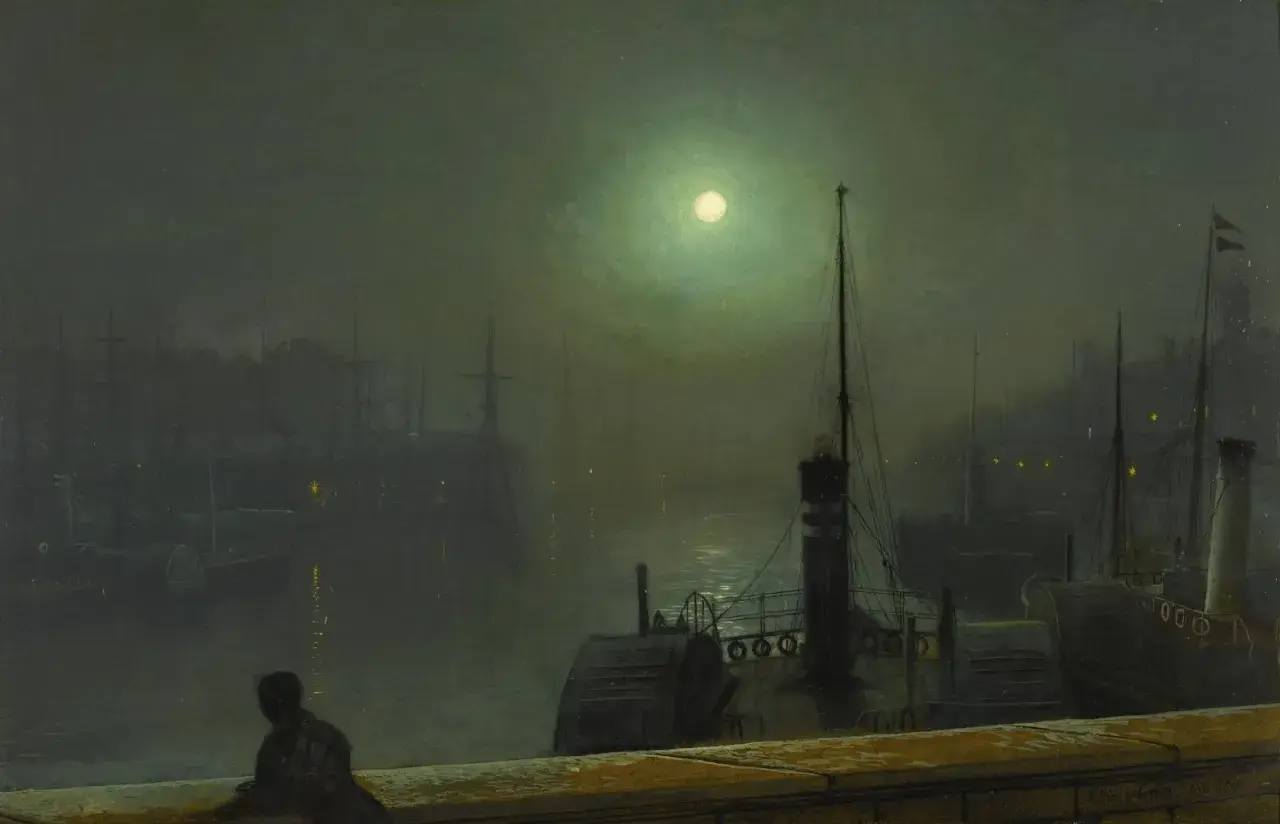
John Atkinson Grimshaw stands out because his paintings make evening light feel physical: wet stone, reflected lamps, and mist all seem to hold their own weight. In this article, I look at who he was, why his nocturnes are so effective, which works best show his range, and how to judge a possible attribution without relying on wishful thinking. That mix matters if you care about art history, collecting, or preservation, because his best paintings reward close looking.
The essentials to keep in view
- Born in Leeds in 1836 and died in 1893, he built a career outside the academic center of Victorian art.
- He is best known for moonlit streets, docks, rivers, and suburban roads rendered with unusual control of atmosphere.
- His paintings often combine Pre-Raphaelite detail with a more modern feeling for light, shadow, and silence.
- He also painted interiors, fairy subjects, and quieter northern views, so he is broader than the “night scene” label suggests.
- Attribution depends on more than subject matter; support, provenance, handling, and condition all matter.
- Preservation is critical because the mood can be weakened by overcleaning, yellowed varnish, and poor light exposure.
Who he was and why his career looks unusual now
Grimshaw was born in Leeds and came to painting without the polish of a formal academy path. He first worked as a clerk for the Great Northern Railway, then left office work to paint full time by 1861. That matters, because his career was not built around academic approval; it was built around a very disciplined visual instinct and a private market that valued the mood he could create.
He showed only a small number of works at the Royal Academy, which is one reason he never became a standard textbook Victorian. Instead, he worked mainly for private patrons and returned again and again to the places he knew best: Leeds, Liverpool, Glasgow, Scarborough, Whitby, London, and the river edges in between. I think that distance from the official center gave him freedom, but it also means his work can be underestimated if you only look for grand historical ambition. He was after something more specific: controlled atmosphere, accurate light, and a scene that feels quietly observed rather than staged. That independence is part of why the paintings feel so personal, and it leads directly into the logic of his style.
Why his moonlit scenes still feel modern
When I talk about Grimshaw, I usually start with light before subject matter. In Victorian painting, a nocturne is a composition built around low light and tonal unity, where the mood matters as much as the literal description. Grimshaw understood that principle instinctively. He used darkness not as a blank space, but as a way to sharpen reflections, gas lamps, windows, and the edges of architecture.
His best night scenes work because the light is never random. Wet paving throws back a lamp glow, a bridge divides the frame with hard structure, and fog softens the far distance without erasing it. He often gives you just enough detail in the foreground to trust the setting, then lets the middle and far distance dissolve into haze. A camera obscura, an optical device that projects a scene onto a surface, may have helped him organize those perspectives, and his interest in photography probably strengthened that exacting eye for arrangement.What separates him from painters who simply liked dark palettes is the balance between description and restraint. He does not overfill the scene. He leaves silence in it. That silence is the point: it lets the viewer feel the weather, the hour, and the social mood of the street all at once. Once you can read those visual habits, the next question becomes which paintings show them best.

The paintings that best show his range
If you want a quick route into Grimshaw's work, I would start with a few paintings that show different sides of the same eye. They prove that he was not just repeating a single formula, even if the moonlit views are the most famous part of the story.
| Work | Date | Why it matters |
|---|---|---|
| Leeds Bridge | 1880 | An essential industrial city view that shows how well he handled reflections, distance, and the hard geometry of urban architecture. |
| View of Southwark Bridge at Night | 1882 | A strong London nocturne that proves he could move the formula beyond Leeds without losing clarity or atmosphere. |
| The Thames by Moonlight with Southwark Bridge, London | 1884 | One of the clearest examples of his river mood, where broad water, bridge structure, and silver light work together. |
| Iris | 1886 | A reminder that he also worked in fairy and neo-classical modes, not only urban night scenes. |
| Sunday Night, Knostrop Cut, Leeds | 1893 | A late work that brings the atmospheric approach back to a very local, grounded setting. |
What I like about this group is the range of scale and intention. The bridge pictures are architectural and public; Iris is more imaginative and decorative; the late Leeds view feels intimate and almost domestic in its quiet. That spread matters because it keeps him from being flattened into a single “moonlight painter” stereotype, and it also gives you a better base for judging attribution.
How I would judge a possible attribution
I would not treat a moonlit street as proof by itself. Too many later painters borrowed the mood, and too many reproductions circulate with enough visual similarity to confuse a quick glance. A serious attribution has to stack evidence: subject, support, handling, signature, provenance, and condition. If one of those pillars is missing, the rest need to work harder.
| What to check | What I am looking for | Why it matters |
|---|---|---|
| Support | Canvas, wood panel, or another period-appropriate support with age consistent with the work | Support does not prove authorship, but it can quickly rule out anachronisms |
| Surface handling | Careful transitions in shadow, layered reflections, and controlled highlights | His atmosphere comes from structure, not just from dark paint |
| Signature and inscriptions | Present, absent, or altered markings that fit the rest of the evidence | Signatures vary, so they are a clue, not a verdict |
| Provenance | Ownership history, sale records, exhibition labels, or family documentation | Provenance often does more work than style alone |
| Condition and restoration | Overcleaned dark passages, flattened glazes, or suspicious retouching | Poor treatment can erase the very depth that makes the picture convincing |
The most common mistake is trusting the mood instead of the structure. A convincing fake may get the moon and the lamps right, but it often misses the way Grimshaw organizes streets, tree branches, and reflections so that the eye travels naturally through the scene. Another common error is overvaluing a dramatic signature while ignoring a thin provenance or a strangely generic composition. I would also be careful with pictures that look “too Grimshaw” in a superficial way: exaggerated fog, overdone orange lamps, and dead black shadows can be a warning sign rather than a confirmation. Once the attribution questions are under control, preservation becomes the next practical issue.
What I would protect first if one enters a collection
These paintings are vulnerable because their effect depends on layers. If a restorer strips away too much varnish or the surface has been aggressively cleaned, the soft transition from lamp glow to night sky can collapse. That is not a small cosmetic loss; it changes the whole reading of the work. The atmosphere is not decoration. It is the subject.
If I were advising a collector or curator, I would start with a few non-negotiables:
- Keep light controlled, with no direct sunlight and no unnecessary exposure to harsh illumination.
- Maintain stable humidity and temperature rather than chasing perfect numbers; sudden swings are the real enemy.
- Document the reverse before any treatment, including labels, stamps, inscriptions, and old frame evidence.
- Test before cleaning; dark passages and glazes can be far more fragile than they look.
- Preserve the frame when possible, because period framing can support both dating and presentation.
A large public collection of his work is held by Leeds Museums and Galleries, and that is a useful reminder that these paintings are no longer just admired for mood; they are treated as objects that need care, records, and controlled handling. If you own, inherit, or are asked to assess one, I would begin with the simple question of what is original in the object itself, not just in the image it presents. That is usually where the difference between a picture of night and a preserved nocturne becomes clear.
