
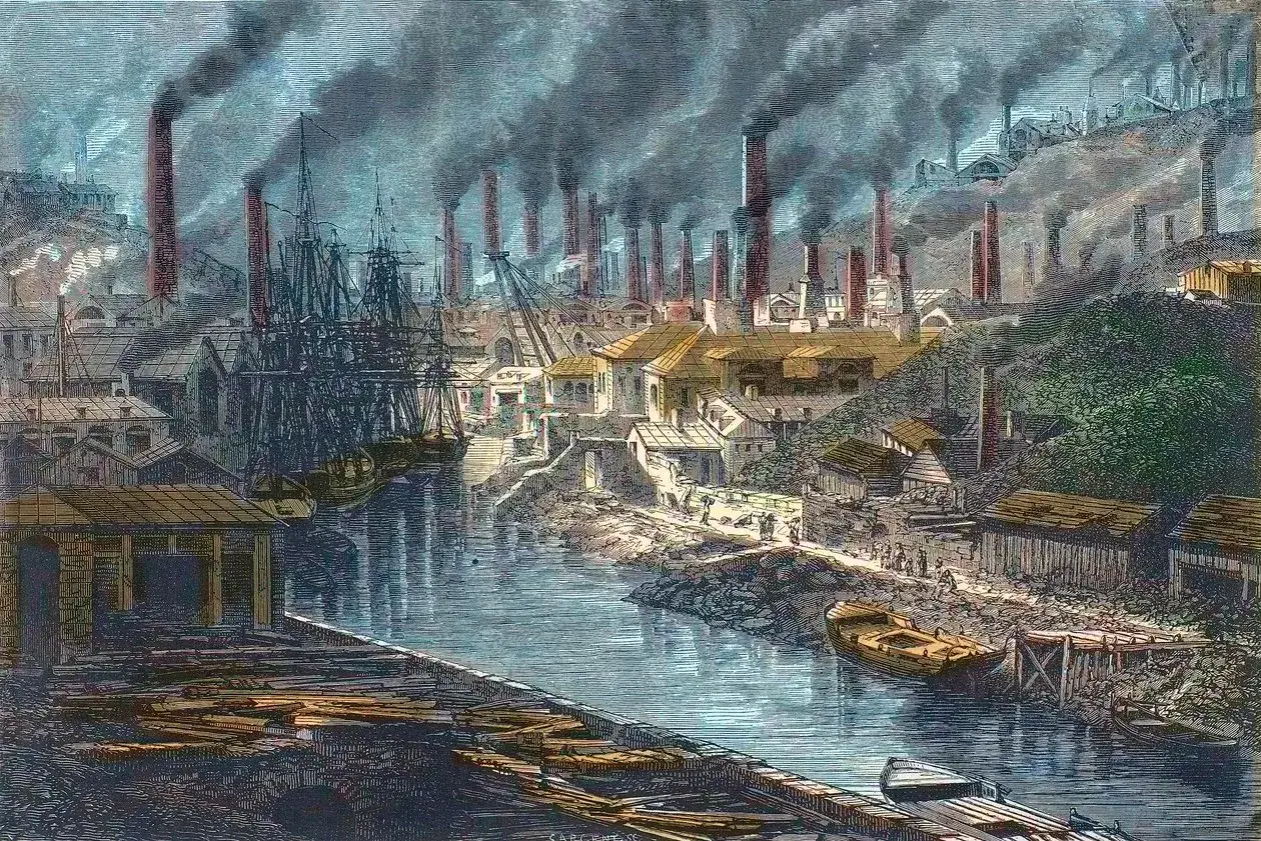
Industrial-era scenes in painting are rarely about machines alone. An industrial revolution painting usually treats furnaces, railways, and factories as part of a larger story about labor, speed, power, and social upheaval, which is why these works still matter to museum visitors, collectors, and students of visual culture. In this article I focus on the artists and artworks that defined the subject, how to read them, and what matters if you want to study or evaluate them seriously.
The essentials to keep in view
- These paintings are strongest when they balance technological progress with human cost, smoke, noise, and scale.
- Joseph Wright of Derby, Philippe Jacques de Loutherbourg, J.M.W. Turner, and Ford Madox Brown are central British names.
- For a U.S. audience, Charles Sheeler shows how industrial imagery shifted into a cleaner, more geometric modern language.
- The best-known works are useful not just as images, but as historical evidence of how people imagined industry.
- Provenance, condition, medium, and restoration history matter if you are studying, collecting, or authenticating one of these works.
Why industrial scenes became a serious artistic subject
Industry changed the visual world before it changed anything else. New factories, furnaces, bridges, railways, and machine halls introduced subjects that painters could use to explore labor, class, speed, and the uneasy beauty of modern engineering.
The key idea is the industrial sublime, which means the mixture of awe and discomfort that appears when human-made systems feel too large, too hot, or too fast to fully control. In these pictures, a glowing furnace can look majestic in one moment and threatening in the next.
That tension is what gives the subject its durability. A painting of industrial change can function as record, warning, celebration, or elegy, sometimes all at once. Once you understand that, the major artists make much more sense.
The next step is to look at the painters who turned that tension into a visual language that still reads clearly today.
The British artists who defined the visual language
Joseph Wright of Derby and the drama of labor
Wright is the early figure I would start with. Tate has described him as the first professional painter to express the spirit of the Industrial Revolution, and that assessment still holds because he treats science, industry, and labor with unusual seriousness.
In An Iron Forge (1772), the forge is not a background detail. The worker at the anvil becomes the center of attention, and the lighting makes the heat feel physical. Wright’s use of tenebrism, a strong contrast between light and dark, gives the scene a sculptural force that makes labor look almost monumental.
Philippe Jacques de Loutherbourg and the furnace at night
Coalbrookdale by Night (1801) pushes the subject into a more dramatic key. The furnaces blaze against the dark landscape, and the smoke and flame turn the whole valley into a theater of production. The work is often read as one of the clearest images of industrial power in early British art.
What makes it interesting is the double register. It celebrates energy and invention, but it also lets the viewer feel the cost in heat, glare, and atmospheric disturbance. That mix of attraction and alarm is exactly what made industrial imagery so potent in the first place.
J.M.W. Turner and the speed of modernity
Turner is the artist who turns industry into motion. In The Fighting Temeraire (1839), a celebrated old warship is towed by a steam tug toward its end, which gives the painting a quiet but unmistakable sense of historical transition. It is not a factory scene, but it is essential because it stages the replacement of sail by steam.
Rain, Steam and Speed - The Great Western Railway (1844) goes further. Turner compresses weather, water, bridge, and locomotive into one unstable image, and the result feels like speed itself. The diagonals pull the eye forward, while the blurred atmosphere makes the machine seem both triumphant and barely contained.
Read Also: Kusama's Pumpkins - Art or Decoration? Find Out Now
Ford Madox Brown and the social cost of work
Brown’s Work (1852-65) is one of the most socially dense paintings of the period. Instead of focusing on a single factory or furnace, he places laborers, middle-class observers, and idle figures into the same crowded urban space. The image is structured around social hierarchy as much as industry.
That is why the painting matters. Brown does not simply depict work; he asks who does it, who watches it, and who benefits from it. If Wright gives you the drama of invention and Turner gives you the pace of modernity, Brown gives you the human system underneath both.
Those four artists set the template, but it helps to compare the works side by side before moving into later American developments.
Landmark works every reader should know
This is not a closed canon, but it is the most useful reading list if you want a quick map of the subject. I would keep these works in mind because each one captures a different way of seeing industrial change.
| Work | Artist | Date | Why it matters |
|---|---|---|---|
| An Iron Forge | Joseph Wright of Derby | 1772 | One of the earliest major paintings to dignify industrial labor through dramatic light and close observation. |
| Coalbrookdale by Night | Philippe Jacques de Loutherbourg | 1801 | A classic image of the industrial sublime, with furnace glare, smoke, and a landscape transformed by production. |
| The Fighting Temeraire | J.M.W. Turner | 1839 | A symbolic farewell to the age of sail and a subtle meditation on technological replacement. |
| Rain, Steam and Speed | J.M.W. Turner | 1844 | One of the clearest painterly statements about velocity, engineering, and the uncertainty of modern movement. |
| Work | Ford Madox Brown | 1852-65 | A crowded social panorama that turns industrial labor into a moral and class-based subject. |
| Classic Landscape | Charles Sheeler | 1931 | An American industrial image that replaces smoke and drama with geometry, restraint, and precision. |
The shift from Wright to Sheeler is revealing. The early paintings are warmer, darker, and more theatrical, while the later American work is cool, orderly, and almost architectural. That change tells you a lot about how industrial imagery matured over time.
From here, the American version of the story becomes much easier to read.
The American version of industrial modernity
In the United States, the industrial image often becomes less narrative and more formal. Instead of an obvious scene of labor, you get structures, grids, bridges, smokestacks, and power plants arranged as if they were abstract compositions with real-world weight.
Charles Sheeler is the key figure. In works like Classic Landscape (1931) and Water (1945), he strips away most human presence and lets pipes, buildings, and infrastructure carry the image. The result is cool, controlled, and slightly uncanny. It does not romanticize industry, but it does not condemn it either.
That restraint is important for a U.S. audience because it reflects a different stage of industrial culture. Britain’s earlier paintings often show the shock of change. Sheeler shows a world in which industry has already become part of the landscape, and the painter’s job is to organize it with clarity.
Once you see that shift, the real question becomes formal: how do these paintings make industry legible on the canvas?
How to read composition, light, and symbolism
When I look at these works, I start with five things: light, scale, motion, atmosphere, and the position of people. Those elements usually tell you more than the subject label does.
- Light often acts as the moral center. In Wright and Loutherbourg, the glow of fire or forge heat is not just descriptive; it sets the emotional tone.
- Scale shows whether the artist wants the machine to dominate the worker or the worker to remain the visual anchor.
- Motion becomes especially important in Turner. Foreshortening, which compresses depth so objects rush toward the viewer, can make a train or bridge feel almost in motion.
- Atmosphere is never neutral. Smoke and steam can soften a composition, hide engineering details, and suggest pollution at the same time.
- People may be central, marginal, or absent. That choice tells you whether the work is social, documentary, symbolic, or almost abstract.
There is also a practical interpretive habit worth keeping: do not ask only whether a painting celebrates industry or criticizes it. Ask where it places human labor relative to the machine, and whether the painter treats technology as a system, a spectacle, or a warning. That question leads directly into the issues that matter for conservation and authentication.
What collectors and conservators should check first
If I were examining one of these works for a collection, I would start with provenance, medium, and condition before I worried about interpretation. Industrial subjects were widely reproduced, copied, and adapted, so a sound chain of ownership and a clear material history matter a great deal.
- Provenance should show a coherent ownership chain, not a gap filled by guesswork.
- Medium changes both value and risk. Oil, watercolor, lithograph, and print all age differently.
- Condition is crucial in dark, atmospheric works because over-cleaning can flatten smoke, shadow, and glaze.
- Restoration history matters because relining, revarnishing, and retouching can change the appearance and complicate attribution.
- Supporting evidence such as sketches, inscriptions, exhibition records, and related versions can help confirm authorship.
For works on paper, light exposure and acidic framing materials are the usual threats. For oil paintings, varnish discoloration and surface wear are more common. A serious evaluation asks not only whether the image looks right, but whether the object can withstand long-term study and display without losing the qualities that make it historically valuable.
That material reality is the final reason these pictures remain worth studying, even now.
What these paintings still teach in 2026
In 2026, these works feel less like relics than like early tests of questions we still have not solved. How do you picture progress without ignoring labor? How do you show technological scale without losing the human story? How do you balance admiration for engineering with awareness of cost?
My advice is to read them in pairs. Put Wright beside Loutherbourg, Turner beside Brown, and then compare the British works with Sheeler’s American industrial images. The differences are more useful than any single label, because they show how the visual language of industry changed from heat and spectacle to geometry and control.
If you want the shortest possible route into the subject, start with one forge, one railway, and one factory landscape. Those three views are enough to show why industrial art still matters: it records not just what was built, but how modern life first learned to see itself.
