
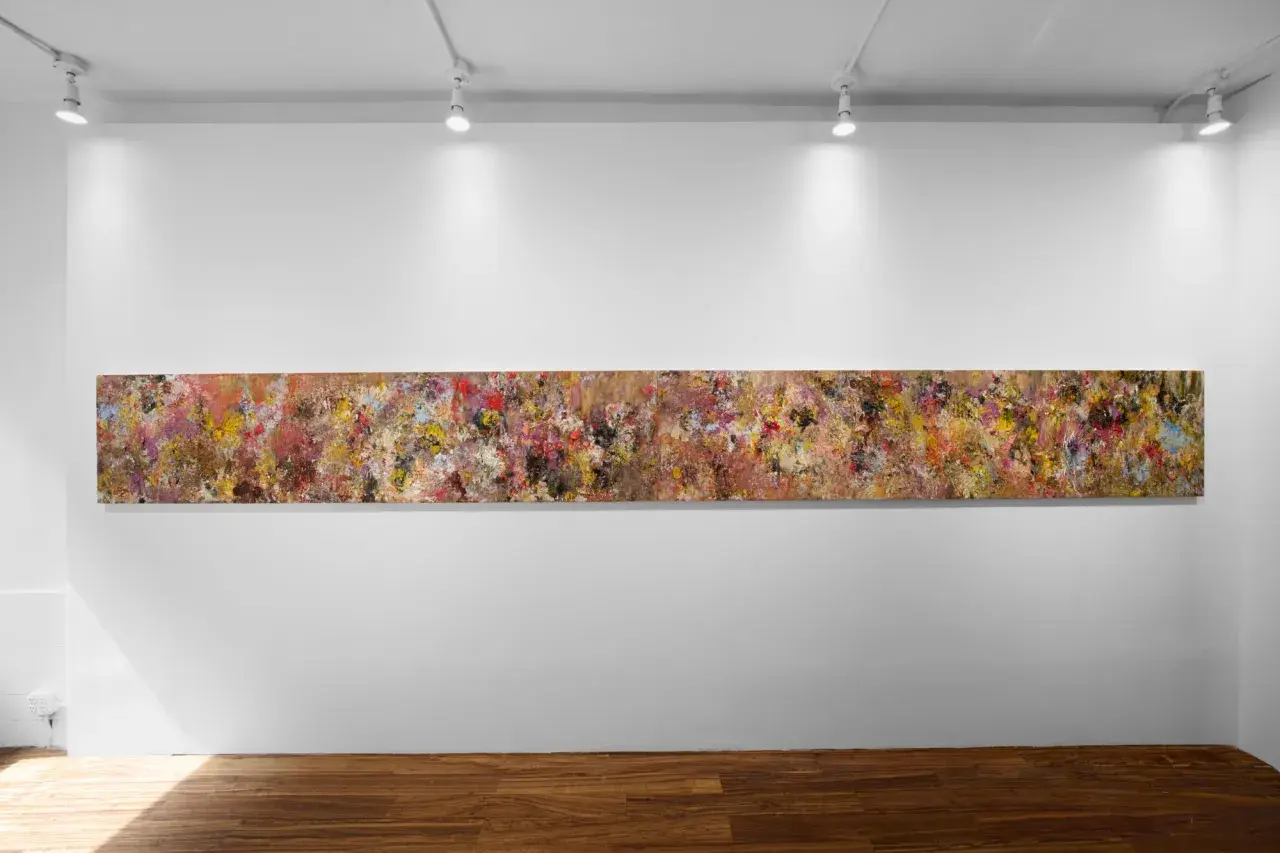
Angela China’s work is easiest to read as a transition from street energy to studio painting: the same urgency remains, but the surfaces are now thicker, larger, and more psychologically layered. This article explains who she is, what defines her paintings, which works and exhibitions matter, and how I would approach value, provenance, and condition if I were cataloging or buying a piece.
The essentials at a glance
- Angela China is a New York-based artist, born in 1985 in Baltimore, whose practice moved from street art into gallery painting.
- Her work sits between figuration and abstraction, with women’s experience, transformation, and emotional charge as recurring themes.
- Works such as Take Me to Mars, Man with a Plant (Pink), Purple Landscape, and After the Rain (the extended version) show the range of her language.
- Public market data is still thin, so medium, size, exhibition history, and condition matter more than a title alone.
- For collectors, the real question is not whether a work resembles another one, but whether the documentation matches the object in hand.
Understanding the Angela China artist profile and market context
At a basic level, Angela China is not a mystery name. She is a New York-based painter born in Baltimore in 1985, and her public biography traces a clean line from street art into gallery painting. That path matters because it explains why her work still carries the directness of urban visual culture even when the final object is a large oil painting.
She first became visible under the tag Gumshoe, where her iconography leaned into heels, legs, and hard-edged public interventions. Later, after moving to New York in 2010 and earning an MFA from The New York Academy of Art in 2017, she shifted the emphasis from wall-based graphics to studio painting. I read that shift as more than a medium change: it is the difference between making a statement in public and building one slowly on canvas.
That distinction is useful for collectors and researchers. Early street works, later canvases, and editioned material should not be treated as interchangeable just because the artist name is the same. When I evaluate a body of work like this, I separate chronology, format, and intended audience before I touch market value or authenticity. That separation leads naturally to the paintings themselves.
What her paintings are actually saying on the wall
The strongest reading of China’s paintings starts with surface. Her abstract work explores the emotional resonance of the feminine experience, and that is a fair summary, but it is not the whole story. Her canvases are built from gesture, texture, and color, and the emotional charge comes from how those elements collide rather than from a literal narrative.
I think of her work as deliberately unstable. A painting may suggest a landscape, a figure, or a studio interior, but those cues tend to dissolve as you keep looking. In works such as Purple Landscape and Artist's Studio, brushwork, scraped passages, and built-up paint create a sense of weather, memory, and pressure without locking the image into one fixed scene.
| Visual cue | What it usually signals | Why it matters |
|---|---|---|
| Heavy paint build-up | Layering, revision, and physical labor | It tells you the surface is not decorative; it carries time and reworking. |
| Loose figuration | A bridge between memory and observation | It keeps the work from becoming pure abstraction or simple illustration. |
| Color shifts from warm to cool | Mood and spatial tension | Those transitions often do the emotional work that a narrative would otherwise do. |
| Scraped or incised marks | Correction and insistence | They are also the areas I would inspect most carefully in a conservation review. |
That surface language is why her paintings reward slow looking. They do not rely on a single symbol, and they do not collapse neatly into one category, which is exactly why the next step is to look at the works and exhibitions that mark her development.
The works and exhibitions I would start with
If I were building an internal reference file on Angela China, I would begin with a small set of works that show the range without flattening it. The goal is not to chase every title, but to understand how the subject matter, scale, and finish change over time.
| Work or exhibition | Year | Why it matters |
|---|---|---|
| Take Me to Mars | 2021 | A strong example of her gallery-era painting, where scale and color carry the image as much as subject matter does. |
| Man with a Plant (Pink) | 2021 | Useful for seeing how a domestic or figurative cue becomes icon-like rather than strictly descriptive. |
| Girl on the Grass, Malin Gallery | 2023 | Her debut solo show signaled that the work had moved well beyond street-art novelty and into serious painterly territory. |
| Purple Landscape | 2023 | A large canvas that shows how she handles atmosphere, depth, and visible paint movement. |
| After the Rain (the extended version), Half Gallery annex | 2025 | The sixteen-foot-long format makes her interest in horizon, color, and physical buildup especially legible. |
| Active New York gallery programming | 2025-2026 | This shows that her profile is still active, which matters if you are tracking a living artist rather than reconstructing a closed market. |
What I take from this sequence is simple: the work has not settled into a single formula, and that is a good sign. It means the artist's vocabulary is developing in public, which makes careful comparison essential rather than optional. From here, the real question becomes how to judge quality and legitimacy without relying on reputation alone.
How I would evaluate a painting before buying or cataloging it
For a living artist with a still-developing market, the biggest mistake is to look at the image first and the paperwork later. I would reverse that order. The object, its history, and its condition need to line up before any value judgment is useful.
| Check | What to ask for | Why it matters |
|---|---|---|
| Provenance | Gallery invoice, prior owner, exhibition record, and any consignment history | It is the fastest way to separate a clean work from one that only looks familiar. |
| Medium and support | Oil on canvas, works on paper, print, or photo documentation | Her market data varies by medium, so pricing a canvas like a print is a mistake. |
| Condition | Front, back, edges, stretcher, and any repairs | Thick paint, scraped areas, and large formats can be vulnerable to abrasion and movement. |
| Edition status | Edition number, signature, publisher, and release notes if the work is not unique | Editioned work needs a different valuation logic from unique painting. |
| Comparables | Similar size, year, medium, and condition rather than just a similar title | That is the only comparison that really holds up in a thin market. |
I would also ask for high-resolution images of the reverse, stretcher corners, and signature area. That is not overcautious; it is standard practice when the market is young and the surface quality is central to the work's meaning. A painting that depends on thick, expressive handling should be checked with that same care, because the features that make it compelling are often the ones most exposed to damage.
What the market data suggests in 2026
The market signal around China is real, but it is still modest enough that I would call it emerging rather than fully mature. Auction records point to relatively small public results for prints and photographs, which tells you more about the available record than about the value of her larger paintings. That is the key point for readers who are trying to price, insure, or authenticate a work.
Low public auction volume means you cannot lean on a single result and pretend it represents the whole market. Gallery pricing, direct sales, and resale outcomes may diverge sharply, especially when a work is unique, large, or tied to a notable exhibition. If you are looking at a painting rather than an edition, you need better comparables than a generic headline price.
Her current gallery presence also matters. Shows at Shrine, Half Gallery, Malin Gallery, and other New York programming in 2026 tell me that the artist is still in active circulation, which usually strengthens the need for clean records rather than speculative assumptions. If I were advising a collector, I would say this plainly: keep every invoice, label, loan sheet, and condition note, because the paper trail is part of the value.
What matters most when you encounter her work in the wild
The most useful way to read Angela China today is as an artist whose language keeps widening without losing its original urgency. The street-art origin still shows up in the confidence of her marks, but the paintings now ask for slower looking, better documentation, and more disciplined comparison. If you are studying her work for collecting, authentication, or preservation, start with medium, surface, and exhibition history, then let the imagery confirm the story rather than inventing it.
For me, that is the practical lesson: the paintings are strongest when they are treated as living objects with material histories, not just images with a name attached. That is also why Angela China remains worth tracking in 2026, especially if your interest lies where contemporary art, market evidence, and connoisseurship meet.
