
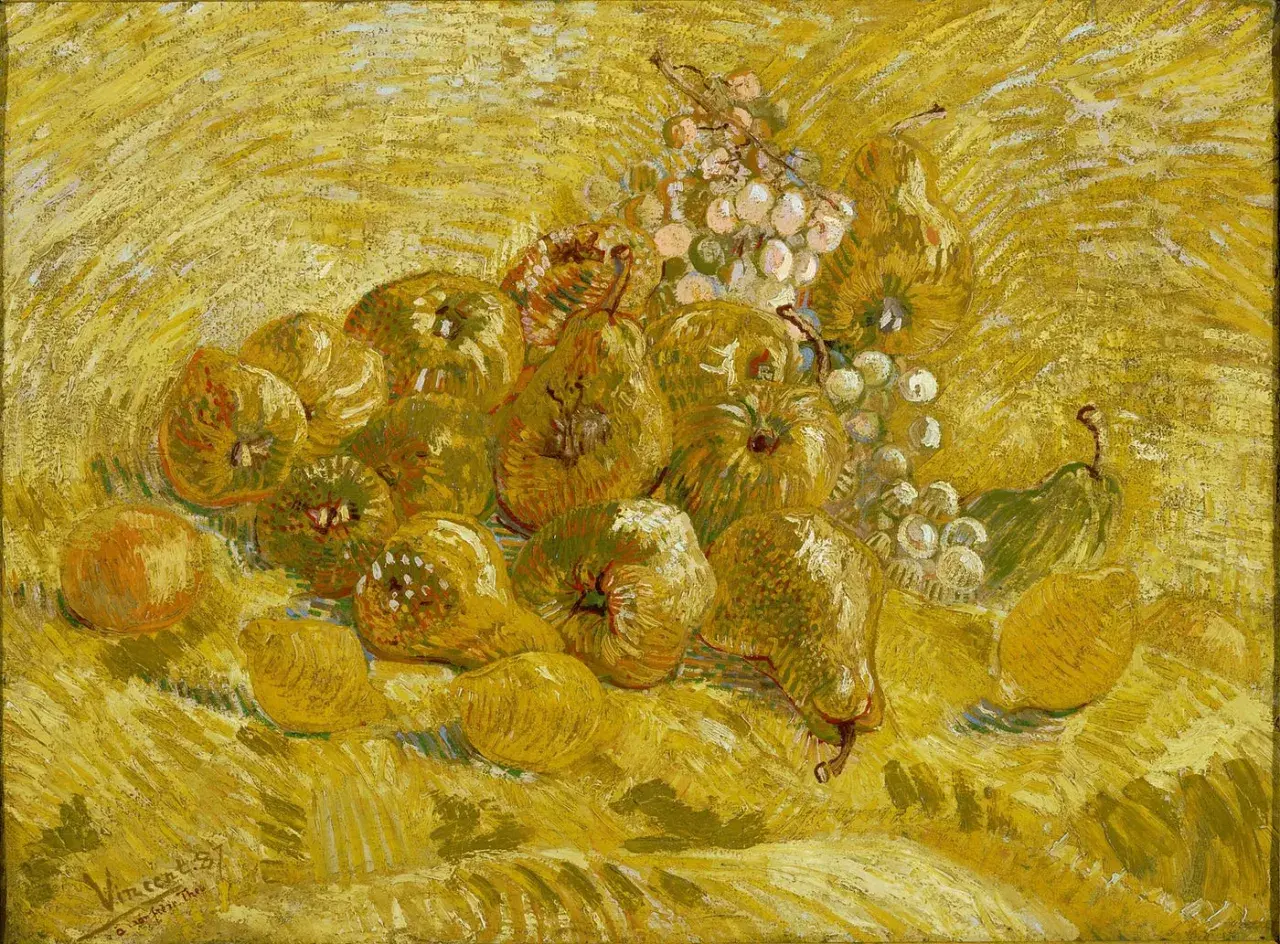
Yellow changes a painting faster than almost any other color. In the most memorable famous yellow paintings, it is rarely just decorative; it becomes light, symbol, structure, or even psychological pressure. Here I focus on the works that matter most, what yellow is doing in each one, and what to notice if you are looking at originals, reproductions, or auction images.
The yellow works worth knowing first
- Van Gogh’s Sunflowers turned yellow into both subject and atmosphere, which is why the series still defines the color for many viewers.
- The Yellow House shows how yellow can stand for place, ambition, and artistic community, not just brightness.
- The Scream uses a yellow-orange sky to heighten unease rather than comfort.
- The Yellow Christ makes yellow symbolic and spiritual instead of naturalistic.
- Gold Marilyn Monroe turns yellow-gold into celebrity, distance, and iconography.
- Yellow is not always happy; in art, it can signal heat, faith, modernity, decay, or tension depending on the painter.
Why yellow keeps pulling the eye
I tend to think of yellow as a high-visibility color with a very wide emotional range. It can read as sunlight, but it can also feel acidic, ceremonial, artificial, or fragile depending on the context. That flexibility is exactly why artists return to it again and again: yellow makes forms advance, separates objects cleanly from a background, and can carry more meaning than its brightness suggests.
There is also a technical reason it matters. In painting, yellow pigments have historically been among the most expressive and, in some cases, the most unstable. Some yellows stay radiant; others darken, fade, or shift after years of light exposure and varnish aging. That is part of the fascination here: yellow is both a visual event and a conservation problem, which is why it rewards close looking instead of casual viewing. Once you see that, the individual masterpieces start to make much more sense.

The landmark works most people mean when they think about yellow
| Work | Artist | Why the yellow matters | What to notice |
|---|---|---|---|
| Sunflowers (1888-1889) | Vincent van Gogh | Yellow is the subject, the mood, and the formal engine of the picture. Van Gogh used it to make the flowers feel alive even as they move toward decay. | Look at the layered brushwork, the different stages of the flowers, and the way the yellows shift from pale and chalky to deep ochre. |
| The Yellow House (1888) | Vincent van Gogh | The color becomes a place. Yellow marks the house in Arles, but it also carries his idea of a studio for like-minded artists. | Notice how the yellow façade sits against cooler blues and greens, which makes the building feel both inviting and slightly exposed. |
| The Scream (1893) | Edvard Munch | The sky is the emotional pressure point. The yellow-orange field turns the landscape into a state of mind. | Focus on the horizon line and the sky behind the figure; that color does most of the psychological work. |
| The Yellow Christ (1889) | Paul Gauguin | Yellow is deliberately symbolic, not realistic. Gauguin uses it to detach the figure from ordinary flesh and turn it into an idea. | Watch the contrast between the cloying yellow Christ, the dark cross, and the rural background. The color is carrying theology and emotion at once. |
| Gold Marilyn Monroe (1962) | Andy Warhol | The gold field transforms Marilyn into an icon and hints at the distance between celebrity and personhood. | Observe how flat the surface feels compared with the dramatic subject. The color makes the image feel both sacred and manufactured. |
These are not all the same kind of yellow painting, and that is the point. Some are about sunlight, some about belief, some about mood, and some about the way modern culture turns a face into an image. Once you separate those jobs, the whole field becomes easier to read.
How the color shifts from artist to artist
Van Gogh makes yellow structural
Van Gogh is the artist most viewers think of first, and for good reason. In his best-known yellow works, the color does more than decorate the surface; it builds the painting. In Sunflowers, yellow is not a highlight added at the end. It is the visual logic of the work, from the background to the petals to the thick paint itself. He also used yellow in The Yellow House to define a place he hoped would become an artists’ home, which makes the color feel architectural and aspirational at the same time.
The Van Gogh Museum notes that he and his contemporaries used natural yellow ochre as well as newer pigments such as zinc yellow, cadmium yellow, and chrome yellow, and that chrome yellow can fade and darken over time. That matters because Van Gogh’s yellows were never meant to be passive. They were built to radiate, and when they age, the entire emotional balance of the picture can shift.
Gauguin makes yellow symbolic
Gauguin treats yellow very differently. In The Yellow Christ, the color is intentionally unnatural, which is exactly why it works. He is not trying to match a real body tone; he is turning the figure into a visual statement about suffering, piety, and isolation. I read that painting as a deliberate break with ordinary observation. The yellow makes the image feel less like a scene from life and more like a mind thinking in symbols.
Munch makes yellow psychological
Munch uses yellow as weather for the soul. In The Scream, the glowing sky is not a neutral backdrop. It seems to press in on the figure and flatten the whole scene into anxiety. That is why the work still feels modern: the color is not just describing sunset, it is translating panic into atmosphere. Even in quieter works such as The Girls on the Bridge, Munch knows how to use summer color so the picture keeps its emotional charge instead of slipping into sentiment.
Read Also: Marc Chagall's Famous Works - Why Do They Still Matter?
Warhol makes yellow iconic
Warhol’s Gold Marilyn Monroe sits at the other end of the spectrum. Here yellow-gold is not about nature or landscape at all. It is about glamour, reproduction, and distance. MoMA describes the work as the only one of Warhol’s Marilyns to use this gold field, and that choice matters because it pushes Monroe toward the language of icons. The surface is bright, but the feeling is oddly hollow, which is classic Warhol: the image is dazzling, yet the person remains out of reach.
When I compare these four artists, the pattern is clear. Yellow can be structural with Van Gogh, symbolic with Gauguin, psychological with Munch, and commercial-iconic with Warhol. That range is what keeps the color from becoming predictable. From there, the next question is not what yellow means in theory, but how it behaves as a material on the canvas.
Why yellow is tricky for conservation and authentication
Yellow surfaces often age more visibly than viewers expect, which is one reason they matter so much in preservation work. A painting can look too warm, too dull, or too green depending on varnish, dirt, old restoration, or lighting. In other words, yellow is one of the easiest colors to misread if you are judging by a screen, a gallery lamp, or an old reproduction.
For authentication, that is a serious issue. A supposed old master with a yellow-heavy palette needs to be judged on the full material picture: brushwork, pigment behavior, support, ground, craquelure, and provenance. If the yellow looks unnaturally flat or freshly saturated, that does not prove the work is fake, but it does mean I would want to inspect the surface history very carefully. Aged yellow can tell you as much about a painting as intact yellow.
It also explains why museum display choices matter. Light exposure, color temperature, and even wall color can change how yellow reads in the room. A good conservation strategy does not try to make yellow look louder; it tries to keep it legible. That distinction becomes obvious once you know what to look for in the gallery.
How I would read one in person
When I stand in front of a yellow-dominant painting, I usually work through the same sequence. It is simple, but it saves time and it keeps me from overreacting to the first impression.
- Ask what role yellow is playing. Is it the subject, the light, the background, or the emotional trigger?
- Step back first. From a distance, yellow often reveals the composition better than any other color because it organizes the whole field.
- Check the neighboring colors. Blue makes yellow vibrate, red can make it unstable, and green can either soften or sharpen it.
- Look at the surface texture. Thick impasto catches light differently from smooth paint, and that changes the reading of the color immediately.
- Watch the shadows. In strong yellow paintings, the shadows are rarely neutral; they often carry the real mood of the piece.
- Separate color from condition. Ask whether the yellow feels inherent to the design or whether age, varnish, or restoration is altering the effect.
This is the practical part that viewers often skip. They see a bright canvas and stop there, but yellow usually becomes interesting only after you notice what it is doing in relation to everything around it. If you are comparing originals, reproductions, or catalog images, that habit matters even more.
The shortest useful shortlist
If I were building a mental map of yellow in art history, I would start with Sunflowers and The Yellow House for Van Gogh, move to The Yellow Christ for symbolism, pause at The Scream for psychological color, and end with Gold Marilyn Monroe for Pop Art’s cool, manufactured brilliance. Those works cover the main functions yellow can have in painting: light, place, belief, anxiety, and image-making.
That is why yellow never stays simple for long. In the best paintings, it does not just brighten the surface; it organizes meaning, directs the eye, and changes the temperature of the whole image. Once you can tell whether yellow is acting as light, symbol, or structure, the rest of the canon becomes much easier to read.
