
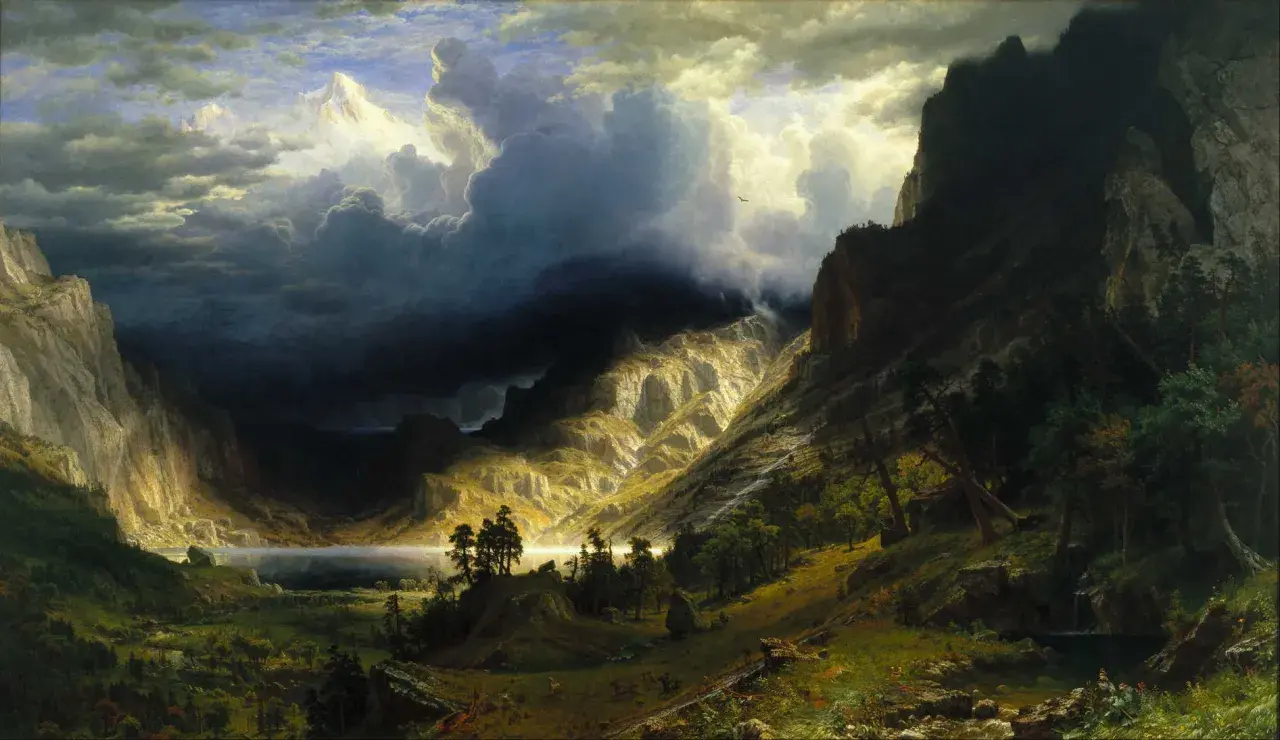
Landscape painting rewards artists who can turn a place into a feeling. The strongest works do more than record trees, rivers, or mountains; they shape light, scale, weather, and atmosphere into something memorable. That is why the names that dominate any discussion of famous landscape artists keep returning in museum labels, art books, and collection notes.
The key names all solve the same problem in different ways
- Landscape art became serious when painters learned to make nature carry mood, symbolism, and national identity.
- Claude Lorrain, Constable, Turner, Friedrich, Thomas Cole, Church, Bierstadt, and Monet are the most useful reference points to start with.
- The American branch of the genre is shaped above all by the Hudson River School, especially Cole, Church, and Bierstadt.
- When I judge a landscape work, I look first at light, composition, and whether the scene feels observed or invented.
- For originals, condition, provenance, and medium matter as much as the subject itself.

The artists you should know first
| Artist | Why they matter | Good starting work | What to notice |
|---|---|---|---|
| Claude Lorrain | He gave landscape a classical, idealized order and made luminous distance feel prestigious. | The Ford | Balanced foregrounds, soft horizons, and a calm, staged sense of space. |
| John Constable | He made weather, clouds, and local English scenery central rather than secondary. | The Hay Wain | Precise skies, damp air, and the feeling that the place was studied outdoors. |
| J.M.W. Turner | He pushed landscape toward motion, storm, and near-abstraction. | Snow Storm - Steam-Boat off a Harbour's Mouth | Energy in the paint itself, not just in the subject. |
| Caspar David Friedrich | He turned landscape into a setting for solitude, reflection, and spiritual tension. | Wanderer above the Sea of Fog | Solitary figures, symbolic silence, and landscapes that feel inward as well as outward. |
| Thomas Cole | He is the founding figure of the American landscape tradition that became the Hudson River School. | View from Mount Holyoke, Northampton, Massachusetts, after a Thunderstorm - The Oxbow | Nature and settlement held in the same frame, with clear moral and civic tension. |
| Frederic Edwin Church | He expanded American landscape into panoramic spectacle without losing detail. | Niagara | Immense scale, careful observation, and a sense that the viewer is standing at the edge of the scene. |
| Albert Bierstadt | He turned the American West into a monumental visual myth. | The Rocky Mountains, Lander's Peak | Dramatic light, heroic scale, and frontier imagery that feels cinematic. |
| Claude Monet | He recast landscape as a study of changing light, repeated motifs, and perception. | Haystacks series | How one subject changes with time, season, and atmosphere. |
If I had to build a starter list, I would begin with Constable, Turner, Friedrich, and Cole. Those four show the genre at its most important pressure points: observation, atmosphere, psychology, and national meaning. From there, the American Hudson River painters and Monet show how landscape moved into scale, spectacle, and modern perception.
Why these painters became reference points
I think the reason these names still matter is simple: each one solved a problem landscape painting kept running into. Claude Lorrain gave the genre classical order and luminous distance, Constable made weather feel specific, Turner pushed light and motion toward abstraction, and Friedrich turned silence into content rather than emptiness. Tate places Constable alongside Turner as one of Britain's great landscape painters, which is exactly right, because they are useful together only if you want to see two very different definitions of truth in nature.
Landscape used to sit low in the academic hierarchy, but these painters kept proving that a riverbank, a storm cloud, or a mountain ridge could carry the same weight as a grand historical scene. That change is why the genre stopped being decorative. It became a way to argue about memory, faith, nationalism, and the human place inside nature. Once that happened, landscape art was never just scenery again, and that leads directly to the American side of the story.
The American tradition that shaped the genre in the United States
In the United States, landscape painting never stayed purely descriptive for long. The Met identifies Thomas Cole as the founding figure of the Hudson River School, and that is still the cleanest shorthand for the American branch of the genre. Cole's View from Mount Holyoke, Northampton, Massachusetts, after a Thunderstorm - The Oxbow (1836) stages wilderness, settlement, and weather in a single composition, while Frederic Edwin Church and Albert Bierstadt stretched the format into panoramic drama with works such as Niagara and The Rocky Mountains, Lander's Peak.
What matters here is not just size. It is the way scale changes meaning. In Cole, the land can feel morally charged, almost like a civic argument. In Church, it becomes immersive and precise, the kind of image that rewards slow looking because every edge and shadow has been built carefully. Bierstadt goes even further and makes the West feel mythic, which is powerful, but it also warns us to read these paintings critically: the view is often shaped as much by national desire as by direct observation.
- Cole gives the genre its moral framing.
- Church gives it immersion and technical clarity.
- Bierstadt gives it frontier spectacle.
- Durand and Kensett offer quieter, more observational alternatives inside the same American conversation.
That mixture of admiration, ambition, and unease is exactly why U.S. landscape painting still feels fresh in museums: it is not just about open space, but about what a nation thinks open space means.
How I read a landscape painting in the gallery or the archive
When I evaluate a landscape in a gallery or archive, I do not start with the signature. I start with structure. A convincing composition usually gives the eye a path into the scene, uses the sky as an active part of the design, and keeps the horizon doing real work instead of serving as filler. If those pieces are weak, the painting may still be pretty, but it will rarely feel memorable.
- Light - Is the direction of light believable, and does it shape the forms consistently?
- Weather - Do clouds, mist, rain, or heat feel observed, or are they generic atmosphere?
- Space - Is depth built with a road, river, slope, or diagonal, or does the scene flatten out?
- Technique - Plein air means painted outdoors from direct observation; impasto means paint laid on thick enough to hold physical texture.
- Evidence - For originals, provenance, paper or canvas quality, and condition tell you more than a dramatic subject line.
That last point matters because landscape art is often reproduced well and authenticated badly. A famous image can still be the wrong object if the surface, date, and materials do not match the story attached to it. In other words, the image may be right and the artwork may still need scrutiny. That is where the next step becomes useful: choosing a sensible route through the genre instead of relying on a random greatest-hits list.
A compact route through the names that matter most
If I were guiding someone through landscape art in a museum or catalogue, I would use this order: Claude Lorrain for balance and light, Constable for weather, Turner for motion, Friedrich for inwardness, Cole for national meaning, Church for scale, Bierstadt for spectacle, and Monet for repeated motifs and changing perception. Read them in that sequence and the history of the genre starts to look less like a list of famous names and more like a series of artistic problems solved in different ways.
If you remember one thing, make it this: the best landscape artists do not merely paint land. They decide what kind of encounter the viewer should have with it, and that choice is what keeps their work relevant long after the scene itself has changed.
