
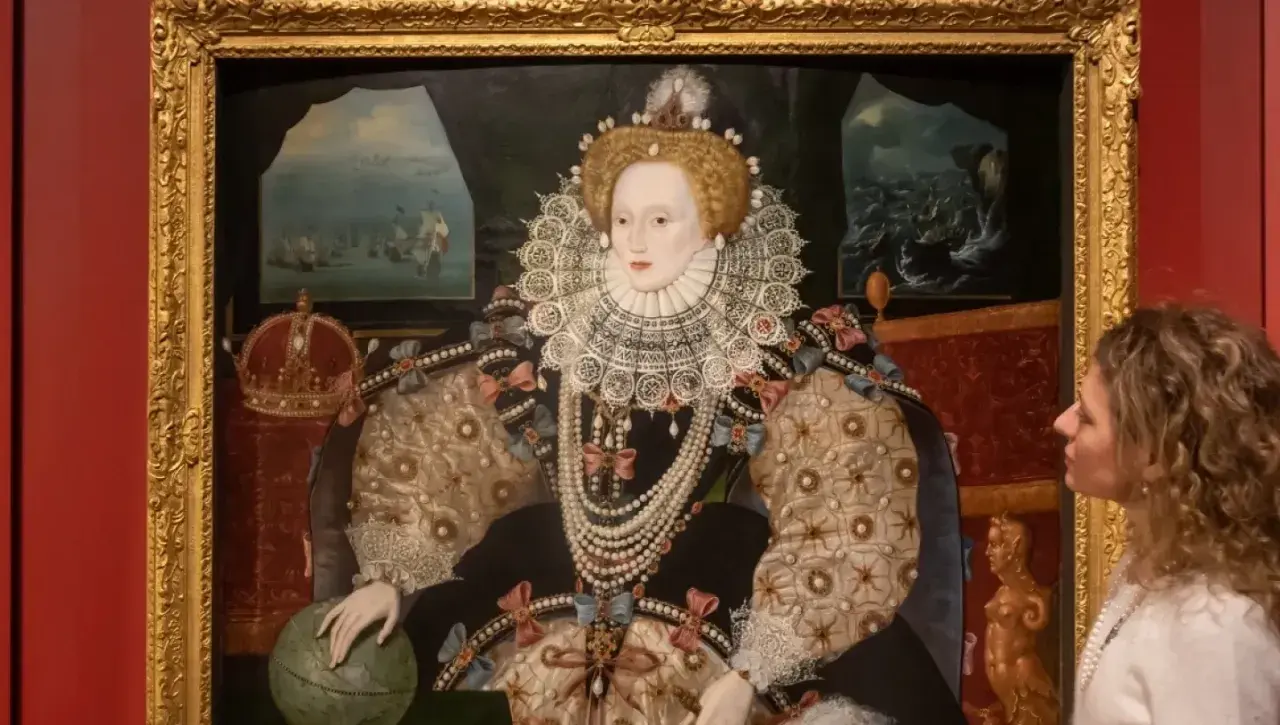
A painted likeness of Queen Elizabeth is rarely just a face on panel or canvas. In art history, it usually means Elizabeth I, whose image was shaped as carefully as her policy, with costume, jewels, and pose doing as much work as the sitter herself. This article explains what these portraits were for, how to read the symbols, how the main formats differ, and what I look for when a work needs to be judged as original, workshop, or later copy.
Key points to know before you read the portrait
- Most surviving examples are portraits of Elizabeth I, not casual likenesses of a queen but controlled images with political purpose.
- Many versions were workshop copies or pattern-based repeats, so a convincing face does not automatically mean an autograph painting.
- Symbols matter as much as resemblance: pearls, ruffs, crowns, globes, and sea imagery all carry specific Tudor meanings.
- Miniatures and full-length portraits served different audiences, from private gifting to public display and diplomacy.
- Authentication depends on provenance and technical study, not just style or family tradition.
What a portrait of Queen Elizabeth usually means
For most viewers, the first question is simple: is this a real likeness or a court image built from a pattern? The National Portrait Gallery notes that Elizabeth became a public icon and that only a few portraits were painted from life, which is why so many versions feel related even when they differ in details. I read these works as a blend of likeness, repetition, and political messaging, not as spontaneous snapshots.
That distinction matters because a Tudor portrait could be intended to reassure courtiers, celebrate a diplomatic moment, or circulate the queen's authority far beyond the court. Once you know that, the symbols stop looking decorative and start reading like a statement.
Why Elizabeth's image was controlled so tightly
Elizabeth's image was controlled because it had to solve several problems at once. She ruled as a woman in a political culture that still expected kings, she had no consort, and her unmarried status became part of the monarchy's public story. Portraits gave artists a way to turn those pressures into a coherent image: stable, self-possessed, and harder to challenge.
I also think of these paintings as tools of circulation. A miniature could be carried privately, while a full-length portrait could announce sovereignty in a hall or embassy setting. The result was not a single portrait but a repeatable visual system, and that is exactly why it is so useful to study the details.

How to read the symbolism in Tudor portraits
The symbols do the real heavy lifting in these works. Black and white often signal chastity and constancy; pearls point to purity; and mythological references such as Cynthia or the phoenix push Elizabeth away from ordinary portraiture and toward a constructed royal identity. Royal Museums Greenwich explains that the black-and-white scheme in one Armada image was meant to read as chastity and eternal virginity, which tells you how seriously the palette itself was treated.
Clothing and colour
High ruffs, white lace, and dense embroidery frame the face so that it seems almost lit from within. That is not just fashion. It is a visual claim that the queen is the center of order, refinement, and restraint.
Jewels and emblems
The pelican stands for sacrifice and piety, while the phoenix suggests rebirth and chastity. In the Phoenix and Pelican portraits, Hilliard used two related images to separate two aspects of rule, which is why the pair matters so much to historians. The same logic applies to crowns, sceptres, globes, and armillary spheres: they are not props, they are arguments.
Read Also: Cleopatra's Real Face - What Do Her Portraits Actually Show?
Background and setting
Sea scenes, columns, maps, and court interiors usually frame the queen as more than an individual. In the Armada and Ditchley portraits, the setting is part of the message, linking her body to state power, maritime victory, and a carefully managed idea of empire. When I see those elements together, I assume the painting is asking to be read politically first and aesthetically second.
Once you can decode that visual language, the next question is how the image was actually made.
The main portrait types and what each one tells you
Not every Elizabeth image was meant to do the same job. A collector, curator, or researcher has to separate intimate images from public ones, and that is easier when you sort them by format.
| Type | What it was for | Visual clues | What it usually means today |
|---|---|---|---|
| Full-length state portrait | Public display, diplomacy, ceremony | Standing figure, elaborate dress, emblems, elaborate background | Usually the strongest signal of official image-making |
| Bust portrait | Circulation of the queen's face and costume | Head-and-shoulders format, strong patterning, tighter focus on the face | Useful for tracing model types and workshop repetitions |
| Portrait miniature | Private gift, loyalty token, portable image | Watercolour on vellum, small scale, jewel or locket format | Often closer to a personal sitting and sometimes more immediate in character |
| Allegorical portrait | Political messaging through myth and symbol | Mythic figures, exaggerated emblems, celestial or classical references | Best read as an ideological portrait rather than a naturalistic one |
| Workshop copy | Wider circulation of an approved image | Reused face pattern, repeated costume, minor changes in hands or jewelry | Historically important even when not autograph |
Medium matters too. Oils on panel usually served larger public images, while miniatures were more intimate and technically demanding. If you mistake one category for another, you will misread the whole object, so format is the first filter I apply before I even start arguing about style.
How specialists authenticate and conserve these paintings
When I assess an Elizabeth portrait, I do not start with the face. I start with provenance, support, and evidence of later alteration. A convincing likeness can still be a later copy, and a rougher image can sometimes be the more important survivor if it preserves an early pattern or an original sitting.
- Provenance tells you where the painting has been and when it first appears in records.
- Support tells you whether it is panel, canvas, or vellum, and that affects age, movement, and treatment.
- X-radiography and infrared reflectography can reveal underdrawing, earlier faces, and compositional changes.
- Pigment analysis can show fading, later retouching, or pigments that do not fit the claimed period.
- Dendrochronology can date the wood panel by its tree rings, which is especially useful for Tudor works.
The National Portrait Gallery's technical work on Elizabeth portraits shows why this matters: some versions were painted over earlier sitters, and some compositions were adjusted mid-process, sometimes replacing one emblem with another. That kind of evidence is not glamorous, but it is often the difference between a plausible story and a defensible attribution. In conservation, the aim is not to make the picture look newer; it is to stabilize the object while preserving the evidence it carries.
For display, the basic rule is boring but non-negotiable: keep light low, humidity stable, and handling minimal. If a portrait is on wood, fluctuations in moisture are especially risky; if it is a miniature, the surface can be vulnerable to abrasion and old adhesives. Good conservation does not try to invent originality, and that restraint is usually what protects the portrait's historical value.
Those methods become much easier to understand when you look at the portraits that defined the whole visual language.
The portraits that matter most for historians
Some Elizabeth images are famous because they are beautiful; others matter because they changed the way monarchy was pictured. I treat the second group as the essential ones.
- The earliest full-length portrait, c. 1567 is important because it gets unusually close to an actual early likeness. It shows how quickly Elizabeth's image was being standardized into a state form.
- The Phoenix and Pelican portraits, c. 1575 matter because they show the same queen image used twice with different emblems, which is a clear sign of controlled symbolism and workshop planning.
- The Armada portrait, c. 1588 turns military victory into visual theatre. The sea, crown, and inscriptions make the queen look like the calm center of a national story.
- The Ditchley portrait, c. 1592 pushes that story further by placing her over a map and linking her to territory, loyalty, and reconciliation.
- Hilliard's miniatures are worth close attention because they were small, portable, and often closer to private sitting than the large public images. They show how intimacy and authority could sit inside the same object.
For a U.S. reader, it is also worth knowing that major examples have been shown in American museums, including the earliest known full-length portrait at Yale and an early likeness in Denver. That makes this field less remote than it can first appear: you do not need to be in London to study the canon, but you do need to read each work as part of a larger system of repetition.
Once those examples are in view, the final step is deciding what to check when a portrait turns up in a collection, an estate inventory, or a private home.
What I check before calling it a real Elizabeth portrait
If a portrait of Elizabeth comes across my desk, I run through five questions before I make any strong claim.
- Does the face follow a known Elizabethan pattern, or does it look like a later fantasy?
- Do the costume and jewels fit the claimed date, or are they borrowed from a different moment?
- Is the provenance continuous enough to support the attribution?
- Do technical images show changes, overpaint, or a reused panel?
- Is the painting best understood as autograph, workshop, or copy?
That last distinction is the one many people underestimate. A workshop version can still be historically valuable, because it tells you how Elizabeth was meant to be seen by her contemporaries, while a later copy may tell you more about the afterlife of her image than about the queen herself. If you read the portrait that way, the image stops being a pretty surface and becomes a record of power, fashion, and control.
